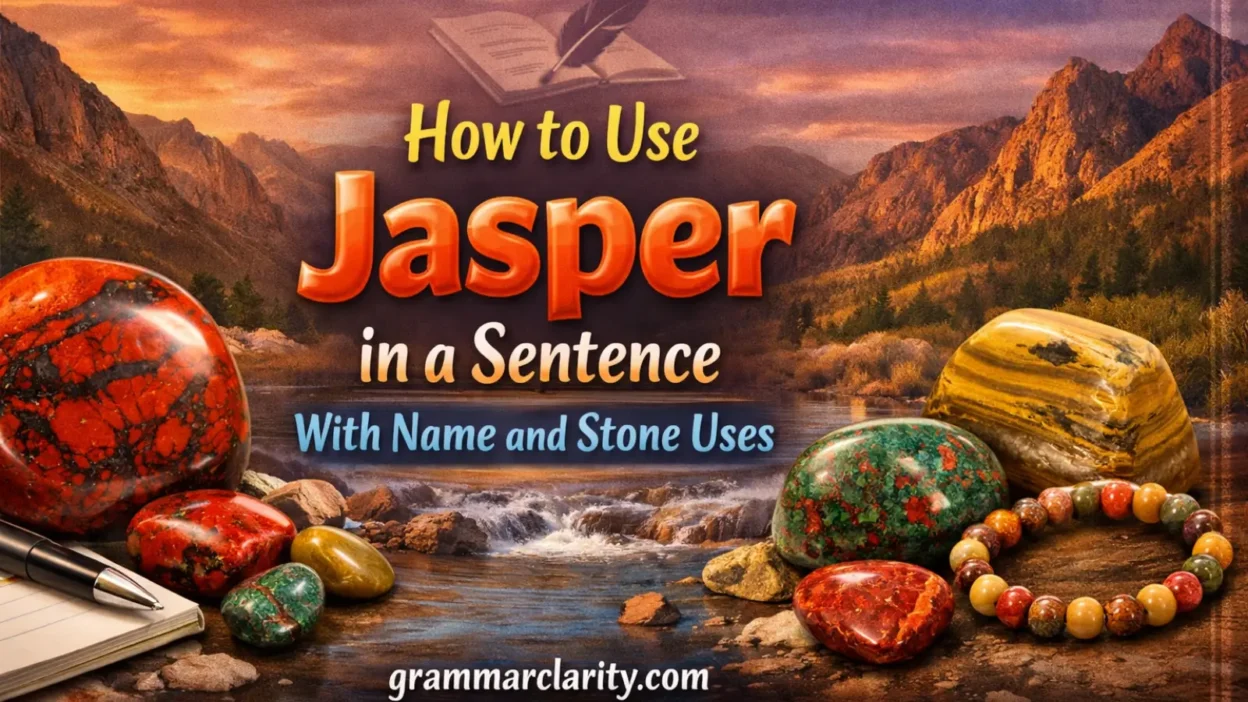
Sometimes Jasper is a proper noun, usually a person’s name or part of a place name. Sometimes jasper is a common noun that refers to the stone. That difference matters because it changes both capitalization and sentence structure.
Once you know which meaning you want, using the word becomes straightforward.
Quick Answer
Use Jasper with a capital letter when you mean a person, place, or another proper name: Jasper called me after lunch.
Use jasper in lowercase when you mean the stone: She wore a necklace made of jasper.
In both cases, the word is usually a noun. The key is choosing the meaning first, then building a sentence that fits that meaning naturally.
What The Term Means
In everyday English, Jasper most often appears in two ways.
The first is as a name. In that use, it works like any other proper noun: Jasper forgot his jacket in the car. You capitalize it because it names a specific person, place, or title.
The second is jasper, the stone. In that use, it is a common noun: The pendant was carved from red jasper. You lowercase it unless it begins a sentence.
That is why this word can look simple at first but still trip writers up. The form stays almost the same, but the role changes with the meaning.
How It Works In A Sentence
When Jasper is a name, it behaves like a regular subject or object.
You can write:
Jasper texted me this morning.
I met Jasper at the coffee shop.
When jasper means the stone, it usually appears after words that show material, color, design, or decoration.
You can write:
The bracelet was made of jasper.
She picked a ring with green jasper in the center.
It can also modify another noun in a natural way:
jasper pendant
jasper bowl
jasper beads
That means the word is flexible, but it still needs a sentence that clearly signals which meaning you intend.
Common Sentence Patterns
| Sentence Pattern | Example | Why It Works |
| Jasper + verb | Jasper arrived early for the interview. | Here, Jasper is a person’s name acting as the subject. |
| verb + Jasper | I asked Jasper to review the schedule. | Here, Jasper is the object of the verb. |
| made of + jasper | The vase was made of jasper. | This pattern clearly shows the stone or material meaning. |
| jasper + noun | She bought a jasper necklace at the market. | jasper works naturally before a noun to describe what the item is made from. |
Natural Example Sentences
These examples sound natural in modern American English and show both common uses.
Jasper left his notebook on the kitchen table.
I ran into Jasper outside the library.
Jasper said he would send the file tonight.
The museum displayed a carved jasper bowl.
She chose a pendant with deep red jasper.
The jeweler recommended jasper for the center stone.
We saw a small box inlaid with jasper and brass.
Her bracelet mixed silver, turquoise, and jasper.
Notice how the name examples usually focus on a person doing something, while the stone examples usually describe an object, a material, or a design detail.
Formal Vs Informal Use
Jasper does not become formal or informal on its own. The tone comes from the rest of the sentence.
In casual writing, you might say:
Jasper grabbed tacos before the game.
In more formal writing, you might say:
Jasper submitted the final report before noon.
The stone sense also works in both tones.
Informal:
She found a cool jasper ring at the flea market.
More formal:
The collection included several polished jasper ornaments.
So the word itself is not the problem. The question is whether the full sentence matches your setting.
Common Mistakes (and Fixes)
One common mistake is capitalizing jasper when you mean the stone in the middle of a sentence.
Wrong: She bought a Jasper necklace.
Better: She bought a jasper necklace.
Another common mistake is lowercasing Jasper when you mean a person’s name.
Wrong: jasper called after dinner.
Better: Jasper called after dinner.
A third mistake is using the word without enough context.
Weak: I bought jasper.
Better: I bought a piece of jasper for a pendant.
Better: I bought a jasper pendant.
The fix is simple: make the meaning obvious.
Similar Uses Readers Confuse
Writers often confuse Jasper and jasper because the spelling is almost identical.
If you mean a person, use Jasper:
Jasper is joining us for brunch.
If you mean the stone, use jasper:
The ring features polished jasper.
Some readers also confuse the name use with place names.
For example:
We spent the weekend in Jasper.
That sentence uses Jasper as a place name, so it stays capitalized.
The useful rule is this: if the word names a specific person or place, capitalize it. If it names the stone, lowercase it.
Quick Usage Tips
Decide on the meaning before you write the sentence.
If it is a name, treat it like any other name.
If it is the stone, pair it with clear context such as made of, set with, carved from, or polished.
Use lowercase for the stone unless the word starts the sentence.
Avoid vague lines like I bought Jasper unless you truly mean a person, pet, or brand name.
When The Term Sounds Unnatural
The word can sound awkward when the sentence leaves out the information readers need.
For example, The necklace is jasper is not wrong, but it can sound stiff or incomplete in ordinary writing. A more natural version would be The necklace is made of jasper or The necklace has a jasper centerpiece.
Likewise, I saw Jasper stone sounds unnatural in normal prose. Better choices include I saw a jasper stone, I saw a piece of jasper, or I saw a jasper carving.
With the name sense, the main problem is less about grammar and more about missing context. Jasper did it is correct, but it may feel abrupt if the reader does not know who Jasper is.
Natural writing gives just enough detail to remove doubt.
Conclusion
To use Jasper in a sentence correctly, start by choosing the right meaning. Use Jasper with a capital letter for a name or place, and use jasper in lowercase for the stone.
From there, build a sentence that makes the meaning clear. Name sentences usually show a person doing something. Stone sentences usually show material, color, jewelry, art, or decoration.