
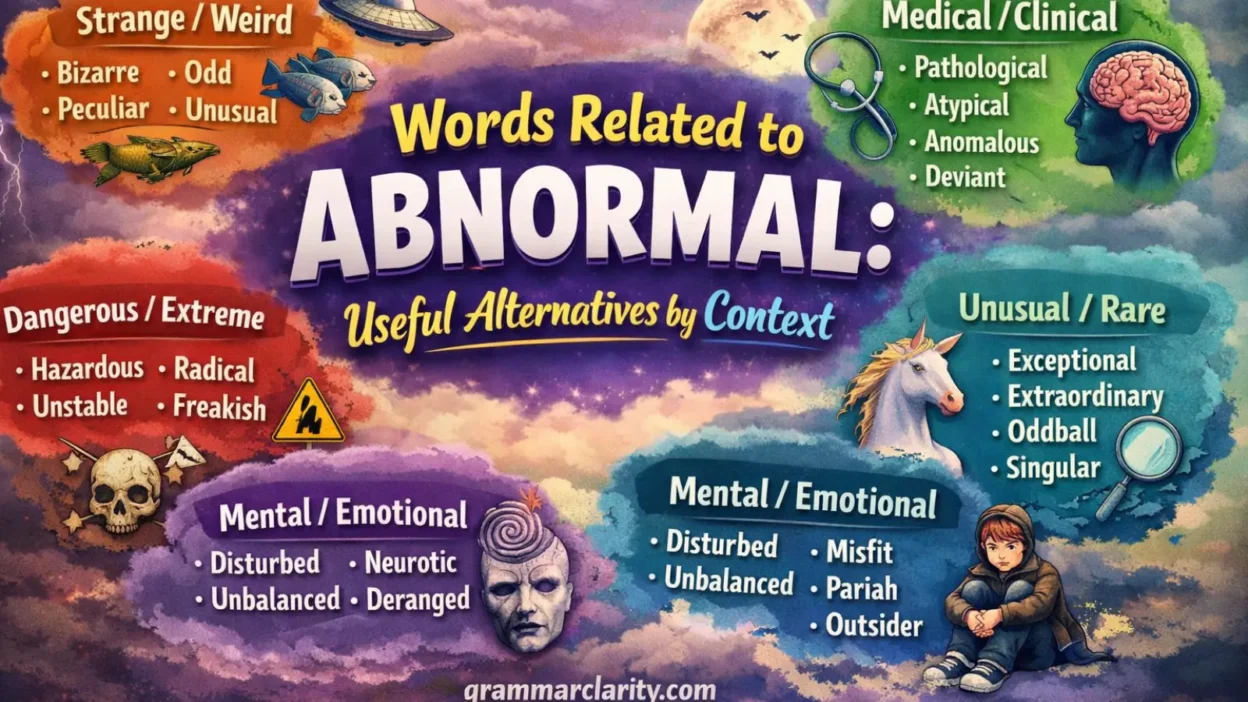
If you are looking for words related to abnormal, the best choice depends on what you actually mean. Sometimes you want a close substitute like unusual or atypical. Other times you need a more specific word like irregular, anomalous, or deviant. Those are not always interchangeable.
That is the main point readers usually need early: related words are not all exact synonyms. Some sound neutral. Some sound clinical. Some sound judgmental. Some fit patterns, behavior, data, appearance, or medical findings better than others.
This guide gives you clear, usable alternatives and shows which words work best in everyday American English.
Quick Answer
Common words related to abnormal include unusual, atypical, irregular, anomalous, odd, strange, deviant, and aberrant. The best everyday choices are usually unusual, atypical, and irregular because they are clear and less loaded.
Use a more specific option when the context demands it. For example, anomalous often fits data or technical writing, while deviant can sound moral or behavioral rather than simply different.
What The Topic Means
The word abnormal usually refers to something that differs from what is typical, expected, regular, or standard. But that broad idea can point in several directions.
It can describe behavior, test results, body function, patterns, weather, numbers, appearance, or social expectations. Because the meaning is broad, the strongest related word is often the one that tells the reader how something is different.
That is why a flat list of substitutes is not enough. Good word choice depends on tone and context.
Core Related Words
Here are strong, defensible related words for abnormal and how they usually work:
| Word | How It Relates | Best Use |
| unusual | Something is not common or expected | Everyday writing |
| atypical | Not typical of the usual pattern | Formal or neutral writing |
| irregular | Not following a regular pattern or rule | Schedules, shapes, results, functions |
| anomalous | Standing out from the norm or data pattern | Technical, scientific, or formal writing |
| odd | Noticeably different in a mild or casual way | Conversation and informal writing |
| strange | Different in a way that feels unfamiliar | Everyday description |
| aberrant | Departing from an accepted path or norm | Formal, academic, or behavioral contexts |
| deviant | Departing from accepted behavior or standards | Sociology, psychology, or strong judgment contexts |
| unusual-looking | Different in appearance | Descriptive everyday writing |
| unconventional | Not following the usual way | Style, ideas, methods, behavior |
Related Words By Meaning Group
Not all related words point to the same kind of difference. Grouping them by meaning makes them easier to use correctly.
Neutral everyday words
These are the safest choices in general writing: unusual, odd, strange, different, out of the ordinary.
Formal or technical words
These fit reports, academic writing, and professional contexts: atypical, anomalous, irregular, aberrant.
Behavior-focused words
These often describe conduct rather than simple difference: deviant, aberrant, unconventional.
Medical or diagnostic words
These work when something differs from expected physical or clinical patterns: abnormal, atypical, irregular, anomalous, pathological in very specific contexts.
Appearance or pattern words
These help when describing shape, form, or structure: irregular, uneven, distorted, asymmetrical, depending on the subject.
Close Synonyms Vs Broader Related Words
A close synonym tries to replace abnormal directly in many sentences. A broader related word connects by meaning but may shift the tone or focus.
For example, atypical is often a close synonym. You can say “an atypical result” where you might also say “an abnormal result.” But unconventional is broader. It suggests a break from custom or tradition, not necessarily a problem.
Likewise, odd and strange are related, but they sound more conversational and less precise. They often work in casual speech, but they may weaken formal writing.
A good rule is simple: if the word changes the kind of difference you are describing, it is related but not fully interchangeable.
Words By Context
The smartest way to choose a related word is by situation.
For everyday conversation
Use unusual, odd, or strange.
For school or professional writing
Use atypical, irregular, or anomalous.
For data, research, or reports
Use anomalous or irregular.
For social or behavioral discussion
Use deviant or aberrant only when you really mean departure from accepted norms, not just harmless difference.
For sensitive topics
Be careful with abnormal itself. In some contexts, especially when describing people, it can sound blunt or stigmatizing. A more precise word is often better.
Example Sentences
Here are natural examples that show how these related words work in real sentences.
The weather has been unusually warm for early March.
Her test results showed an atypical pattern, so the doctor ordered follow-up testing.
The machine made an irregular clicking sound during operation.
Analysts flagged the transaction as anomalous after reviewing the account history.
That is an odd reaction for someone who said they were fine.
The painting has a strange but memorable composition.
The report focused on aberrant behavior in a very narrow research setting.
The policy addresses deviant conduct, not minor rule-breaking.
His handwriting looks unusual, but it is still easy to read.
Their approach was unconventional, though it turned out to be effective.
Common Mistakes When Choosing Related Words
One common mistake is treating every related word as an exact substitute. That leads to awkward or misleading sentences.
Another mistake is choosing a word that sounds harsher than the situation calls for. Deviant is much stronger than unusual. It can imply social or moral judgment, not just difference.
Writers also sometimes use strange where a more exact word would help. If the issue is a pattern, use irregular. If the issue is statistics or data, use anomalous. If the issue is simply that something is not typical, use atypical.
A final mistake is using abnormal for people when the point could be stated more carefully. In many cases, unusual, atypical, or a more specific description will sound better and say more.
Quick Reference List
Here is a clean working list of words related to abnormal:
unusual
atypical
irregular
anomalous
odd
strange
aberrant
deviant
unconventional
different
out of the ordinary
uneven
distorted
asymmetrical
unexpected
This list is useful, but context still matters more than quantity.
Best Picks for Everyday Use
For most readers and most sentences, the best choices are these:
Unusual works when you want something simple, clear, and neutral.
Atypical works when you want a more formal tone without sounding harsh.
Irregular works when the issue involves pattern, timing, rhythm, shape, or consistency.
Anomalous works best in technical or analytical writing.
If you are unsure, unusual is usually the safest starting point in general American English.
Conclusion
The best words related to abnormal are not just the closest-looking synonyms. They are the ones that match your exact meaning, tone, and context. Unusual, atypical, irregular, and anomalous are often the strongest choices because they are clear and specific without adding unnecessary judgment.
That is the real distinction to keep in mind: related words are connected by meaning, but they are not all equal substitutes. Pick the word that explains the kind of difference you mean, and your sentence will sound sharper, more natural, and more precise.