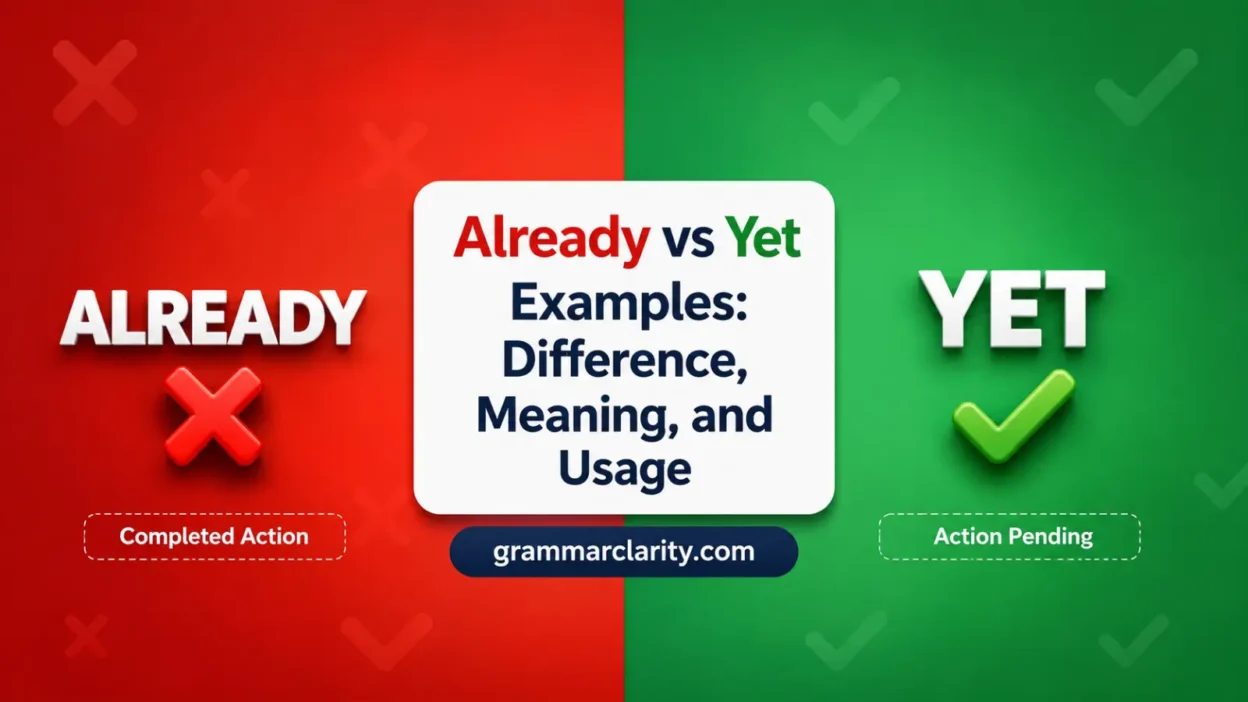
Many English learners and native speakers occasionally hesitate when choosing between already and yet. Both words relate to time, and both often appear in present perfect sentences. Because of that, they can seem very similar.
However, they are not interchangeable in most situations.
The difference is actually straightforward once you understand the message each word communicates. Already usually shows that something happened sooner than expected, while yet commonly refers to something that has not happened up to the present moment or asks whether it has happened.
Understanding this distinction can instantly make your English sound more natural.
Quick Answer
Use already when something has happened before now, often sooner than expected.
- I have already finished my homework.
- She already knows the answer.
- We have already booked the tickets.
Use yet when something has not happened up to now or when asking if it has happened.
- I haven’t finished my homework yet.
- Has she answered yet?
- We haven’t booked the tickets yet.
A simple memory trick:
- Already = It happened.
- Yet = It hasn’t happened or we’re checking if it happened.
Why People Confuse Them
People confuse these words because both are connected to timing and frequently appear with the present perfect tense.
Consider these examples:
- I have already eaten.
- Have you eaten yet?
Both sentences discuss eating before the current moment. However, the speaker’s purpose is different.
The first sentence confirms completion.
The second sentence asks whether completion has happened.
Another reason for confusion is that some languages use a single word where English uses both already and yet. As a result, learners often try to apply one word to every situation.
The good news is that English follows consistent patterns, making the distinction easier once you see common sentence structures.
Key Differences At A Glance
| Context | Best Choice | Why |
|---|---|---|
| Something happened sooner than expected | Already | Shows completion |
| Confirming a finished action | Already | Action is done |
| Asking if something happened | Yet | Used in questions |
| Saying something has not happened | Yet | Used in negative statements |
| Emphasizing completion | Already | Focuses on result |
| Emphasizing non-completion | Yet | Focuses on expectation |
Quick Comparison
| Feature | Already | Yet |
|---|---|---|
| Main idea | Completed action | Expected but incomplete action |
| Common in positive sentences | Yes | Rare |
| Common in questions | Sometimes | Very common |
| Common in negative sentences | Rare | Very common |
| Focus | Completion | Expectation |
Meaning and Usage Difference
The core distinction is simple.
Already tells us that an action is complete.
Yet tells us that an action is expected but has not occurred so far, or asks whether it has occurred.
Using Already
Already usually appears when a speaker wants to emphasize that something has happened.
Examples:
- I already sent the email.
- They have already left.
- The movie has already started.
- We already know the results.
- She has already completed the project.
In many cases, the sentence implies surprise or earlier-than-expected completion.
Example:
- The kids are already asleep.
This suggests the speaker expected them to be awake longer.
Using Yet
Yet is commonly used in questions and negative sentences.
Examples:
- Have you finished yet?
- Has the package arrived yet?
- I haven’t finished yet.
- The package hasn’t arrived yet.
- We haven’t made a decision yet.
Here, the action is still expected, but it has not happened at this point.
Present Perfect Patterns
Already frequently appears in affirmative present perfect sentences.
- I have already eaten.
- She has already graduated.
Yet frequently appears in negative and interrogative present perfect sentences.
- Have you eaten yet?
- She hasn’t graduated yet.
These patterns are among the most common in modern American English.
Tone, Context, and Formality
Both words work in casual and formal English.
You can use them in:
- Conversations
- Emails
- Business communication
- Academic writing
- News reports
Tone of Already
Already often sounds confident and definitive.
Examples:
- We already approved the proposal.
- I already completed the report.
The speaker is emphasizing completion.
Tone of Yet
Yet often suggests waiting, expectation, or uncertainty.
Examples:
- The report isn’t finished yet.
- Have they responded yet?
The speaker is focused on whether something will happen.
Formal Usage
Formal:
- The committee has already reviewed the application.
- The committee has not reached a decision yet.
Informal:
- I already did it.
- Not yet.
Both words function naturally across different levels of formality.
Which One Should You Use?
Ask yourself one question:
Has the action happened?
If yes, use already.
- We already paid.
- He already called.
- The store already opened.
If no, or if you are asking whether it happened, use yet.
- We haven’t paid yet.
- Has he called yet?
- The store hasn’t opened yet.
This simple test works in most situations.
When One Choice Sounds Wrong
Sometimes replacing one word with the other creates an unnatural sentence.
Correct:
- I have already eaten.
Incorrect:
- I have yet eaten.
Correct:
- I haven’t eaten yet.
Incorrect:
- I haven’t eaten already.
Correct:
- Has the bus arrived yet?
Incorrect:
- Has the bus arrived already?
While “already” can occasionally appear in questions, it often expresses surprise:
- Has the bus arrived already?
This means the speaker is surprised that the bus may have arrived sooner than expected.
That is different from the neutral question:
- Has the bus arrived yet?
Understanding this subtle difference helps avoid awkward wording.
Common Mistakes (and Quick Fixes)
Mistake 1
Incorrect:
- I already haven’t finished.
Correct:
- I haven’t finished yet.
Mistake 2
Incorrect:
- Have you already finished yet?
Correct:
- Have you finished yet?
Or:
- Have you already finished?
Mistake 3
Incorrect:
- The package yet arrived.
Correct:
- The package has already arrived.
Mistake 4
Incorrect:
- I yet completed the task.
Correct:
- I already completed the task.
Mistake 5
Incorrect:
- We already didn’t start.
Correct:
- We haven’t started yet.
Learning these patterns helps eliminate some of the most common English errors involving time expressions.
Everyday Examples
School
- I already submitted my assignment.
- I haven’t submitted my assignment yet.
- Has the teacher posted grades yet?
Work
- We already finished the presentation.
- The manager hasn’t approved it yet.
- Have the clients responded yet?
Travel
- We already checked into the hotel.
- The flight hasn’t boarded yet.
- Has the train arrived yet?
Shopping
- I already bought groceries.
- I haven’t gone shopping yet.
- Have you ordered it yet?
Family Life
- The kids already cleaned their rooms.
- The kids haven’t eaten yet.
- Has Dad come home yet?
Technology
- I already updated the software.
- The update hasn’t downloaded yet.
- Has your phone charged yet?
These examples reflect situations people encounter every day.
Dictionary-Style Word Details
Verb
Already: Not commonly used as a verb in standard US English.
Yet: Not commonly used as a verb in standard US English.
Noun
Already: Not commonly used as a noun in standard US English.
Yet: Not commonly used as a noun in standard US English.
Both words primarily function as adverbs.
Synonyms
Already:
Closest plain alternatives:
- previously
- before now
- by this time
- earlier
Yet:
Closest plain alternatives:
- so far
- up to now
- as of now
- by this point
Possible opposite ideas:
Already
- not yet
- still pending
Yet
- already
- completed
These alternatives may not fit every sentence exactly, but they often convey similar timing concepts.
Example Sentences
Already
- We have already discussed the issue.
- She already knows where to go.
- The store has already closed.
- They already bought a new car.
- I already told him.
Yet
- Have you called her yet?
- I haven’t called her yet.
- Has the game started yet?
- We haven’t decided yet.
- The results aren’t available yet.
Word History
Already
Derived from older English forms meaning “completely ready” or “before this point.” Over time, it developed its modern meaning of something occurring before now.
Yet
Has existed in English for centuries and developed meanings connected to “up to now” and “still.” Modern usage largely centers on expectation and timing.
Phrases Containing
Already
- already finished
- already completed
- already done
- already paid
- already started
Yet
- not yet
- yet to come
- yet again
- have you finished yet
- hasn’t arrived yet
FAQs
Can already and yet appear in the same sentence?
Yes.
Example:
- Have you already finished yet?
However, this is usually awkward and uncommon.
More natural examples include:
- Have you already finished?
- Have you finished yet?
Can already be used in questions?
Yes.
Example:
- Have you already eaten?
This often suggests surprise or expectation that the action happened sooner than expected.
Is yet only used with the present perfect?
No.
Although it commonly appears with the present perfect, it can occur in other structures.
Examples:
- Are we there yet?
- Not yet.
Can yet be used in positive sentences?
Sometimes.
Examples include:
- The best is yet to come.
- More changes are yet to happen.
However, most everyday uses of yet appear in questions and negative statements.
Which word is more common in conversation?
Both are extremely common. Their frequency depends on the situation.
When discussing completed actions, speakers often use already.
When asking about progress or waiting for something, speakers frequently use yet.
Why does “Has it arrived already?” sound different from “Has it arrived yet?”
The first expresses surprise.
- Has it arrived already?
The second simply asks whether the arrival has happened.
- Has it arrived yet?
This difference is important in natural conversation.
Conclusion
The distinction between already and yet becomes much easier once you focus on completion versus expectation.
Use already when an action has happened before now, especially when emphasizing completion or earlier-than-expected timing.
Use yet when something has not happened up to the present moment or when asking whether it has happened.
Remember the simplest rule:
- Already = completed.
- Yet = not completed or checking completion.
Once you practice these patterns in everyday sentences, choosing between already and yet becomes almost automatic.