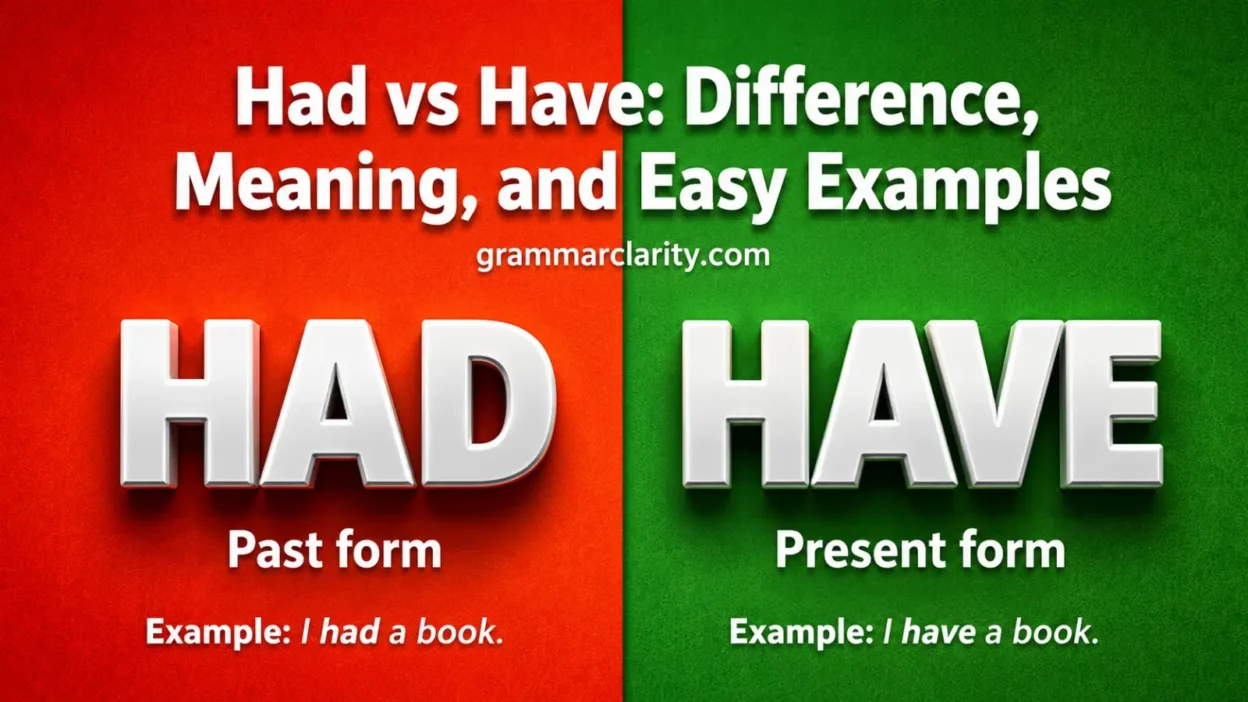
Had vs have is a common grammar choice because both words come from the same verb: have. The difference is mainly about time.
Use have when you are talking about the present, a general situation, or a completed action connected to now. Use had when you are talking about the past or something that happened before another past event.
The easiest way to remember it is this: have is present, had is past.
Quick Answer
Use have with I, you, we, and they in the present tense.
Examples:
- I have a meeting today.
- You have two options.
- We have enough time.
- They have a new apartment.
Use had for the past tense with any subject.
Examples:
- I had a meeting yesterday.
- She had a long day.
- We had enough time last week.
- They had a new apartment before they moved.
Use have as a helping verb in present perfect sentences.
Example:
- I have finished the report.
Use had as a helping verb in past perfect sentences.
Example:
- I had finished the report before the meeting started.
Why People Confuse Them
People confuse had and have because both can show possession, experience, obligation, and completed action.
Compare these:
- I have a car.
- I had a car.
The first sentence means you own the car now. The second means you owned it in the past.
The confusion grows when these words appear before another verb:
- I have eaten lunch.
- I had eaten lunch before noon.
Both describe completed actions, but they point to different time relationships. Have eaten connects to the present. Had eaten places one past action before another past moment.
Key Differences At A Glance
| Context | Best Choice | Why |
|---|---|---|
| Present possession | have | Shows what someone owns or has now |
| Past possession | had | Shows what someone owned or experienced before |
| Present perfect | have | Connects a completed action to the present |
| Past perfect | had | Shows one past action happened before another |
| With I, you, we, they in present tense | have | Matches plural subjects and “I/you” |
| With any subject in past tense | had | Past tense form stays the same for all subjects |
Compact comparison:
- Have = present form for I, you, we, they.
- Had = past form for all subjects.
- Have can mean own, experience, need to, or complete an action.
- Had can mean owned, experienced, needed to, or completed something earlier.
Meaning and Usage Difference
Have means to possess, hold, experience, or be required to do something in the present.
Examples:
- I have a question.
- We have dinner at seven.
- They have to leave early.
- You have a strong point.
Had is the past form of have. It shows that something belonged, happened, existed, or was required in the past.
Examples:
- I had a question.
- We had dinner at seven.
- They had to leave early.
- You had a strong point.
The word have can also help form the present perfect tense.
Examples:
- I have seen that movie.
- We have finished the project.
- They have moved to Chicago.
The word had can help form the past perfect tense.
Examples:
- I had seen that movie before.
- We had finished the project before Friday.
- They had moved to Chicago before winter.
Tone, Context, and Formality
Both had and have are neutral words. They work in casual speech, school writing, business writing, and formal writing.
The difference is not tone. The difference is time.
Casual:
- I have a minute.
- I had a great weekend.
Professional:
- We have several updates to review.
- We had several concerns during the last meeting.
Formal:
- The committee has reviewed the proposal.
- The committee had reviewed the proposal before the vote.
One important note: in present tense, he, she, and it usually take has, not have.
Correct:
- She has a laptop.
Incorrect:
- She have a laptop.
But in the past tense, had works with all subjects.
Correct:
- She had a laptop.
- They had a laptop.
- I had a laptop.
Which One Should You Use?
Choose have when the sentence is about now.
Examples:
- I have a dentist appointment today.
- We have enough chairs.
- They have a lot of work to do.
Choose had when the sentence is about the past.
Examples:
- I had a dentist appointment yesterday.
- We had enough chairs at the event.
- They had a lot of work to do last month.
Choose have when using the present perfect with I, you, we, or they.
Examples:
- I have called twice.
- We have decided to stay.
- They have already left.
Choose had when showing that one past action happened before another past action.
Examples:
- I had called before you texted me.
- We had decided to stay before the storm started.
- They had already left when I arrived.
Can I say “I had” instead of “I have”?
Yes, but only if you mean the past. I have a dog means you have one now. I had a dog means you had one before.
Is “have had” correct?
Yes. It means you experienced or possessed something from the past up to now, or at some point connected to now. Example: I have had this phone for three years.
Is “had had” correct?
Yes, although it can sound awkward. It is used when one past possession or experience happened before another past event. Example: She had had enough practice before the performance.
Should I use “had” after “did”?
Usually, no. After did, use the base form have. Correct: Did you have time? Incorrect: Did you had time?
When One Choice Sounds Wrong
Have sounds wrong when the sentence clearly refers to a finished past time.
Incorrect:
- I have a meeting yesterday.
Correct:
- I had a meeting yesterday.
Had sounds wrong when the sentence is clearly about the present.
Incorrect:
- I had a question right now.
Correct:
- I have a question right now.
Have also sounds wrong with he, she, or it in simple present statements.
Incorrect:
- He have a car.
Correct:
- He has a car.
Had can sound confusing if you use it when the time relationship does not require the past perfect.
Awkward:
- I had finished my lunch.
Better, if no later past event is mentioned:
- I finished my lunch.
Better, if the action connects to now:
- I have finished my lunch.
Common Mistakes (and Quick Fixes)
Mistake: Using had after did.
Incorrect: Did she had a chance to reply?
Correct: Did she have a chance to reply?
Mistake: Using have with a past-time word.
Incorrect: We have a meeting last night.
Correct: We had a meeting last night.
Mistake: Using had for a current situation.
Incorrect: I had two emails to answer today.
Correct: I have two emails to answer today.
Mistake: Using have instead of has with a singular third-person subject.
Incorrect: Maria have a new job.
Correct: Maria has a new job.
Mistake: Using had when the present perfect is needed.
Incorrect: I had lived here for five years, and I still live here.
Correct: I have lived here for five years.
Everyday Examples
- I have a headache.
- I had a headache yesterday.
- We have a few minutes before class.
- We had a few minutes before class started.
- They have a house near the lake.
- They had a house near the lake before they moved.
- I have finished my homework.
- I had finished my homework before dinner.
- You have a good reason to ask.
- You had a good reason to ask.
- We have to leave soon.
- We had to leave early last night.
- I have had this jacket for years.
- She had had a rough week before the trip.
Dictionary-Style Word Details
Verb
Have is a verb. It can mean to own, hold, experience, receive, eat, drink, or be required to do something.
Examples:
- I have a camera.
- We have lunch at noon.
- They have to sign the form.
Had is the past tense and past participle form of have.
Examples:
- I had a camera.
- We had lunch at noon.
- They had to sign the form.
Noun
Have can also be used as a noun in phrases that describe people with wealth or advantages, such as the haves and the have-nots.
Had is not commonly used as a noun in everyday English.
Synonyms
Depending on the sentence, have can be close in meaning to:
- own
- possess
- hold
- receive
- experience
- include
- need
- eat
- drink
Depending on the sentence, had can be close in meaning to:
- owned
- possessed
- held
- received
- experienced
- included
- needed
- ate
- drank
Example Sentences
- I have a new notebook.
- I had a new notebook last semester.
- We have a lot to discuss.
- We had a lot to discuss after the announcement.
- They have already paid.
- They had already paid before the deadline.
- You have every right to ask.
- You had every right to ask at the time.
Word History
Have is an old English verb with a long history in everyday use. Had developed as its past form. Today, both forms remain among the most common verbs in English because they work as main verbs and helping verbs.
Phrases Containing
Common phrases with have:
- have a good day
- have fun
- have to
- have a look
- have a chance
- have in mind
- have no idea
- have enough
Common phrases with had:
- had enough
- had to
- had a chance
- had a good time
- had no idea
- had in mind
- had better
- had a feeling
FAQs
What is the difference between had and have?
Have is usually used for the present, while had is used for the past.
Examples:
- I have a question.
- I had a question yesterday.
When should I use have?
Use have when talking about something that is true now or connected to the present.
Examples:
- I have a car.
- We have enough time.
- They have finished their work.
When should I use had?
Use had when talking about something in the past.
Examples:
- I had a car before.
- We had enough time yesterday.
- They had finished before we arrived.
Is “have had” correct?
Yes. Have had is correct when talking about something that started in the past and is still connected to the present.
Example:
- I have had this phone for three years.
Is “had had” correct?
Yes. Had had is grammatically correct, but it can sound awkward. It is used when one past action or experience happened before another past event.
Example:
- She had had enough practice before the final game.
Do I use had or have after did?
Use have after did.
Correct:
- Did you have lunch?
Incorrect:
- Did you had lunch?
Can I say “I had” instead of “I have”?
Only if you mean the past. I have means something is true now. I had means it was true before.
Examples:
- I have a dog.
- I had a dog when I was younger.
Which is correct: “I have been” or “I had been”?
Both can be correct. Use have been for something connected to the present. Use had been for something that happened before another past event.
Examples:
- I have been busy today.
- I had been busy before you called.
Is it “she have” or “she had”?
In the present tense, use has with she, not have.
Correct:
- She has a new job.
Use had for the past.
Correct:
- She had a new job last year.
What is the easiest way to remember had vs have?
Use have for now and had for before.
Examples:
- I have time now.
- I had time yesterday.
Conclusion
The difference between had vs have is mostly about time. Use have for present situations with I, you, we, and they. Use had for past situations with any subject.
Use have when something is true now:
- I have a plan.
Use had when something was true before:
- I had a plan.
Use have for completed actions connected to the present:
- I have finished.
Use had for an action completed before another past action:
- I had finished before she arrived.
When in doubt, ask whether the sentence is about now or the past. If it is about now, choose have. If it is about the past, choose had.