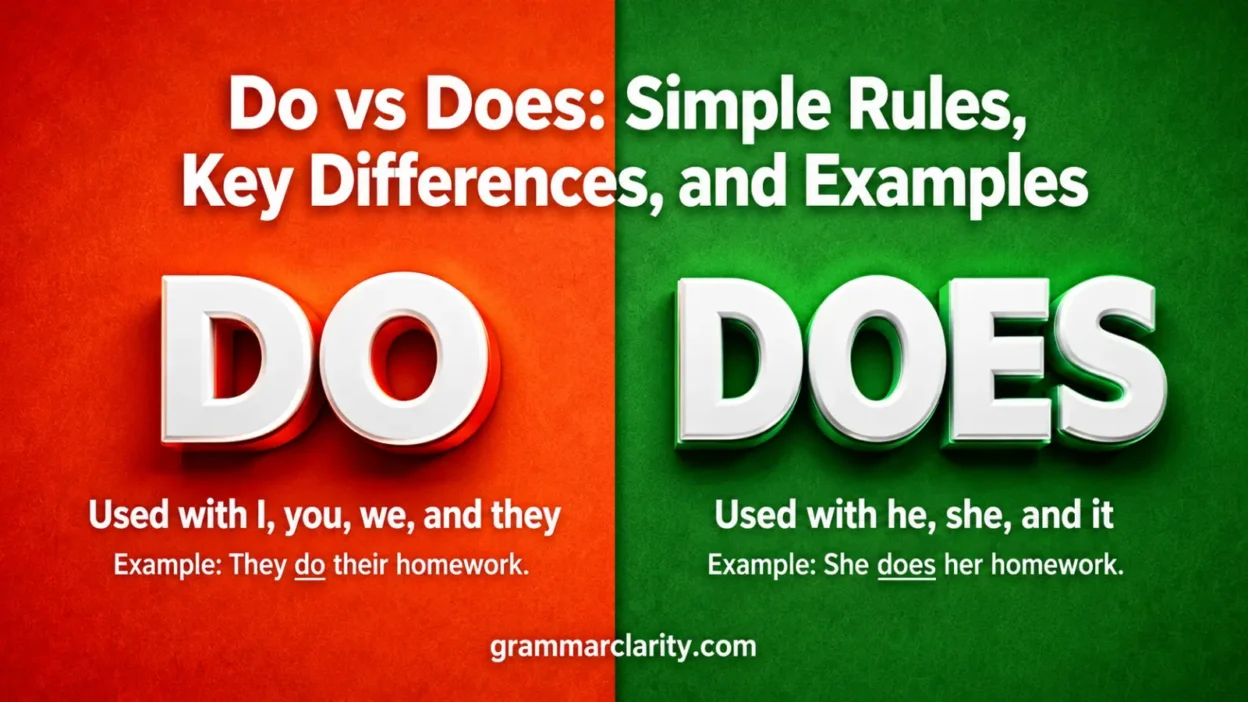
Do vs does is a common English grammar choice, but the rule is simple: use do with I, you, we, they, and plural subjects. Use does with he, she, it, and singular subjects.
Both words come from the verb do. The difference is not meaning. The difference is subject agreement in the present tense.
You use them in questions, negative sentences, short answers, emphasis, and everyday statements.
Quick Answer
Use do with:
- I do
- you do
- we do
- they do
- the students do
- my friends do
Use does with:
- he does
- she does
- it does
- the teacher does
- my brother does
- the company does
Correct examples:
- Do you want coffee?
- Does she work here?
- I do understand.
- He does understand.
- They do not agree.
- It does not matter.
The main verb after do or does stays in its base form:
- Correct: Does she like pizza?
- Incorrect: Does she likes pizza?
Why People Confuse Them
People confuse do and does because both words have the same basic meaning. They are forms of the same verb, but they match different subjects.
Another reason is that does already carries the third-person singular ending. That means the main verb does not need another -s.
That is why this sentence is wrong:
- She does likes music.
The -s belongs to does, not like.
Correct:
- She does like music.
Key Differences At A Glance
| Context | Best Choice | Why |
|---|---|---|
| I, you, we, they | do | These subjects use the base present form. |
| Plural nouns | do | Plural subjects take do. |
| He, she, it | does | Third-person singular subjects take does. |
| Singular nouns | does | One person, place, thing, or idea usually takes does. |
| Questions with I/you/we/they | do | The auxiliary matches the subject. |
| Questions with he/she/it | does | The auxiliary marks third-person singular. |
| Negative sentences with plural subjects | do not / don’t | The negative form follows do. |
| Negative sentences with singular subjects | does not / doesn’t | The negative form follows does. |
Meaning and Usage Difference
Do and does usually mean “perform,” “complete,” or “carry out” when they act as main verbs.
Examples:
- I do my homework after dinner.
- She does her homework after dinner.
- They do the dishes every night.
- He does the dishes every night.
They also work as helping verbs in questions and negatives.
Examples:
- Do you drive to work?
- Does your sister drive to work?
- We do not accept late forms.
- The office does not open on Sundays.
Compact comparison:
- Do: used with I, you, we, they, and plural subjects.
- Does: used with he, she, it, and singular subjects.
- Do and does both belong to the present tense.
- After do or does, use the base verb: go, work, need, like, want.
Tone, Context, and Formality
Do and does are neutral. They work in casual speech, business writing, school assignments, emails, instructions, and formal writing.
The more formal choice is usually do not or does not instead of don’t or doesn’t.
Casual:
- I don’t know.
- She doesn’t agree.
More formal:
- I do not know.
- She does not agree.
For emphasis, do and does can make a statement stronger.
Examples:
- I do care about the result.
- He does know how to fix it.
- They do want to help.
- The rule does apply here.
Which One Should You Use?
Choose do when the subject is I, you, we, they, or a plural noun.
Examples:
- Do I need a receipt?
- Do you have a minute?
- Do we need to sign in?
- Do they live nearby?
- Do the employees receive training?
Choose does when the subject is he, she, it, or a singular noun.
Examples:
- Does he need a receipt?
- Does she have a minute?
- Does it include tax?
- Does the employee receive training?
- Does your phone support that feature?
A helpful shortcut: if you would normally add -s to the main verb in a simple statement, use does in the question or negative.
Statement:
- She likes coffee.
Question:
- Does she like coffee?
Negative:
- She does not like coffee.
When One Choice Sounds Wrong
Do sounds wrong when the subject is third-person singular.
Incorrect:
- Do he work here?
- Do the car need gas?
- Do Sarah know the answer?
Correct:
- Does he work here?
- Does the car need gas?
- Does Sarah know the answer?
Does sounds wrong when the subject is plural or when the subject is I or you.
Incorrect:
- Does you need help?
- Does they live here?
- Does my parents know?
Correct:
- Do you need help?
- Do they live here?
- Do my parents know?
Common Mistakes (and Quick Fixes)
Mistake: Using does with you
Wrong: Does you have a pen?
Correct: Do you have a pen?
Mistake: Using do with he or she
Wrong: Do she work today?
Correct: Does she work today?
Mistake: Adding -s to the main verb after does
Wrong: Does he wants lunch?
Correct: Does he want lunch?
Mistake: Using don’t with a singular third-person subject in standard writing
Wrong: She don’t know.
Correct: She doesn’t know.
Mistake: Forgetting that a singular noun works like he, she, or it
Wrong: Do the laptop need charging?
Correct: Does the laptop need charging?
Everyday Examples
- Do you want to sit outside?
- Does your mom know you’re coming?
- I do my grocery shopping on Fridays.
- He does his best work in the morning.
- Do the kids need jackets?
- Does the bus stop near your apartment?
- We don’t have any open seats.
- She doesn’t check email after 6 p.m.
- Do these shoes come in black?
- Does this charger work with your phone?
- I do remember that meeting.
- The app does save your changes automatically.
Dictionary-Style Word Details
Verb
Do is the base present form used with I, you, we, they, and plural subjects. It can be a main verb or a helping verb.
Examples:
- I do the laundry on Sunday.
- Do they need more time?
Does is the third-person singular present form used with he, she, it, and singular nouns.
Examples:
- She does the payroll.
- Does the store close early?
Noun
In the do vs does grammar choice, both words should be treated as verb forms.
The word do can appear as a noun in other contexts, such as an informal event or a hairstyle, but that is not the meaning involved when choosing between do and does.
Does is not used as a noun in this grammar choice.
Synonyms
When do or does works as a main verb, possible replacements include:
- perform
- complete
- carry out
- finish
- handle
- manage
Examples:
- She does the report every Friday.
- She completes the report every Friday.
When do or does works as a helping verb, it usually should not be replaced with a synonym.
Example Sentences
- Do you know the answer?
- Does he know the answer?
- I do my taxes online.
- My accountant does my taxes online.
- They do not allow pets.
- The lease does not allow pets.
- We do want a second opinion.
- She does want a second opinion.
Word History
Do is one of the core verbs in English and has long been used for action, performance, completion, questions, negatives, and emphasis.
Does developed as the third-person singular present form of do. In modern English, it agrees with singular subjects such as he, she, it, the manager, and the building.
Phrases Containing
Common phrases with do:
- do your best
- do homework
- do the dishes
- do business
- do well
- do not
- don’t worry
- what do you mean?
Common phrases with does:
- does not
- doesn’t matter
- what does it mean?
- how does it work?
- does the job
- does well
- does anyone know?
- what does she do?
FAQs
Is it “do” or “does” with you?
Use do with you.
Correct:
- Do you need help?
- Do you live nearby?
- Do you want coffee?
Incorrect:
- Does you need help?
Is it “do he” or “does he”?
The correct form is does he.
Correct:
- Does he work here?
- Does he know the answer?
Incorrect:
- Do he work here?
Is it “do she” or “does she”?
The correct form is does she.
Correct:
- Does she have a car?
- Does she like tea?
Incorrect:
- Do she have a car?
Do I use “do” or “does” with they?
Use do with they.
Correct:
- Do they live in Chicago?
- They do not agree.
Incorrect:
- Does they live in Chicago?
Do I use “do” or “does” with a name?
Use does with one person’s name.
Correct:
- Does Sarah work today?
- Does Mark know about the meeting?
Use do when two or more names are the subject.
Correct:
- Do Sarah and Mark work today?
Why is “Does she likes pizza?” wrong?
It is wrong because does already shows the third-person singular form. The main verb should stay in its base form.
Correct:
- Does she like pizza?
Incorrect:
- Does she likes pizza?
Is “she don’t” ever correct?
In standard American English, use she doesn’t, not she don’t.
Correct:
- She doesn’t know.
- He doesn’t agree.
- It doesn’t matter.
What is the easiest way to remember do vs does?
Use this simple rule:
Do goes with I, you, we, they.
Does goes with he, she, it.
Examples:
- I do.
- You do.
- We do.
- They do.
- He does.
- She does.
- It does.
Conclusion
The difference between do vs does comes down to the subject.
Use do with I, you, we, they, and plural nouns. Use does with he, she, it, and singular nouns.
The most important rule is this: after does, keep the main verb in its base form.
Correct:
- Does she work here?
- He does not like onions.
- The printer does need paper.
Once you match the helping verb to the subject, the choice becomes much easier.