
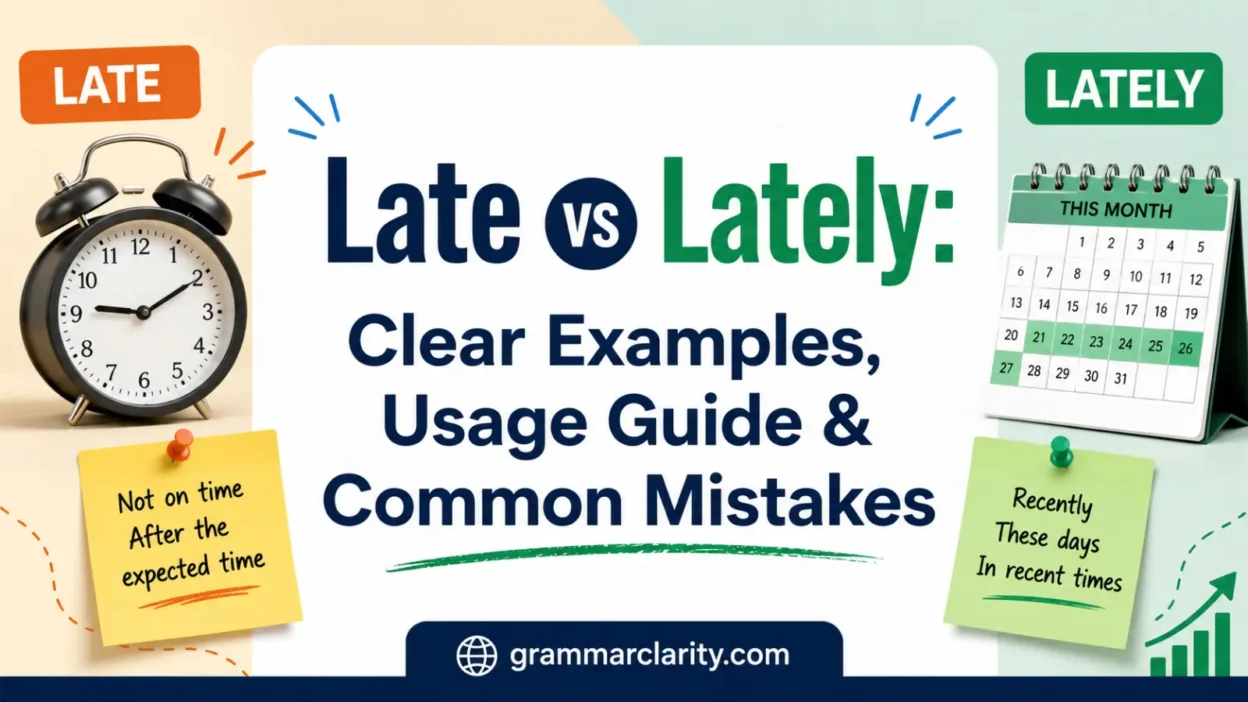
In everyday American English, small word choices can make a big difference in how clearly your message comes across. “Late” and “lately” are two words that frequently cause confusion because they look and sound similar while relating to time. However, they serve distinct purposes in sentences.
Many people, especially those learning English or even native speakers writing quickly, mix them up. This comprehensive guide breaks down late vs lately with practical explanations, real-world US examples, comparison tables, and fixes for common errors. Whether you’re writing an email to your boss in Chicago, texting friends in Los Angeles, or drafting a report in Dallas, understanding this pair will help your communication sound natural and professional.
This article explores the full picture of when to use each word, why the distinction matters, and how to avoid sounding awkward in different situations.
Quick Answer
Late describes something happening after the expected time or toward the end of a period. It functions as both an adjective and an adverb. Lately means “recently” and is used only as an adverb to talk about events or situations in the near past.
They are not interchangeable. Using the wrong one can confuse listeners or readers. For example:
- Correct: “The train arrived late.”
- Incorrect: “The train arrived lately.”
Why People Confuse Them
The confusion between late and lately stems from their shared connection to time and similar spelling. Both words trace back to concepts of delay or recency in English, leading many to assume they can swap places.
Non-native speakers often default to “lately” when describing tardiness because it feels like it relates to recent actions. Even Americans might hesitate in writing: “Have you been late to meetings lately?” uses both correctly, but swapping them creates odd phrasing like “Have you been lately to meetings late?”
Social media, texting, and fast-paced work culture in the US amplify these mix-ups. People type quickly on phones in cities like Miami or Seattle and don’t always catch the subtle difference until someone points it out.
Key Differences At A Glance
Here is a clear overview to help you decide quickly:
| Context | Best Choice | Why It Fits Best |
|---|---|---|
| Missing a scheduled time | late | Focuses on specific delay or timing |
| Recent changes in behavior | lately | Refers to the period of recent days/weeks |
| Describing a person or event | late | Works as adjective |
| Updating on current trends | lately | Strictly adverb for near-past |
| Work or travel delays | late | Common with transportation |
| Personal habits or feelings | lately | Natural with present perfect tense |
Additional Feature Comparison
- Flexibility: Late can describe timing, people, or periods; lately is narrower and always about recency.
- Common Pairing: Lately often appears with “have/has been”; late pairs with simple tenses.
- Emotional Tone: Late can imply mild criticism; lately feels more observational.
Meaning and Usage Difference
Late as an adjective tells us something or someone is not on time or occurs near the end. Examples include “late payment,” “late afternoon,” or “late stage.” As an adverb, it modifies verbs to show timing: “She arrived late.”
Lately exclusively functions as an adverb meaning “during recent times” or “recently.” It describes patterns or states over the past few days or weeks: “Lately, I’ve been exercising more.”
The core distinction is this: late focuses on a point in time being delayed or terminal, while lately addresses a span of recent time. This makes late more versatile in US English, appearing in news reports (“late breaking news”), daily conversation (“Sorry I’m late”), and formal writing. Lately shines in casual updates (“Lately, the weather has been unpredictable”).
In American workplaces, “late” often appears in performance reviews or project management: “The report was submitted late.” “Lately” fits team check-ins: “Lately, productivity has improved.”
Tone, Context, and Formality
Both words maintain a neutral tone suitable for most US contexts. Neither feels overly formal nor slangy, making them appropriate from casual chats in coffee shops in Portland to business meetings in Atlanta.
“Late” can carry slight negative connotations when discussing tardiness (“He’s always late”), which is common in American punctuality culture. “Lately” sounds more neutral and reflective, often used to share observations without judgment (“Lately, she’s seemed happier”).
In formal writing like academic papers or legal documents, “late” appears more frequently in phrases like “late filing.” “Lately” fits conversational professional emails. Regional US variations are minimal — both words work consistently from coast to coast.
Which One Should You Use?
Choose late when the focus is on deviation from an expected schedule or position near the end of something:
- Deadlines
- Transportation
- Time of day
- Life stages (“late 20s”)
Choose lately when discussing trends or situations from the recent past:
- Changes in habits
- Recent observations
- Updates on feelings or conditions
Quick test: If you can replace the word with “recently,” use lately. If you can replace it with “tardily” or “behind schedule,” use late.
When One Choice Sounds Wrong
Certain combinations immediately sound incorrect to American ears.
“I have been arriving late lately” works because it combines both properly. However, “I have been arriving lately” feels incomplete and unnatural.
Other examples that sound wrong:
- “The meeting started lately” (should be “late”)
- “My late friend has been calling me” (mixes meanings incorrectly)
- “Lately payments are due” (wrong word order and usage)
These mistakes often appear in emails from international teams working with US companies, creating small but noticeable awkwardness.
Common Mistakes (and Quick Fixes)
Mistake 1: Using “lately” for single instances of delay. Fix: “I came late to the party” not “I came lately.”
Mistake 2: Treating “lately” as an adjective. Fix: “Recent changes” or “lately” with a verb only.
Mistake 3: Overusing “late” for recent periods. Fix: “I’ve been tired lately” not “I’ve been tired late.”
Mistake 4: Confusing with similar words like “later.” Fix: “Later” means at some future point; “late” means delayed.
Mistake 5: Using “of late” incorrectly in casual speech. Fix: “Of late” is somewhat formal; “lately” is preferred in everyday US English.
Everyday Examples
Here are realistic scenarios from American life:
Work Context
- Late: “Traffic made me late to the important client meeting in downtown Houston.”
- Lately: “Lately, remote work has made me more productive during mornings.”
Daily Life
- Late: “We ate a late lunch after finishing errands at the mall.”
- Lately: “Lately, I’ve been trying new restaurants in my neighborhood.”
Family and Friends
- Late: “My late grandmother taught me how to bake apple pie.” (deceased reference)
- Lately: “Have you talked to Mom lately? She mentioned moving to Florida.”
Travel
- Late: “Our flight to Las Vegas left two hours late.”
- Lately: “Lately, airline prices have been rising quickly.”
Health and Habits
- Late: “Staying up late affects my energy levels the next day.”
- Lately: “Lately, I’ve been sleeping better after changing my routine.”
Combined Usage “I used to be an early riser, but lately I’ve been staying up late to watch NBA games.”
These examples reflect how Americans actually speak and write in 2026 across different states and situations.
Dictionary-Style Word Details
Verb
- Late: Not commonly used as a verb in standard US English. Rare archaic uses exist but are not part of modern conversation.
- Lately: Not used as a verb.
Noun
- Late: Not used as a noun in contemporary American English.
- Lately: Not used as a noun.
Synonyms
- Late: Closest plain alternatives include tardy, delayed, overdue, behind schedule.
- Lately: Closest plain alternatives include recently, of late, in recent times.
No direct antonyms exist for either word, as they describe time relationships rather than absolute opposites.
Example Sentences
- Late: “The bookstore stays open late on weekends in many cities.”
- Lately: “Lately, more people are choosing electric vehicles in California.”
- Late: “Better late than never applies to filing your taxes.”
- Lately: “Things have felt different lately since the new year started.”
- Late: “She takes late-night walks when the weather is nice.”
- Lately: “Lately, my coffee order has changed to oat milk.”
Word History
Both terms relate to time concepts in English. Specific detailed origins for their modern usage distinctions are not always clearly documented in popular references, but their current meanings have stabilized in American English over time.
Phrases Containing
- Late: Late night, late bloomer, late in life, late starter, fashionably late, late fees, late riser.
- Lately: Not lately, as of lately (less common), have you been…lately?
Frequently Asked Questions
Is “late” only used for being tardy?
No. “Late” has multiple uses in American English, including time of day (“late evening”), life stages (“in her late 30s”), and referring to someone who has passed away (“my late father”).
Can I use “lately” at the beginning of a sentence?
Yes, it works naturally: “Lately, gas prices have been fluctuating a lot in Texas.”
What’s the difference between “lately” and “recently”?
They are very close in meaning. “Lately” feels slightly more conversational in US English, while “recently” can sound a bit more formal.
Is “I am late” different from “I have been late lately”?
Yes. “I am late” describes your current state. “I have been late lately” describes a pattern over recent weeks.
Does “late” have different pronunciations?
It is pronounced /leɪt/ in all standard uses. No significant pronunciation differences affect meaning.
Can “lately” be used with future tense?
It is uncommon. “Lately” typically pairs with present perfect or present continuous for recent past/present connection.
What’s the best way to remember the difference?
Think: Late = specific timing problem. Lately = recent time period observation.
Are there regional differences in the US?
Very minimal. Both words are used consistently across regions, though “late” for deceased relatives appears more in Southern states.
Is “of late” the same as “lately”?
“Of late” is a slightly more formal or literary alternative that means the same as “lately” but sounds less common in casual American speech.
Conclusion
Understanding late vs lately strengthens your American English skills significantly. Late handles timing and delays across many contexts, while lately specifically addresses recent periods and changes. By following the guidelines, examples, and fixes in this guide, you can confidently choose the right word in any situation.
Practice by reviewing your recent messages or journal entries. Notice where time words appear and test whether “late” or “lately” fits best. With consistent use, this distinction becomes second nature, helping your communication sound polished whether you’re in New York, Phoenix, or anywhere in between.