Hard and hardly are two words that frequently trip up both native speakers and English learners in the United States. Despite their similar appearance and shared origins, they convey nearly opposite ideas in many situations. Choosing the wrong one can reverse the intended meaning of a sentence, leading to confusion in conversations, emails, reports, and even casual social media posts.
In American English today, these words appear constantly in everyday communication. You might hear someone say they “worked hard” on a project in a Dallas office or that they “hardly had time” for lunch during a busy New York commute. Understanding the distinction helps you communicate more clearly and confidently. This guide breaks down everything you need to know, with practical advice tailored for US English users in 2026.
Whether you’re writing a business proposal, chatting with friends, or preparing for a job interview, getting hard versus hardly right makes your language sound natural and professional. Let’s explore the real differences step by step.
Quick Answer
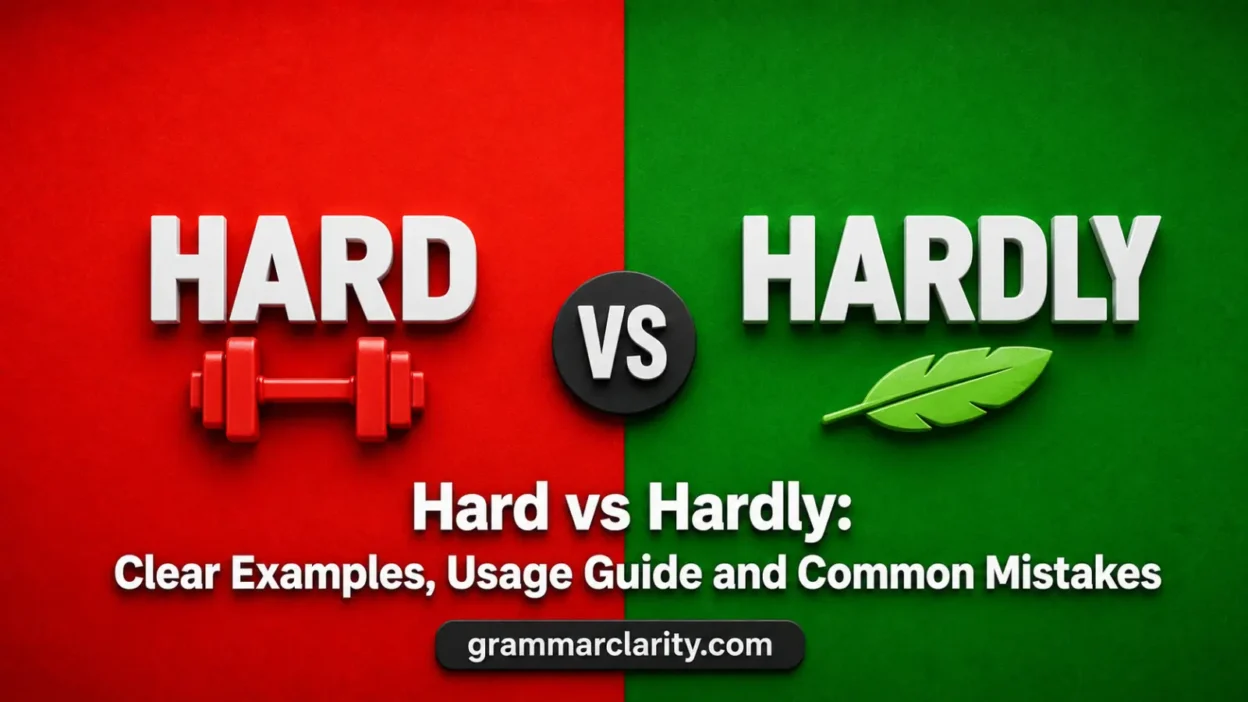
Hard means with a lot of effort, intensity, or difficulty. It describes strong action or something challenging. Hardly means almost not at all, barely, or scarcely. It suggests a very small amount or near absence of something.
These two words are not interchangeable. Using one in place of the other often creates the opposite meaning. For instance, “I worked hard” shows dedication, while “I hardly worked” implies laziness or minimal effort. The quick rule: reach for “hard” when emphasizing strength or struggle, and “hardly” when downplaying or negating.
Why People Confuse Them
The confusion stems from several factors common in English. First, both words look and sound similar, especially when spoken quickly in American accents. Second, many learners assume that adding “-ly” turns an adjective into an adverb, so they incorrectly create “work hardly” when they mean “work hard.”
English has irregular adverbs like this. Unlike “quick” becoming “quickly,” “hard” as an adverb stays “hard” when meaning with effort. “Hardly” evolved separately into a word that adds negation or minimality. Non-native speakers whose first languages form adverbs differently often default to “hardly” for effort contexts.
Even native Americans mix them up occasionally in fast speech or informal writing. Social media, texts, and rapid conversations amplify these slips. The similar spelling makes autocorrect unreliable, and without clear context, listeners might misinterpret intent. This mix-up ranks among top grammar questions for US English users.
Key Differences At A Glance
Here’s a straightforward comparison:
| Context | Best Choice | Why |
|---|---|---|
| Describing effort or intensity | hard | Shows strong action, determination, or force |
| Meaning almost none or barely | hardly | Adds a sense of scarcity or negation |
| Physical firmness or challenge | hard | Adjective for solid, tough, or difficult |
| Scarcely or only just | hardly | Adverb indicating minimal degree |
| After action verbs like run, play, study | hard | Intensifies the verb positively |
| Before main verbs to minimize | hardly | Creates near-negative tone |
Additional Feature Comparison:
- Hard: Functions as adjective and adverb. Positive or neutral tone when showing effort. Can describe physical objects or abstract difficulties.
- Hardly: Strictly an adverb. Often carries a subtle negative or understated tone. Commonly pairs with “ever,” “any,” or “believe.”
This table helps visualize why swapping them changes everything from encouragement (“Study hard!”) to mild criticism (“You hardly studied.”).
Meaning and Usage Difference
Hard serves dual roles effectively in US English.
As an adjective, it describes something difficult or not soft: “The math exam was really hard this semester.” Or “This new mattress feels too hard for comfortable sleep.” It can also mean strict or harsh: “The coach was hard on the players during training camp.”
As an adverb, “hard” means with great effort or intensity: “She pushed hard on the door until it opened.” “The rain fell hard during the Midwest thunderstorm.” Position usually follows the verb it modifies. Pronunciation stays straightforward: /hɑːrd/.
Hardly operates only as an adverb. It means almost not, barely, or only just: “I hardly recognized my old high school friend after so many years.” It often appears before the main verb: “They hardly noticed the temperature drop in Seattle.”
“Hardly” frequently combines with other words for emphasis: “hardly ever” means almost never, and “hardly any” means almost none. It carries a slight negative shade, implying insufficiency or surprise at the small amount.
The core distinction: “hard” builds up intensity while “hardly” reduces it. Real usage from current American sources confirms this separation remains consistent across formal and casual contexts.
Tone, Context, and Formality
“Hard” projects determination and strength. In professional US settings like tech companies in Austin or finance hubs in Chicago, saying “We worked hard to meet the deadline” sounds motivated and positive. It fits motivational speeches, performance reviews, and sports commentary.
“Hardly” sounds more reflective or cautious. It softens statements: “The meeting hardly lasted thirty minutes” feels neutral or slightly disappointed. In formal writing like reports or emails, “hardly” adds precision when describing limitations.
Neither word is strictly formal or slang. Both appear across American English registers in 2026. However, “hardly” pairs naturally with understatement common in polite Southern or Midwestern conversations. “Hard” feels more direct, suiting energetic East or West Coast styles.
Context matters for natural flow. Sports and fitness discussions favor “hard” (“Train hard, play hard”). Scientific or analytical writing leans on “hardly” for measured observations (“The data hardly supports that conclusion”).
Which One Should You Use?
Choose based on your intended meaning:
- Use hard for encouragement, physical descriptions, or effort: “Keep working hard toward your goals.”
- Use hardly for scarcity, surprise, or minimal occurrence: “We hardly see each other since the move to California.”
In most everyday American situations, the choice becomes intuitive once you internalize the effort-versus-minimal contrast. Listen to podcasts or news from sources like NPR or CNN to hear natural patterns. When in doubt, ask: Am I describing strong action (hard) or near absence (hardly)?
When One Choice Sounds Wrong
Certain combinations immediately signal an error to American ears:
- “It’s raining hardly” sounds incorrect and unnatural. Correct versions: “It’s raining hard” (heavy rain) or “It’s hardly raining” (light drizzle).
- “I studied hardly for the test” implies almost no study, probably not the intended message. Use “I studied hard” for dedication.
- “She hit the ball hardly” feels off. Better: “She hit the ball hard.”
These mismatches disrupt flow and can cause misunderstandings. Native speakers might pause or correct gently in conversation. In writing, they stand out as non-standard. Avoiding them keeps your English polished for job applications, client meetings, or social interactions across the US.
Common Mistakes and Quick Fixes
English learners and even some natives commonly stumble here. Here are frequent issues with direct fixes:
- Mistake: “He works hardly every day.” Fix: “He works hard every day.” This shows consistent effort rather than minimal work.
- Mistake: “I hard believe the news.” Fix: “I hardly believe the news.” Meaning it’s difficult to accept.
- Mistake: Placing “hardly” after the verb for effort: “They trained hardly.” Fix: “They trained hard.” Keep “hard” post-verb for intensity; use “hardly” pre-verb for negation.
- Mistake: Overusing “hardly” in positive contexts. Fix: Reserve it for minimizers. Test by replacing with “barely” — if it fits, “hardly” works.
- Mistake: Confusing in negatives: “I don’t hardly know him.” (Double negative) Fix: “I hardly know him.”
Practice these fixes in daily journaling or speaking aloud. Record yourself describing a busy workday using both words correctly to build muscle memory.
Everyday Examples
Modern US life offers countless opportunities to apply these words naturally:
- “The startup team in Silicon Valley pushed hard to launch the app before the holiday season.”
- “After the long flight from Miami, I could hardly keep my eyes open during the meeting.”
- “This puzzle is hard, but I enjoy the challenge on rainy Portland afternoons.”
- “We hardly ever eat out anymore since groceries got more expensive.”
- “The football players hit hard during practice in Green Bay.”
- “There was hardly any traffic on I-95 this morning, which was surprising.”
- “She tried hard to learn Spanish before her trip to Mexico.”
- “The kids hardly touched their vegetables at dinner in our suburban Chicago home.”
- “It snowed hard last night, making the morning commute tough in Denver.”
- “I hardly recognized the neighborhood after all the new construction.”
These examples reflect real 2026 American scenarios — from tech work to weather to family life. Notice how “hard” energizes and “hardly” qualifies.
Dictionary-Style Word Details
Verb
- Hard: Not used as a verb in standard US English in this context.
- Hardly: Not used as a verb.
Noun
- Hard: Not commonly a noun here (occasional technical uses like “the hards” in materials science are rare and unrelated).
- Hardly: No noun usage.
Synonyms
- Hard (adjective): difficult, tough, solid, firm, challenging. Hard (adverb): intensely, vigorously, energetically (closest plain alternatives).
- Hardly: barely, scarcely, almost not, rarely.
Antonyms:
- Hard: easy, soft, simple.
- Hardly: fully, completely, easily (context-dependent, not always perfect opposites).
Example Sentences
- Hard: “Athletes must practice hard if they want to compete at the Olympic level.”
- Hardly: “The restaurant had hardly any customers on that slow Tuesday night.”
- Hard: “The negotiators bargained hard for better contract terms.”
- Hardly: “You can hardly tell the difference between the two phone models.”
Word History
Both words trace back to Old English roots connected to firmness and difficulty. “Hard” retained core senses of effort and solidity. “Hardly” developed its minimizing meaning over centuries. Modern US English maintains a clear split without major regional shifts.
Phrases Containing
- Hard: work hard, think hard, hit hard, rain hard, try hard, play hard.
- Hardly: hardly ever, hardly any, hardly a, hardly believe, hardly worth.
FAQs
Is “hardly” always negative?
It often carries a negative or limiting sense by suggesting “almost not,” but it can be neutral depending on context, such as “hardly surprising” meaning expected.
Can I use “hard” as an adverb in all situations?
Yes, when meaning with effort or force. It follows the verb naturally in American English: “Drive safe and work hard.”
What’s the difference between “hardly ever” and “never”?
“Hardly ever” means very rarely, while “never” means not at all. “I hardly ever miss deadlines” implies occasional misses are possible.
Do British and American English differ on hard vs hardly?
The core distinction remains the same, though Americans might use slightly more casual phrasing in daily speech.
How do I remember the difference easily?
Think “hard” = hustle/effort (positive push). “Hardly” = hesitant/barely (holding back).
Is it okay to say “working hard or hardly working” as a joke?
Yes, this common American pun plays on the exact contrast and is widely understood.
Can “hard” describe personality?
Yes, as in “a hard person to please” meaning strict or demanding.
What about pronunciation differences?
“Hard” is /hɑːrd/. “Hardly” is /ˈhɑːrdli/. The extra syllable in “hardly” helps distinguish them when spoken.
How common are these mistakes among Americans?
Fairly common in informal settings, especially among younger speakers or in quick texts, but corrected in professional contexts.
Should I avoid “hardly” in positive motivational writing?
Generally yes — “hard” better suits encouragement. Save “hardly” for realistic limitations.
Conclusion
Hard and hardly demonstrate how small spelling changes create big meaning shifts in American English. “Hard” builds intensity and describes effort or difficulty, while “hardly” minimizes and signals scarcity. Mastering this pair improves clarity in writing, speaking, and understanding others.
Practice by reviewing your own sentences and listening actively in conversations. Over time, the correct choice will feel automatic. Strong command of these words contributes to more confident, natural communication in every part of US life — from boardrooms to backyard chats.