Last Updated: MAY 19, 2026
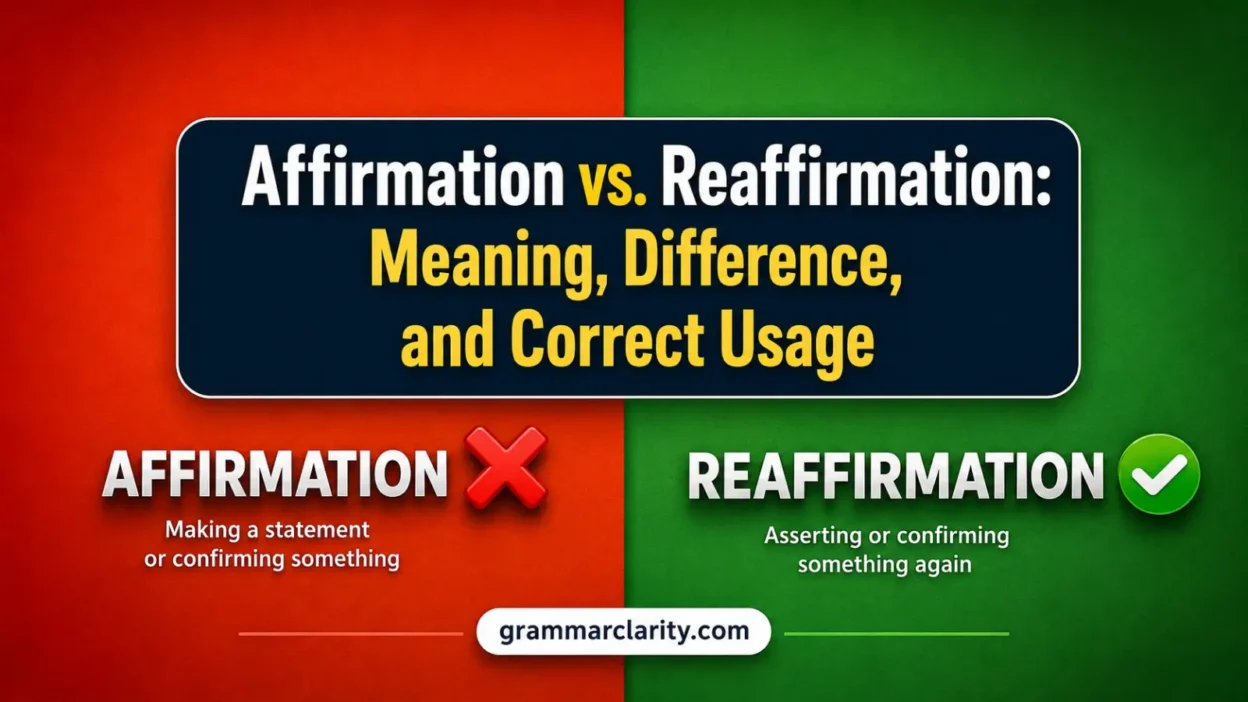
Affirmation vs. reaffirmation is mainly a matter of timing and repetition. The two words are closely related, but they are not always interchangeable.
Use affirmation when something is being stated, confirmed, supported, approved, or expressed. Use reaffirmation when that same belief, support, promise, or commitment is being stated again.
In simple terms:
Affirmation means confirmation, support, approval, or a positive statement.
Reaffirmation means confirmation, support, approval, or a positive statement again.
This small difference matters because using the wrong word can make a sentence sound unnatural, too formal, or logically unclear.
Quick Answer
Use affirmation when you mean a statement of support, approval, belief, validation, or confirmation.
Use reaffirmation when you mean a renewed or repeated statement of support, approval, belief, validation, or confirmation.
If there was no earlier statement, promise, belief, or commitment, affirmation is usually the better word.
If the idea is being repeated, renewed, or restated, reaffirmation is usually more accurate.
Main Difference Between Affirmation and Reaffirmation
The main difference between affirmation and reaffirmation is repetition.
Affirmation can introduce or confirm a belief, value, promise, or support.
Reaffirmation points back to something that was already stated, believed, promised, or accepted before.
For example:
Her speech was an affirmation of equal rights.
This means her speech expressed support for equal rights.
Her second speech was a reaffirmation of that commitment.
This means she had already expressed that commitment before, and the second speech repeated or renewed it.
So, the difference is not about which word is stronger. The difference is whether the idea is being stated once or stated again.
Why People Confuse Affirmation and Reaffirmation
People often confuse affirmation and reaffirmation because reaffirmation sounds like a stronger or more formal version of affirmation.
However, that is not the real difference.
The real difference is this:
Affirmation means something is being confirmed or supported.
Reaffirmation means something is being confirmed or supported again.
Both words can appear in similar contexts, such as relationships, public statements, workplace communication, law, politics, religion, personal development, and official policy language.
Both words can sound formal. Both can express support. But only reaffirmation clearly includes the idea of repetition.
Affirmation vs. Reaffirmation at a Glance
| Context | Best Word | Why |
|---|---|---|
| A first statement of support | Affirmation | Nothing is being repeated |
| A renewed promise after doubt | Reaffirmation | The promise is being stated again |
| A statement confirming values | Affirmation | It confirms or expresses the belief |
| A public restatement of an existing policy | Reaffirmation | The policy already existed |
| A positive personal statement | Affirmation | This is the common everyday term |
| A formal message restating commitment | Reaffirmation | The repeat element is important |
A simple way to remember the difference is:
Affirmation = confirmation, support, or declaration
Reaffirmation = confirmation, support, or declaration again
Meaning of Affirmation
An affirmation is a statement, action, or sign that confirms, supports, approves, or declares something.
It can be used in many different ways. It may refer to emotional support, public approval, moral belief, personal confidence, legal confirmation, or a formal statement of truth.
In personal development, an affirmation often means a positive statement someone repeats to build confidence, motivation, or focus.
Examples of affirmations include:
I am capable.
I can handle this.
I deserve respect.
I am improving every day.
The word affirmation can also be used in broader sentences:
The award was an affirmation of her talent.
His kind words were an affirmation of her efforts.
The decision was an affirmation of the company’s values.
In these examples, affirmation means support, confirmation, validation, or approval.
Meaning of Reaffirmation
A reaffirmation is an affirmation made again. It repeats, renews, or strengthens something that was already said, believed, promised, accepted, or supported.
This word is often used when someone wants to restate a commitment, especially after time has passed, doubt has appeared, criticism has occurred, or circumstances have changed.
Examples:
The company issued a reaffirmation of its mission.
The court’s decision was a reaffirmation of an earlier ruling.
Their conversation became a reaffirmation of trust.
The statement was a reaffirmation of the country’s alliance.
In each example, reaffirmation points back to something that already existed before.
The mission already existed. The ruling came earlier. The trust was already present. The alliance had already been established.
That is why reaffirmation is the correct word.
Affirmation vs. Reaffirmation in Sentences
Compare these two sentences:
The statement was an affirmation of support.
This means the statement expressed support.
The statement was a reaffirmation of support.
This means the support had already been expressed before, and the statement expressed it again.
Here is another example:
Her words were an affirmation of her beliefs.
This means her words confirmed or expressed her beliefs.
Her later speech was a reaffirmation of her beliefs.
This means she had already expressed those beliefs before, and her later speech repeated or renewed them.
The first sentence focuses on confirmation.
The second sentence focuses on confirmation again.
Tone and Formality
Affirmation is more flexible than reaffirmation. It works well in everyday writing, personal writing, emotional language, professional communication, religious contexts, and self-improvement language.
Examples:
The note was an affirmation of friendship.
The award felt like an affirmation of his hard work.
Daily affirmations helped her stay focused.
Her response was an affirmation of kindness and respect.
Reaffirmation is usually more formal and specific. It often appears in official, legal, political, institutional, religious, or relationship-repair contexts.
Examples:
a reaffirmation of company values
a reaffirmation of policy
a reaffirmation of faith
a reaffirmation of trust
a reaffirmation of long-term goals
Because of this, reaffirmation often sounds heavier and more deliberate. It suggests that something needed to be repeated, renewed, or strengthened.
When to Use Affirmation
Use affirmation when you mean:
a statement of support
a confirmation of truth
emotional encouragement
approval or validation
a positive personal statement
a declaration of belief or value
a sign of agreement or recognition
Examples:
Her words were an affirmation of kindness.
The ceremony was an affirmation of community.
The teacher’s praise felt like an affirmation of his progress.
The statement served as an affirmation of the organization’s values.
Writing in a journal can be a quiet form of affirmation.
In these examples, the focus is on support, confirmation, or validation. There is no clear idea of repeating something previously said.
When to Use Reaffirmation
Use reaffirmation when you mean:
a renewed commitment
a repeated promise
a restated belief
a confirmation made again
a renewed statement of support
a return to a previously stated value or principle
Examples:
After the disagreement, the apology became a reaffirmation of respect.
The board released a reaffirmation of its long-term strategy.
The treaty was a reaffirmation of the alliance.
The leader’s speech was a reaffirmation of earlier promises.
The company’s message was a reaffirmation of its commitment to customers.
In these examples, reaffirmation works because the idea, promise, relationship, or commitment already existed before.
Simple Test: Can You Add “Again”?
A helpful way to choose between affirmation and reaffirmation is to ask:
Can I naturally add “again” to the sentence?
If yes, reaffirmation may be the better choice.
If no, affirmation is usually more natural.
Example:
The memo was an affirmation of the team’s goals.
This simply means the memo confirmed or supported the goals.
Now compare:
The memo was a reaffirmation of the team’s goals after last month’s confusion.
This means the goals had already been stated, and the memo restated them.
Because the second sentence includes a clear reason for repeating the message, reaffirmation is more accurate.
When Affirmation Is Better
Use affirmation when the sentence does not involve repetition.
Examples:
Her speech was an affirmation of hope.
The award was an affirmation of his dedication.
The letter was an affirmation of friendship.
The decision was an affirmation of the group’s values.
The compliment felt like an affirmation of her hard work.
In these sentences, the word affirmation is natural because the focus is on support, approval, or confirmation, not on restating something already said.
When Reaffirmation Is Better
Use reaffirmation when the sentence clearly refers to something being stated again.
Examples:
After the crisis, the mayor offered a reaffirmation of public safety commitments.
The board’s announcement was a reaffirmation of its earlier decision.
Their conversation was a reaffirmation of mutual trust.
The agreement served as a reaffirmation of the partnership.
The statement was a reaffirmation of the values the organization had always supported.
In these sentences, reaffirmation is correct because each sentence refers to a repeated, renewed, or continued commitment.
When One Word Sounds Wrong
Sometimes reaffirmation sounds wrong because there is no earlier statement or commitment.
Example:
Incorrect: Her first campaign speech was a reaffirmation of her platform.
This sounds strange unless her platform had already been announced before the speech.
Better:
Correct: Her first campaign speech was an affirmation of her platform.
On the other hand, affirmation can sound too weak or incomplete when the main point is renewal.
Example:
Less precise: After the scandal, the CEO issued an affirmation of company values.
Better:
More precise: After the scandal, the CEO issued a reaffirmation of company values.
The second sentence is better because it shows that the company was returning to values it had already claimed before.
Everyday Examples of Affirmation and Reaffirmation
Here are some natural examples of both words:
Her message was an affirmation of friendship.
Their anniversary trip became a reaffirmation of their marriage.
The workshop gave him an affirmation of his strengths.
The board issued a reaffirmation of its long-term strategy.
Writing positive statements can be a form of affirmation.
After the misunderstanding, her follow-up call served as a reaffirmation of trust.
The court’s ruling was seen as an affirmation of free speech.
The later decision was a reaffirmation of that principle.
Word Forms
Affirmation
Affirmation comes from the verb affirm.
To affirm means to state, confirm, support, uphold, or approve something.
As a noun, affirmation means a statement, act, or sign of support, confirmation, belief, approval, or validation.
Examples:
The award was an affirmation of her talent.
His words offered affirmation and comfort.
The decision was an affirmation of their shared values.
Reaffirmation
Reaffirmation comes from the verb reaffirm.
To reaffirm means to affirm again.
As a noun, reaffirmation means a repeated statement, act, or sign that confirms something already stated, promised, believed, or accepted.
Examples:
The agreement was a reaffirmation of their partnership.
Her reply was a reaffirmation of her earlier promise.
The speech was a reaffirmation of the leader’s commitment.
Synonyms of Affirmation
Common synonyms of affirmation include:
confirmation
support
validation
approval
endorsement
declaration
assertion
recognition
encouragement
Examples:
The certificate was an affirmation of his achievement.
The certificate was a recognition of his achievement.
Both sentences are similar, but affirmation often feels more emotional, formal, or supportive.
Synonyms of Reaffirmation
Common synonyms of reaffirmation include:
renewed confirmation
renewed support
restatement
renewal
repeated confirmation
renewed commitment
fresh declaration
continued support
Examples:
The announcement was a reaffirmation of the policy.
The announcement was a restatement of the policy.
Both sentences are close in meaning, but reaffirmation emphasizes support or commitment more strongly than simple restatement.
Common Phrases with Affirmation
Here are some common phrases with affirmation:
self-affirmation
positive affirmation
affirmation of identity
affirmation of support
affirmation of values
affirmation of belief
affirmation of love
affirmation of confidence
Examples:
Positive affirmations can help build confidence.
The speech was an affirmation of cultural identity.
Her kind words were an affirmation of support.
Common Phrases with Reaffirmation
Here are some common phrases with reaffirmation:
reaffirmation of commitment
reaffirmation of values
reaffirmation of policy
reaffirmation of faith
reaffirmation of trust
reaffirmation of support
reaffirmation of principles
reaffirmation of partnership
Examples:
The statement was a reaffirmation of the company’s values.
Their discussion led to a reaffirmation of trust.
The agreement was a reaffirmation of their long-term partnership.
Affirmation vs. Reaffirmation in Personal Development
In personal development, affirmation is the more common word.
A positive affirmation is a statement someone repeats to encourage confidence, focus, or self-belief.
Examples:
I am strong.
I am learning.
I am worthy of respect.
I can improve with effort.
Although these statements may be repeated daily, they are still usually called affirmations, not reaffirmations.
Why?
Because positive affirmation is the standard term in self-help and personal growth.
You would usually say:
She practices daily affirmations.
Not:
She practices daily reaffirmations.
However, reaffirmation can still be used in personal contexts when someone is renewing a belief, promise, or commitment.
Example:
After a difficult year, writing down her goals became a reaffirmation of her belief in herself.
Affirmation vs. Reaffirmation in Relationships
In relationships, both words can be used, but they create different meanings.
Affirmation often refers to support, love, validation, or appreciation.
Example:
His kind words were an affirmation of love.
Reaffirmation often refers to renewing trust, commitment, or emotional connection.
Example:
After the argument, their honest conversation was a reaffirmation of trust.
Use affirmation when expressing love, support, or appreciation.
Use reaffirmation when love, trust, or commitment is being renewed after time, distance, conflict, or doubt.
Affirmation vs. Reaffirmation in Business and Formal Writing
In business, legal, political, and official writing, reaffirmation is common because organizations often restate commitments, policies, strategies, or values.
Examples:
The company released a reaffirmation of its sustainability goals.
The board issued a reaffirmation of its strategic plan.
The government made a reaffirmation of its support for the agreement.
However, affirmation is better when the statement simply confirms or supports something without the idea of repetition.
Example:
The award was an affirmation of the company’s leadership in the industry.
Here, the award confirms or validates the company’s position. It is not necessarily repeating an earlier promise.
Common Mistakes to Avoid
Mistake 1: Using Reaffirmation When Nothing Was Said Before
Incorrect:
The first statement was a reaffirmation of support.
Better:
The first statement was an affirmation of support.
Use reaffirmation only when the support was already expressed before.
Mistake 2: Using Affirmation When Repetition Is the Main Point
Less precise:
The leader gave an affirmation of earlier promises.
Better:
The leader gave a reaffirmation of earlier promises.
Because the promises were made earlier, reaffirmation is more accurate.
Mistake 3: Thinking Reaffirmation Is Always Stronger
Reaffirmation may sound stronger, but it does not simply mean “strong affirmation.”
It means “affirmation again.”
The key idea is repetition, not intensity.
FAQs
Is reaffirmation the same as affirmation?
No. Reaffirmation is a type of affirmation, but it specifically means an affirmation made again. Affirmation can be a first statement of support or confirmation, while reaffirmation repeats or renews something already stated.
Which word is more common, affirmation or reaffirmation?
Affirmation is more common in everyday writing, especially in emotional, personal, and self-improvement contexts. Reaffirmation is more common in formal, official, legal, political, or relationship-repair contexts.
Can I use reaffirmation instead of affirmation?
Only use reaffirmation if something is being confirmed, supported, or promised again. If there is no earlier statement or commitment, use affirmation.
What is a positive affirmation?
A positive affirmation is a positive statement used to encourage confidence, motivation, or self-belief. For example, “I am capable” and “I can handle this” are positive affirmations.
What is an example of reaffirmation?
An example of reaffirmation is:
The company’s statement was a reaffirmation of its commitment to customer privacy.
This means the company had already made that commitment before and was stating it again.
Is reaffirmation more formal than affirmation?
Usually, yes. Reaffirmation often sounds more formal because it is commonly used in official statements, policies, public commitments, and serious relationship or institutional contexts.
What is the easiest way to remember the difference?
Ask whether the idea is being stated again. If yes, use reaffirmation. If not, use affirmation.
Conclusion
The difference between affirmation and reaffirmation is simple: affirmation confirms or supports something, while reaffirmation confirms or supports something again.
Use affirmation when you mean a statement of support, truth, approval, confidence, belief, or validation.
Use reaffirmation when that statement is being repeated, renewed, or strengthened after it was already made before.
The easiest test is to ask whether the sentence naturally includes the idea of “again.” If it does, reaffirmation is probably the better word. If it does not, affirmation is usually more natural.