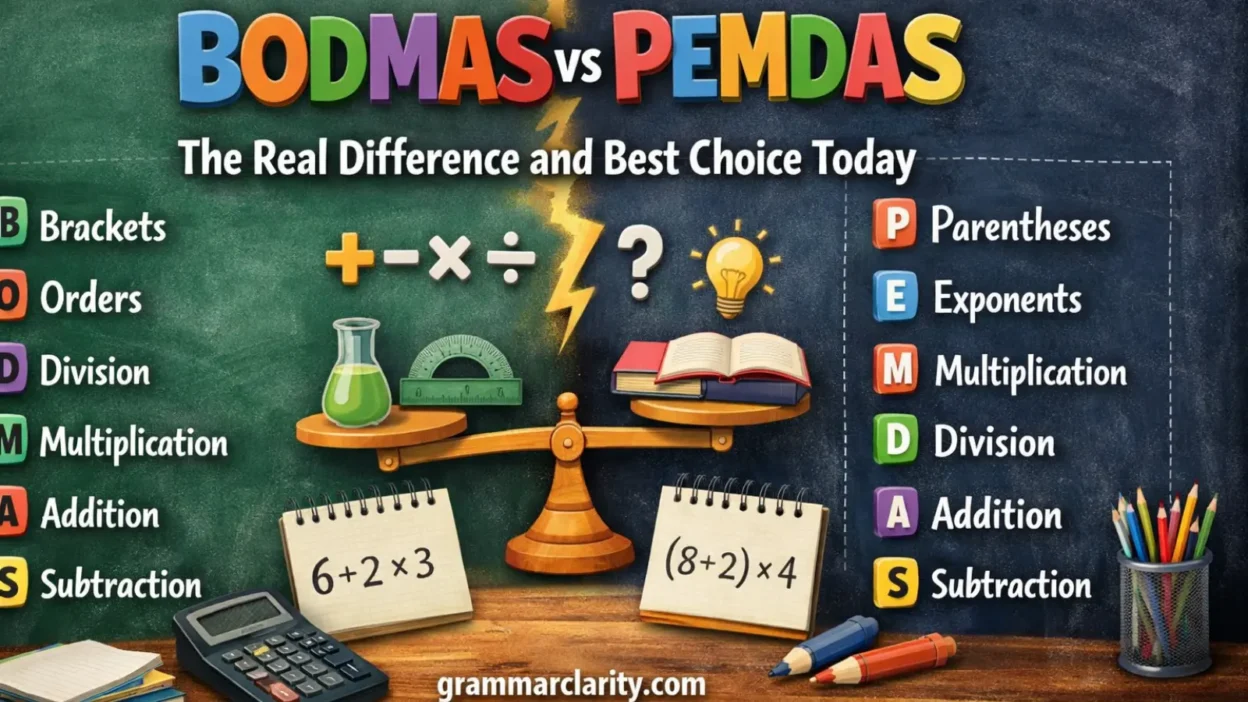
BODMAS vs PEMDAS is not a debate about two different math systems. It is a choice between two regional labels for the same order-of-operations rule. For a US audience, PEMDAS is usually the better fit. For British and many Commonwealth contexts, BODMAS is often the more natural choice.
Quick Answer
Use PEMDAS if you are writing for American readers, US schools, or US-style educational content. Use BODMAS if you are following British or Commonwealth classroom wording. Neither term is more mathematically correct than the other. The real difference is vocabulary: parentheses vs brackets, and exponents vs orders.
A second point matters just as much: the letters do not mean multiplication must always come before division, or addition before subtraction. In both systems, multiplication and division are the same level and are handled left to right. Addition and subtraction work the same way.
Why People Confuse Them
People confuse these terms because they look like competing rules. They are not. They are two memory aids built from different classroom vocabulary. One uses brackets and orders. The other uses parentheses and exponents. The underlying convention stays the same.
The letter order also causes trouble. Some readers see the D before the M in BODMAS and assume division must come first. Others see the M before the D in PEMDAS and assume multiplication must come first. That is the wrong takeaway. Those pairs have equal rank.
Key Differences At A Glance
The table below reflects the real choice readers usually need to make: not which rule is right, but which label fits the audience and context best.
| Context | Best Choice | Why |
| US classroom content | PEMDAS | It matches standard American wording such as parentheses and exponents. |
| UK or Commonwealth school context | BODMAS | It matches regional wording such as brackets and orders. |
| Mixed international audience | order of operations, then either term if needed | The plain concept is clearest across regions. |
| Editing existing teaching materials | Keep the local term already in use | Consistency matters more than switching labels. |
| Explaining whether the rules differ | Either one | They point to the same operation order. |
Meaning and Usage Difference
Here is the real side-by-side difference. The labels change, but the math convention does not.
| Feature | BODMAS | PEMDAS |
| First grouping word | Brackets | Parentheses |
| Power-related word | Orders | Exponents |
| Typical regional pull | UK and many Commonwealth settings | US settings |
| Underlying rule | Same order of operations | Same order of operations |
In practice, orders covers powers and similar exponent-style work, while exponents is the more familiar American school term. That is why the two acronyms sound different even though they guide readers through the same sequence.
Tone, Context, and Formality
Neither term is slang, casual, or improper. This is not a formal-versus-informal choice. It is a regional and educational choice. In a US article, PEMDAS sounds native and expected. In a British-style article, BODMAS sounds normal for the same reason.
If you are writing for a broad public audience rather than a classroom audience, the safest wording is often order of operations. You can then introduce BODMAS or PEMDAS only if your readers are likely to know one of those labels already.
Which One Should You Use?
For most US English writing, use PEMDAS.
That includes blog posts for American readers, tutoring pages aimed at US students, US worksheets, and general educational copy written in American English. It will feel familiar right away, and it avoids making readers wonder whether BODMAS is a different method.
Use BODMAS when you are matching a British or Commonwealth curriculum, keeping regional terminology consistent, or writing for readers who already use brackets and orders in class.
If your audience is mixed, write something like this once near the top: “Using the order of operations (called PEMDAS in the US and BODMAS in many other places)…” That solves the naming issue cleanly without turning the article into a regional vocabulary lesson.
When One Choice Sounds Wrong
BODMAS sounds off in US-focused copy when the rest of the article uses unmistakably American classroom language. If you write parentheses, math class, and sixth grade, then suddenly switch to BODMAS, the wording feels imported rather than natural.
PEMDAS sounds off in a British-style context for the mirror-image reason. If your copy already says brackets and follows a British or Commonwealth classroom frame, PEMDAS can feel like an unnecessary shift in dialect.
Both choices also sound wrong when the writer treats them as different mathematical systems. That is the biggest mistake of all. They are different labels for the same underlying convention.
Common Mistakes (and Quick Fixes)
One common mistake is writing as if BODMAS means divide before multiply and PEMDAS means multiply before divide. Quick fix: explain that those operations share the same level and are completed left to right. The same is true for addition and subtraction.
Another mistake is saying one term is “right” and the other is “wrong.” Quick fix: replace that claim with a regional explanation. Say one term is more natural for a certain audience.
A third mistake is switching terms mid-article without a reason. Quick fix: choose one label based on audience, then stay consistent. If you need both, define them once and move on.
Everyday Examples
Here are natural ways the choice works in real writing.
For a US tutoring page: “Remember PEMDAS when you simplify expressions with parentheses and exponents.”
For a British-style worksheet: “Use BODMAS to decide which part of the expression to solve first.”
For an international explainer: “Follow the order of operations. In US classrooms this is often called PEMDAS, while many other classrooms use BODMAS.”
The math result does not change with the label. For example, in 30 ÷ 5 × 3, you do division and multiplication left to right, giving 18. That is true whether you say BODMAS or PEMDAS.
Dictionary-Style Word Details
Verb
BODMAS: Not normally used as a verb in standard edited English. Writers do not usually say “to bodmas” an expression.
PEMDAS: Also not normally used as a verb. Standard usage treats it as the name of a rule or mnemonic, not an action word.
Noun
BODMAS: A noun and classroom acronym for the order of operations, built from Brackets, Orders, Division, Multiplication, Addition, Subtraction.
PEMDAS: A noun and classroom acronym for the same rule, built from Parentheses, Exponents, Multiplication, Division, Addition, Subtraction.
Synonyms
BODMAS: Close equivalents include BIDMAS, BEDMAS, and the broader phrase order of operations, though that broader phrase names the concept rather than the exact acronym.
PEMDAS: Close equivalents include BODMAS, BEDMAS, BIDMAS, and order of operations for the same reason.
Example Sentences
BODMAS: “My teacher uses BODMAS, so I was taught to look at brackets before anything else.”
BODMAS: “In that workbook, BODMAS is just the local name for the order of operations.”
PEMDAS: “Most US students recognize PEMDAS right away.”
PEMDAS: “If your audience is American, PEMDAS will usually sound more familiar.”
Word History
BODMAS: This term comes from school-based mnemonic wording that favors brackets and orders, which align with British and related classroom vocabulary.
PEMDAS: This term comes from the American preference for parentheses and exponents in classroom language. It names the same operation order through US vocabulary.
Phrases Containing
BODMAS: BODMAS rule, BODMAS question, BODMAS example, BODMAS method.
PEMDAS: PEMDAS rule, PEMDAS example, PEMDAS worksheet, PEMDAS problem.
Conclusion
If you are choosing between BODMAS vs PEMDAS, the best answer is simple. Use PEMDAS for US readers. Use BODMAS when you are matching British or Commonwealth wording. Do not present them as competing mathematical rules, because they are not. The real difference is regional vocabulary, not mathematical substance. And if your audience crosses borders, order of operations is often the clearest lead term of all.