Last Updated: MAY 18, 2026
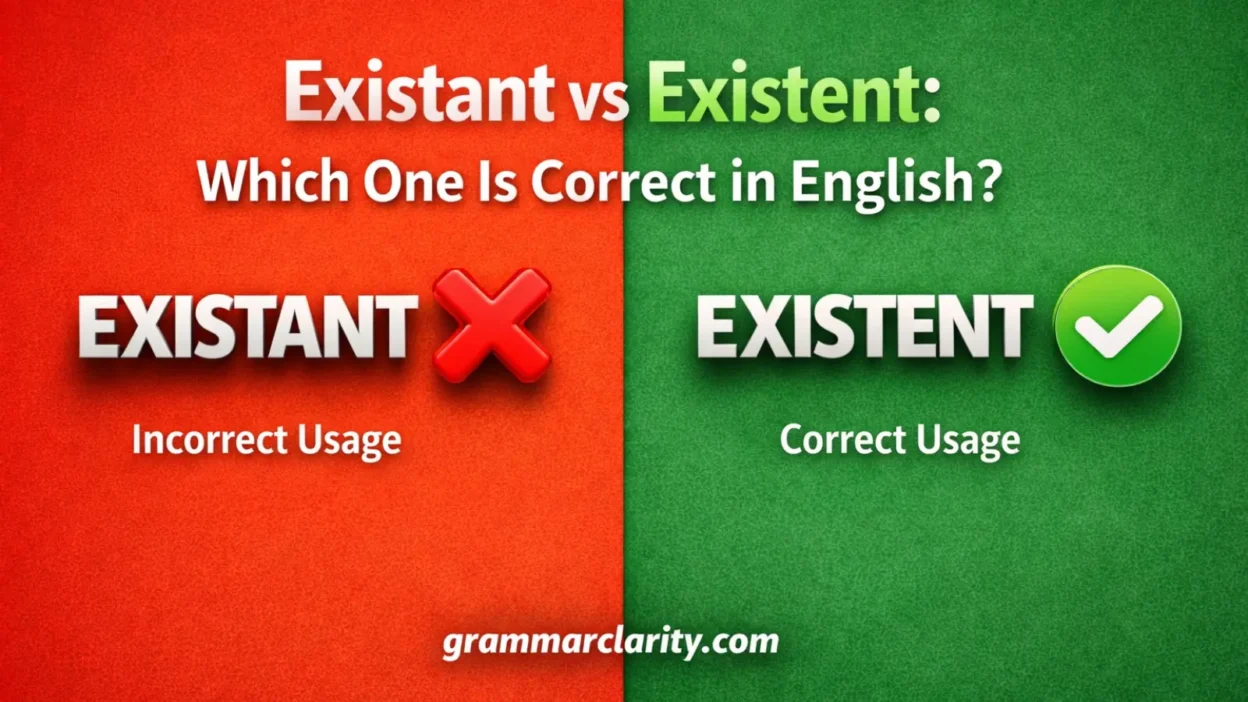
Many writers get confused between existant and existent because both spellings look possible. However, only one of them is correct in standard English. The right word is existent, which means “existing,” “real,” or “having existence.” The spelling existant is nonstandard and should be avoided in professional, academic, and everyday writing.
Still, existent is a formal word, so it is not always the most natural choice. In many normal sentences, existing sounds clearer and smoother. In this guide, you will learn the difference between existant and existent, why the confusion happens, and when to use existent or existing correctly.
Quick Answer
The correct word in standard English is existent, not existant.
Existent means “existing,” “real,” or “having existence.” It is mostly used in formal, academic, legal, philosophical, or theological writing.
Existant is not the standard spelling in modern English. Most readers, editors, and spell-check tools will treat it as incorrect or nonstandard.
However, there is another important point: existent is a formal word. In everyday writing, existing is often clearer and more natural.
Simple rule:
Use existent in formal writing when you mean “having existence.”
Use existing in everyday writing.
Avoid existant in standard English.
Existant vs. Existent: Main Difference
The main difference between existant and existent is spelling and accepted usage.
Existent is the correct standard English form.
Existant is generally considered nonstandard in English.
Correct
The threat was not imaginary; it was fully existent.
Incorrect
The threat was not imaginary; it was fully existant.
Even if readers understand what existant means, the spelling can still make your sentence look unpolished. That is why existent is the safer and more professional choice.
Why Do People Confuse Existant and Existent?
Writers often confuse existant and existent because both spellings look possible.
English has many adjectives ending in -ant and -ent, such as:
- important
- constant
- dependent
- different
Because both endings are common, some people assume existant might also be correct.
Another reason is that existant resembles spellings used in French and some other languages. This can make the word look familiar, even though it is not the standard English spelling.
A third reason is that existent is not very common in everyday speech. Most people usually say existing, real, present, or current instead. Since existent sounds formal, writers may become unsure about its spelling.
Key Differences at a Glance
| Context | Best Choice | Reason |
|---|---|---|
| Standard English | existent | It is the accepted spelling. |
| American English | existent | Existant will usually look incorrect. |
| Academic writing | existent | It fits formal discussion about existence or reality. |
| Legal writing | existent | It can describe rights, duties, or conditions that already exist. |
| Philosophy or theology | existent | It suits abstract ideas about being and reality. |
| Everyday writing | existing | It sounds more natural and less formal. |
| Business writing | existing | It is usually clearer and smoother. |
| French-influenced text | existant may appear | But it is not standard English. |
What Does Existent Mean?
Existent means that something exists, is real, or has being.
It can describe a thing, idea, condition, duty, right, threat, or reality. Because the word has a formal tone, it works best in serious or abstract writing.
Examples of Existent
The court treated the obligation as already existent.
The philosopher argued that moral truths are objectively existent.
The threat was not hypothetical but existent.
The debate focused on whether such a right was legally existent.
In all these examples, existent means that something is real or already exists.
Is Existant a Word?
In standard modern English, existant is not the recommended spelling.
You may see existant in some places, but that does not make it the best choice in English. It is usually the result of spelling confusion, foreign-language influence, or nonstandard usage.
Using existant can create problems because it may:
- make your writing look incorrect
- distract readers from your message
- look like a typo
- suggest weak proofreading
- reduce the professional quality of your sentence
For clear and polished English, avoid existant and use existent or existing instead.
Existent vs. Existing
Although existent is correct, it is not always the best word.
In many everyday sentences, existing sounds more natural than existent.
Natural
We need to update our existing system.
Awkward
We need to update our existent system.
Both words are related to the idea of something that exists, but their tone is different.
Existing is common, simple, and natural.
Existent is formal, abstract, and sometimes philosophical.
Use existing when talking about ordinary things that are already present or already in use.
Use existent when discussing existence, reality, legal status, or abstract ideas in a formal way.
When to Use Existent
Use existent when you need a formal word meaning “real,” “actual,” or “having existence.”
It works well in:
- legal writing
- academic writing
- philosophy
- theology
- formal arguments
- abstract discussion
Examples
The issue was whether a legally existent right had already been established.
The argument depends on whether such entities are actually existent.
Some theologians describe God as self-existent.
The court did not treat the duty as theoretical but as already existent.
These sentences are formal, so existent fits naturally.
When to Use Existing
Use existing in everyday, business, technical, and general writing.
Examples
The company expanded its existing services.
We reviewed the existing customer list.
The museum restored the existing structure.
The team improved the existing website.
The policy applies to all existing rules.
These sentences sound better with existing because they describe things already present or already in use.
In these cases, existent would sound too formal or unnatural.
Common Mistakes with Existant and Existent
1. Using Existant Instead of Existent
Incorrect:
The rule applies to all existant conditions.
Correct:
The rule applies to all existent conditions.
Better in plain English:
The rule applies to all existing conditions.
2. Using Existent in Ordinary Sentences
Too formal:
We updated the existent website.
Better:
We updated the existing website.
Too formal:
The company reviewed its existent policies.
Better:
The company reviewed its existing policies.
3. Thinking Formal Words Are Always Stronger
A formal word is not always a better word. Strong writing is clear, natural, and correct.
If existent sounds heavy in a sentence, replace it with existing, real, present, or current.
Everyday Examples
The company expanded its existing services.
Not: The company expanded its existent services.
The question was whether a legal duty was already existent.
Here, existent works because the sentence is formal and legal.
She wanted evidence of a real threat.
Better than: She wanted evidence of an existent threat.
The museum restored the existing structure.
Not: The museum restored the existant structure.
He argued that free will is existent, not imaginary.
This works in philosophical writing.
The team updated the existing policy.
Better than: The team updated the existent policy.
Dictionary-Style Details
Existant
Part of speech: Not recommended as a standard English word
Status: Nonstandard in modern English
Best replacement: existent or existing
Use in English: Avoid in professional, academic, and American English writing
Existent
Part of speech: Adjective; sometimes a noun in formal writing
Meaning: Existing, real, or having existence
Tone: Formal
Best used in: Academic, legal, philosophical, theological, or abstract writing
Example as an Adjective
The court recognized the duty as already existent.
Example as a Noun
Human beings are one class of existents in that theory.
As a noun, existent is uncommon and mostly appears in philosophy or formal theory.
Synonyms of Existent
Depending on the sentence, you can often replace existent with:
- existing
- real
- actual
- present
- current
- living
- in being
- in place
Examples
An existent threat → a real threat
An existent system → an existing system
An existent rule → an existing rule
An existent condition → a present condition
An existent organization → a current organization
Choosing the right synonym can make your writing clearer and more natural.
Word History and Usage Note
Existent belongs to the same word family as exist and existence. It is an established English word and has long been used in formal contexts.
However, existent is less common than existing in everyday writing. That is why it should be used carefully and only when its formal tone fits the sentence.
Existant is not the standard English form. It may appear because of foreign-language influence or spelling confusion, but it is not the spelling English readers usually expect.
Common Phrases with Existent
You may see existent in formal phrases such as:
- existent rights
- existent duty
- existent threat
- existent reality
- existent condition
- legally existent
- objectively existent
- self-existent
These phrases are most common in legal, philosophical, theological, or academic writing.
FAQs
Is existant correct?
No. Existant is not the standard spelling in modern English. The correct form is existent.
What does existent mean?
Existent means existing, real, or having existence.
Should I use existent or existing?
Use existent in formal or abstract writing. Use existing in everyday, business, and general writing.
Is existent a formal word?
Yes. Existent has a formal tone. In many normal sentences, existing sounds more natural.
What is the best replacement for existant?
The best replacement depends on the sentence. Use existent in formal writing and existing in everyday writing.
Is self-existent correct?
Yes. Self-existent is a correct term, often used in theology or philosophy to describe something that exists by itself and does not depend on anything else.
Conclusion
The correct standard English word is existent, not existant.
However, existent is formal, so it is not always the best choice for everyday writing. In many normal sentences, existing is clearer, smoother, and more natural.
Use existent when you need a formal word meaning “having existence.”
Use existing when you want a natural everyday word.
Avoid existant because it is nonstandard and can make your writing look weaker.
In short, existent is correct, existant is not recommended, and existing is often the best choice for clear modern English.