
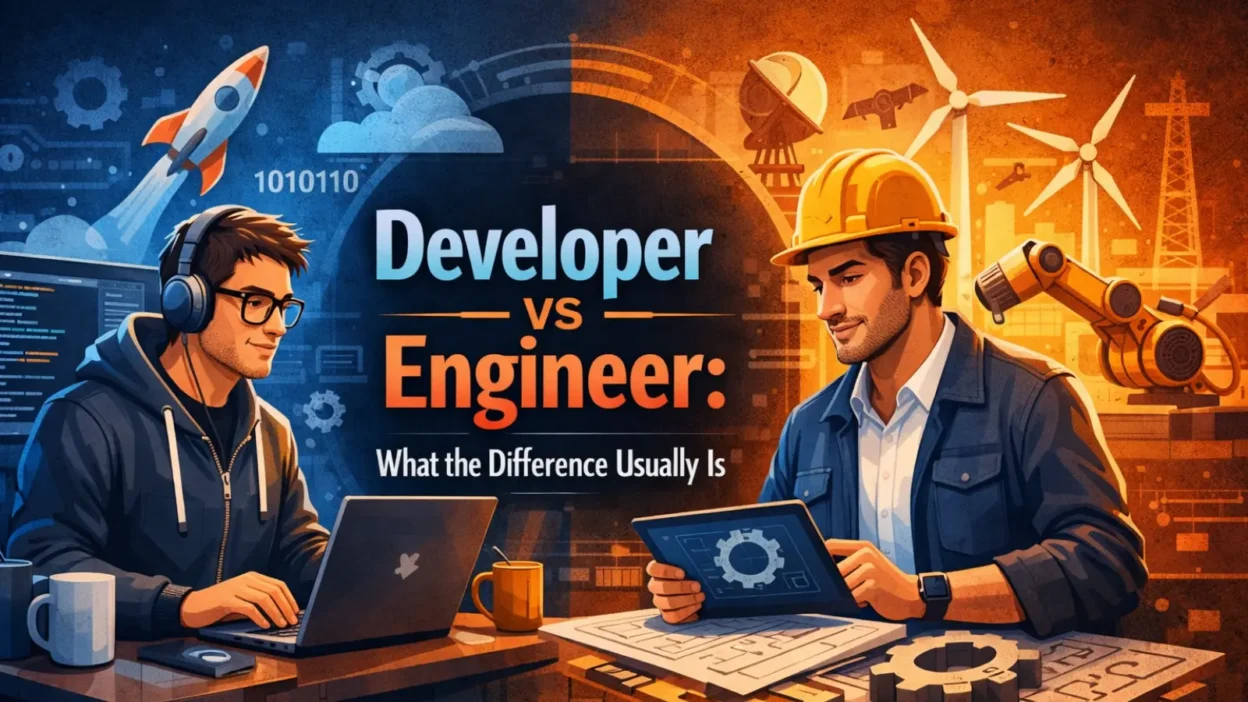
People often treat developer and engineer as if they mean exactly the same thing. In real usage, though, they are not always interchangeable.
The short version is this: developer usually points to someone who builds software or specific product features, while engineer often suggests a broader systems role, a more formal technical frame, or a title tied to design, reliability, and large-scale problem-solving. In many workplaces, especially in tech, the two titles overlap heavily. That overlap is exactly why the choice feels confusing.
So the better question is not “Which word is correct?” It is “Which word fits this context better?”
Quick Answer
Use developer when you want the plainer, more product-focused word for someone who creates software, websites, apps, or features.
Use engineer when you want a title that sounds more systems-oriented, more formal, or more connected to technical design at scale.
In many companies, one person may do work that could reasonably be described with either title. That means the best choice often depends on the employer’s title system, the audience, and the tone you want.
Why People Confuse Them
Writers confuse these words for a simple reason: in modern tech jobs, the actual work often overlaps.
A person called a developer may write code, design features, fix bugs, review pull requests, and help shape a product. A person called an engineer may do those same things. On top of that, companies do not use titles consistently. One company may hire “software developers,” while another hires “software engineers” for nearly identical work. Public career sources also note overlap between the roles, even while describing engineers as more systems-focused and developers as more feature-focused or implementation-focused.
There is also a tone issue. Engineer often sounds more formal and more technical. Developer sounds more direct and more conversational. Because both words can fit the same person, writers hesitate.
Key Differences At A Glance
| Context | Best Choice | Why |
| You are describing someone who builds app features | Developer | It sounds direct, practical, and product-centered |
| You are describing someone who designs systems or infrastructure | Engineer | It better suggests architecture, scale, and technical design |
| You are writing a casual team bio | Developer | It is widely understood and less formal |
| You are using an official job title from a company | Use the company’s exact title | Accuracy matters more than general preference |
| You are describing a broader technical discipline | Engineer | It signals an engineering approach rather than only building features |
| You are talking to a nontechnical audience | Developer | It is often easier for general readers to understand |
Feature comparison:
| Feature | Developer | Engineer |
| Main impression | Builds products or features | Designs and solves at system level |
| Tone | Plain, practical | Formal, technical |
| Common use | Teams, products, web, apps | Systems, platforms, infrastructure |
| Interchangeable at times? | Yes | Yes |
Meaning and Usage Difference
At the word level, developer is broader and more literal. A developer is someone who develops something. In software, that usually means creating or improving an application, tool, platform, or feature.
Engineer carries a different weight. It suggests applied technical method, design decisions, constraints, and problem-solving within a larger system. In software settings, that often means not just writing code but also thinking about maintainability, architecture, performance, testing, and reliability.
That does not mean developers only code small pieces or engineers always work at a higher level. Real jobs are messier than that. But as a word-choice question, the pattern is still useful:
developer points more naturally to building
engineer points more naturally to designing within a system
Tone, Context, and Formality
Tone matters more here than many people realize.
Developer is often the better choice when you want language that feels clear, modern, and everyday. It works well in blog posts, team intros, service pages, portfolio writing, and broad workplace conversation.
Engineer often sounds more formal, more credentialed, and more institutionally structured. It is common in enterprise settings, infrastructure teams, platform teams, and official job ladders. Dictionary definitions also show that engineer has a stronger profession-based meaning, while developer is the more general “one who develops,” including software.
That is why these two sentences give slightly different impressions:
“She is a backend developer.”
“She is a backend engineer.”
Both can be correct. The second usually sounds more formal and more systems-oriented.
Which One Should You Use?
Use developer when:
- you want the simplest label
- the person builds software, apps, websites, or features
- the audience is broad
- the company itself uses developer in the title
Use engineer when:
- the official title is engineer
- the role involves systems design, architecture, infrastructure, or reliability
- you want a more formal professional tone
- the setting treats software work as an engineering discipline
If you are choosing for a resume, LinkedIn headline, or company page, the safest move is usually to follow the employer’s actual title first. If you are writing more generally, choose the word that best matches the level of scope you want to suggest.
When One Choice Sounds Wrong
Sometimes one word is not wrong in a strict sense, but it still sounds off.
Engineer can sound inflated when the work you are describing is clearly narrower, more product-specific, or presented in very casual language. For example, calling someone an “engineer” in a short freelance bio may feel stiffer than needed if the rest of the bio is plainspoken.
Developer can sound too narrow when the role includes architecture, system design, platform ownership, or cross-team technical decisions. In those cases, it may understate the scope of the work.
The mismatch is usually about implication, not grammar.
Common Mistakes (and Quick Fixes)
One common mistake is assuming the two words always mean the same thing.
Quick fix: Treat them as overlapping titles, not perfect synonyms.
Another mistake is assuming engineer always means “higher than developer.”
Quick fix: It may sound broader or more formal, but title hierarchy depends on the employer, not the dictionary.
A third mistake is replacing a real job title with the word you personally prefer.
Quick fix: If a company says “Software Developer,” do not rewrite it as “Software Engineer” unless you are speaking generally rather than quoting the title.
Another weak choice is using developer for roles that are clearly about systems architecture or technical infrastructure leadership.
Quick fix: Use engineer when the systems dimension is central to the description.
Everyday Examples
Here are natural ways the distinction shows up in real writing:
“We’re hiring a front-end developer to build and improve customer-facing features.”
That sounds right because the focus is product work.
“She works as a platform engineer on internal systems.”
That sounds right because the focus is infrastructure and system design.
“Our mobile developers shipped the new update last week.”
This works because the sentence emphasizes building and delivery.
“The security engineer reviewed the design before launch.”
This works because the sentence highlights technical oversight and design judgment.
“He started as a web developer and later moved into a software engineer role.”
This sounds natural when the later role suggests broader technical scope.
Dictionary-Style Word Details
Verb
Developer: Not usually used as a verb form in this comparison. The related verb is develop, as in “develop a feature” or “develop an application.”
Engineer: Can also be a verb. It can mean to design, plan, or arrange something with technical or strategic intent. In general writing, that extra verb sense gives engineer a more deliberate and method-based feel.
Noun
Developer: A noun for a person who develops something. In software contexts, it commonly means someone who creates or improves software products, applications, or features.
Engineer: A noun for a person working in an engineering profession or applying engineering methods. In software contexts, it often implies a broader technical framework, though real job-title use varies.
Synonyms
Developer: builder, creator, programmer, app maker, web creator
Engineer: designer, architect, technical builder, systems specialist, problem-solver
These are not perfect replacements. They only show the general direction each word tends to lean.
Example Sentences
Developer:
“The startup hired a React developer for its customer dashboard.”
“She is a game developer with strong UI skills.”
“Our lead developer owns the checkout flow.”
Engineer:
“He is a software engineer working on distributed systems.”
“The team added a reliability engineer before the rollout.”
“She joined as a machine learning engineer after graduate school.”
Word History
Developer: The word comes from the idea of unfolding, building out, or bringing something into fuller form. That background matches its modern sense of creating or improving software.
Engineer: The word has a longer technical and profession-based history tied to engineering work, design, and applied problem-solving. That history helps explain why it often sounds more formal and more structural than developer. Merriam-Webster’s current definitions still reflect that difference in emphasis.
Phrases Containing
Developer: software developer, web developer, app developer, game developer, front-end developer, back-end developer
Engineer: software engineer, systems engineer, platform engineer, infrastructure engineer, security engineer, reliability engineer
These phrases show how developer often clusters around products and interfaces, while engineer often clusters around systems and technical domains.
Conclusion
Developer vs engineer is not a simple right-or-wrong choice. In many workplaces, the titles overlap. But they still create different impressions.
Choose developer when you want the clearer, more product-focused, more everyday term. Choose engineer when you want the more formal, systems-oriented, or discipline-based term. And if you are referring to a real job title, use the exact title the employer uses.