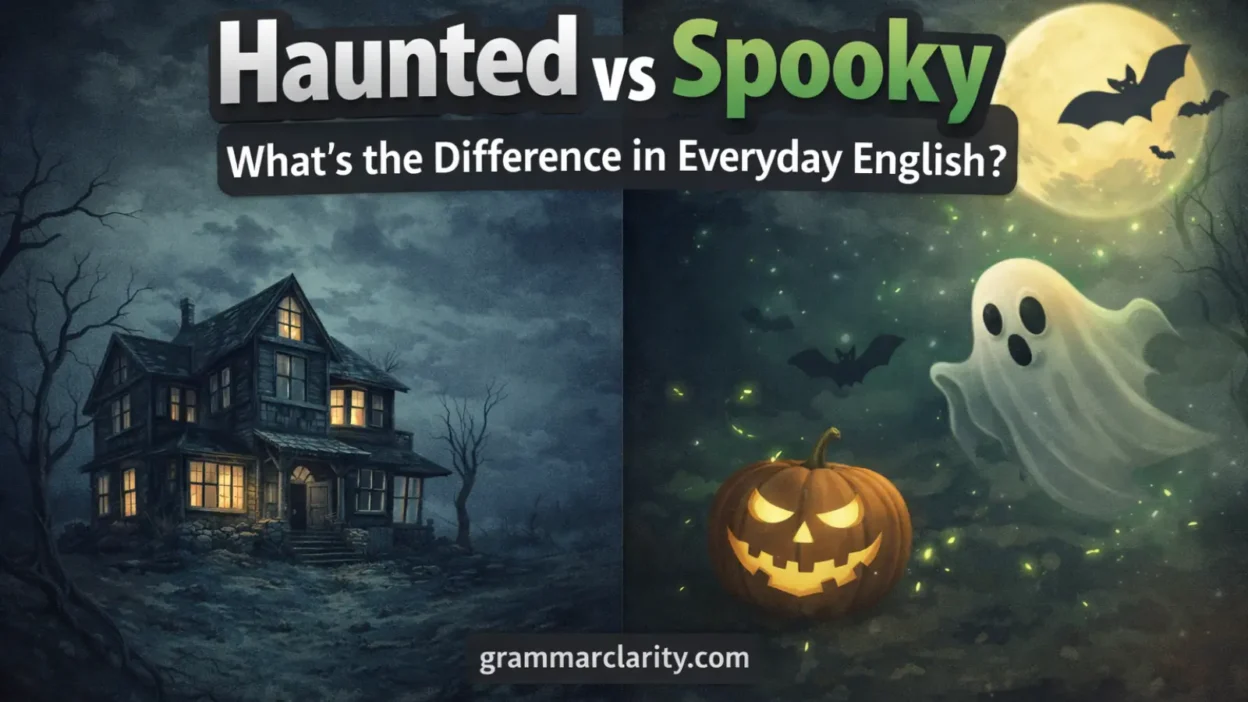
Haunted and spooky can overlap, but they are not the same word. In everyday American English, haunted usually suggests a place is associated with ghosts or that a person is deeply troubled by a memory or feeling. Spooky is broader. It usually means eerie, unsettling, or ghostlike without making a strong claim that actual ghosts are present. That difference matters because one word sounds specific and the other sounds atmospheric.
Quick Answer
Use haunted when you mean a place is believed to have ghosts or when something emotionally lingers in a disturbing way. Use spooky when you mean eerie, creepy, ghostly, or Halloween-like. If you are describing a mood, look, or vibe, spooky is usually the safer choice. If you are describing a supposed paranormal location or a person troubled by something, haunted is usually better.
Why People Confuse Them
People confuse these words because both live in the same general world of fear, mystery, and the supernatural.
A dark hallway can feel spooky.
A house in a ghost story can be haunted.
A haunted place often feels spooky, so the meanings meet in real use. But they still point in different directions. Haunted is more specific. Spooky is more general.
Key Differences At A Glance
- Haunted often implies ghosts, repeated supernatural presence, or emotional torment.
- Spooky usually describes an eerie feeling, appearance, or atmosphere.
- Haunted sounds stronger and more specific.
- Spooky can sound lighter, more casual, or even playful.
- A house can be haunted and spooky at the same time, but a candlelit porch in October is usually just spooky, not haunted.
Meaning and Usage Difference
The core idea behind haunted is presence or lingering effect.
You can use it for places:
“The hotel is rumored to be haunted.”
You can also use it for people, faces, voices, and memories:
“She had a haunted expression.”
“He was haunted by the accident.”
The core idea behind spooky is atmosphere.
You use it for settings, sounds, stories, timing, decorations, and coincidences:
“The woods looked spooky at dusk.”
“That was a spooky coincidence.”
“We went for a spooky Halloween theme.”
So the cleanest distinction is this: haunted points to ghostly occupation or emotional lingering, while spooky points to eerie effect.
Tone, Context, and Formality
Neither word is especially formal, but they do not sound the same.
Haunted often sounds more serious. It can suggest a real claim, even if the speaker is not fully committed to believing it. It also works well in emotional writing because it can describe lasting mental distress.
Spooky often sounds more conversational. It fits casual speech, seasonal writing, and lighter description. It can be playful:
“Spooky movie night.”
“Spooky decorations.”
“Spooky season.”
That is why spooky is common in friendly, everyday phrasing, while haunted can sound heavier and more dramatic.
Which One Should You Use?
| Context | Best Choice | Why |
| A house believed to have ghosts | haunted | It suggests actual ghostly presence or a reputation for it. |
| Halloween decorations on a front porch | spooky | It describes eerie style or mood, not literal haunting. |
| A disturbing memory that will not leave someone alone | haunted | It naturally describes emotional lingering. |
| A foggy street that feels eerie at night | spooky | It focuses on atmosphere and impression. |
| A person’s worried, troubled expression | haunted | This is a standard figurative use. |
| A ghost story aimed at fun seasonal chills | spooky | It sounds lighter and more casual. |
When One Choice Sounds Wrong
Use haunted carefully when you do not want to imply literal ghosts.
“The office felt haunted after everyone left” can work as a dramatic metaphor, but it may sound too strong if you only mean quiet or unsettling. In that case, spooky is probably better.
Use spooky carefully when you mean emotional burden.
“She felt spooky after the breakup” sounds unnatural. If someone is troubled, tormented, or unable to escape a memory, haunted is the better word.
Common Mistakes (and Quick Fixes)
One common mistake is using haunted for any eerie setting.
Weak: “The pumpkin patch looked haunted.”
Better: “The pumpkin patch looked spooky.”
Another mistake is using spooky for psychological distress.
Weak: “He seemed spooky after the trial.”
Better: “He seemed haunted after the trial.”
A third mistake is flattening the tone.
If you want playful October energy, spooky usually fits better than haunted.
If you want a darker, more serious feeling, haunted is often the stronger choice.
Everyday Examples
“The old inn is said to be haunted.”
“We picked a spooky playlist for the party.”
“She gave me a haunted look when the song started.”
“That empty playground feels spooky after dark.”
“He was haunted by what he saw.”
“The store went with a spooky black-and-orange window display.”
Dictionary-Style Word Details
Verb
Haunted: This is the past tense and past participle of haunt. As a verb, haunt can mean to visit as a ghost, to trouble repeatedly, or to linger in the mind.
Spooky: Spooky is not normally used as a verb.
Noun
Haunted: Not usually a noun. The related noun is haunting in some contexts, and haunt itself can be a noun meaning a place someone visits often.
Spooky: Not usually a noun. The related noun is spookiness.
Synonyms
Haunted: ghost-ridden, ghostly, tormented, troubled, possessed, lingering
Spooky: eerie, creepy, uncanny, ghostly, unsettling, atmospheric
These lists are not interchangeable. Tormented leans closer to haunted than spooky, while eerie leans closer to spooky than haunted.
Example Sentences
Haunted
- The mansion is rumored to be haunted.
- She looked haunted when his name came up.
Spooky
- The soundtrack gave the whole trailer a spooky feel.
- We want the party to look spooky, not gruesome.
Word History
Haunted comes from haunt, a word that has older senses connected with frequenting or repeatedly returning to a place. Over time, it also developed the familiar ghost-related and troubling senses.
Spooky is a newer adjective built from spook, a ghost-related word. In current everyday use, spooky mainly means eerie or unsettling in a supernatural way. One note of caution: spook has also been used in American English as an offensive slur, so it is best not to use spook as a label for a person.
Phrases Containing
Haunted
- haunted house
- haunted by the past
- come back to haunt
Spooky
- spooky season
- spooky vibe
- spooky story
- spooky coincidence
Conclusion
Choose haunted when you want to suggest ghostly presence or a deep, lingering emotional effect. Choose spooky when you want to describe an eerie feeling, a ghostly look, or a Halloween-style mood. The easiest way to remember the difference is this: haunted is more specific and heavier, while spooky is broader and more atmospheric. If you are talking about a vibe, start with spooky. If you are talking about ghosts or lasting emotional disturbance, haunted is usually the better fit.