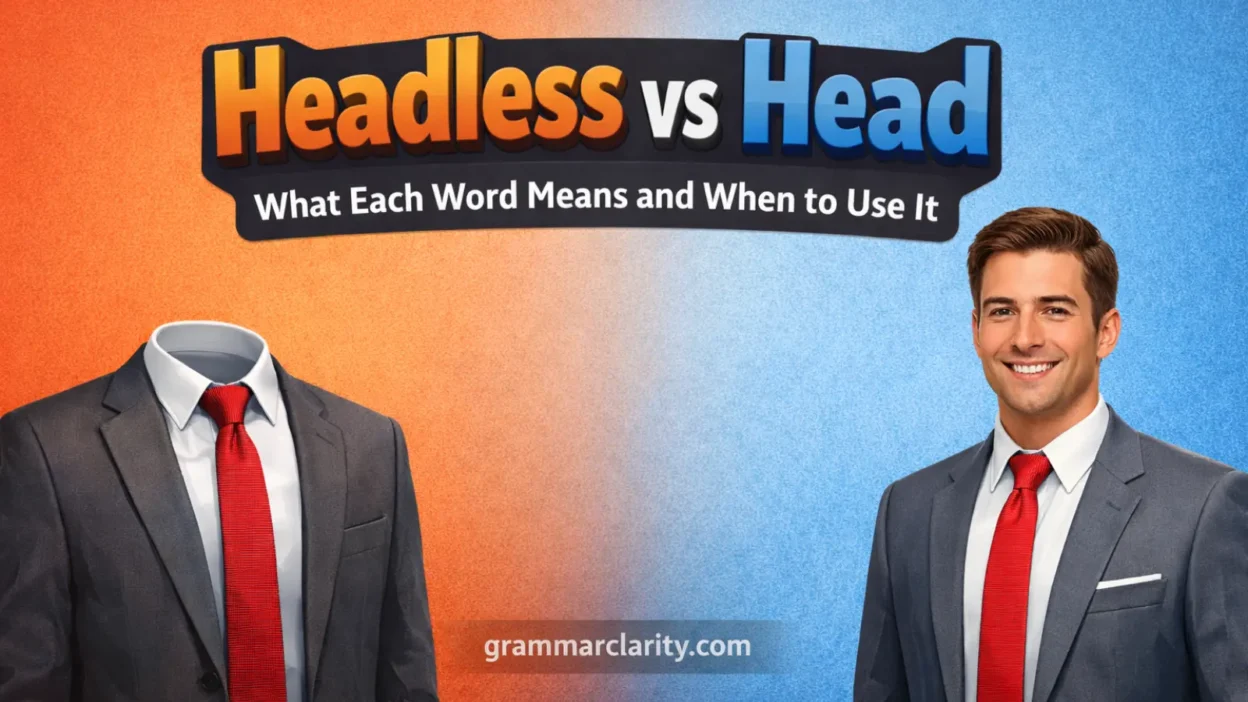
Headless vs head is not a normal one-word choice between two interchangeable options. In most cases, these words do different jobs in a sentence.
Headless is usually an adjective. It describes something as having no head, no leader, or no clear control.
Head is far broader. It can be a noun, a verb, and sometimes an adjective. It usually refers to a body part, a leader, the top or front of something, or the act of moving toward a place.
So the real question is not “Which one is correct?” It is “Which one fits the meaning I want?”
Quick Answer
Use headless when you mean without a head or, by extension, without a leader or without clear direction.
Use head when you mean the body part, the top or front of something, a person in charge, or the action of going toward a place.
They are not interchangeable. If you replace one with the other, the sentence usually becomes wrong or strange.
Why People Confuse Them
People confuse these words because they look closely related. One is built directly from the other.
But that visual similarity hides a major difference: headless is a descriptive form, while head has several meanings and several grammatical roles.
That matters because English often creates adjectives by adding -less to a noun. Once that happens, the new word no longer works like the original word. A careless person is not the same thing as care. A hopeless situation is not the same thing as hope. The same pattern applies here.
Another reason for confusion is figurative use. A phrase like a headless organization does not mean a literal missing head. It means the group has no leader or no clear direction. Readers who focus only on the physical meaning can miss that shift.
Key Differences At A Glance
| Context | Best Choice | Why |
| A statue with no head | headless | You need an adjective meaning “without a head.” |
| I bumped my ___ on the shelf | head | You need the noun for the body part. |
| The company is effectively ___ after the CEO resigned | headless | It means leaderless or lacking direction. |
| She will ___ the marketing team next year | head | Here it is a verb meaning lead. |
| The trail ___s north after the bridge | head | The verb means move or point toward. |
| The ___ of the table | head | The noun means the top, front, or chief position. |
Compact comparison:
- headless = descriptive word meaning without a head, leaderless, or uncontrolled
- head = core base word with many meanings: body part, leader, top/front, or move toward
- headless usually modifies a noun
- head can stand alone as a noun or act as a verb
Meaning and Usage Difference
Headless most often means physically without a head.
- a headless skeleton
- a headless costume prop
It can also mean leaderless or badly directed.
- a headless department after a sudden resignation
- a headless response to a fast-moving crisis
In contrast, head has several common meanings.
As a noun, it can mean:
- the body part above the neck
- the top or front of something
- a person in charge
As a verb, it can mean:
- to lead
- to go toward
- to be at the front of something
Because head is so flexible, it appears in many more sentence patterns than headless does.
Tone, Context, and Formality
Headless often sounds vivid, dramatic, or strongly descriptive. In literal use, it can sound graphic. In figurative use, it can sound critical.
Calling a team headless usually suggests disorder, confusion, or missing leadership. It is stronger than simply saying the team is between leaders.
Head is much more neutral. It works in casual speech, formal writing, journalism, business writing, and everyday conversation.
Compare the tone:
- The committee is headless right now.
This sounds blunt and somewhat critical. - The committee has no permanent head right now.
This sounds more formal and less charged.
That is why the better choice often depends not just on meaning, but also on how strong you want the wording to sound.
Which One Should You Use?
Use headless when your sentence needs an adjective and your meaning is one of these:
- without a head
- without a leader
- lacking organized control
Use head when your sentence needs:
- a noun
- a verb
- a broader, more neutral meaning
A simple test helps:
If you can replace the word with leaderless, decapitated, or without a head, then headless may fit.
If you can replace the word with skull, chief, front, top, lead, or go toward, then head is probably the right choice.
When One Choice Sounds Wrong
Some sentences become obviously wrong when the wrong form is used.
Wrong: I hit my headless on the cabinet.
Right: I hit my head on the cabinet.
Wrong: The village was head after the mayor resigned.
Right: The village was headless after the mayor resigned.
Wrong: She is the headless of the department.
Right: She is the head of the department.
Wrong: They will headless the new task force.
Right: They will head the new task force.
These examples show the real issue: this is not just a meaning difference. It is also a grammar difference.
Common Mistakes (and Quick Fixes)
One common mistake is using headless where a noun is required.
- Wrong: He wore a helmet on his headless.
- Fix: He wore a helmet on his head.
Another is using head where an adjective is required.
- Wrong: The snake looked head after the injury.
- Fix: The snake looked headless after the injury.
Writers also sometimes overuse headless in business or workplace writing because it sounds vivid. That can make the tone feel exaggerated.
- Too strong: The office has been headless for three days.
- Better in many contexts: The office has been without a manager for three days.
Use the sharper word only when you actually want that sharper tone.
Everyday Examples
- The museum displayed a headless marble statue from antiquity.
- After the director left, the group felt headless for a few weeks.
- I turned my head when I heard someone call my name.
- She sat at the head of the table during the meeting.
- Marcus will head the new research project.
- We headed home before the rain started.
- The campaign looked headless after its top staff resigned.
- He rested his head against the window on the drive back.
Dictionary-Style Word Details
Verb
Head: to lead, direct, or move toward something.
Examples: head a team, head north, head the list
Headless: not used as a standard verb.
Noun
Head: the body part above the neck; the top, front, or chief part of something; a leader.
Examples: my head, the head of the line, department head
Headless: not used as a standard noun.
Synonyms
Headless: leaderless, rudderless, uncontrolled, beheaded, decapitated
Use depends on context. Some are literal, and some are figurative.
Head: top, front, chief, leader, director
As a verb, possible near-equivalents include lead and move toward.
Example Sentences
Headless
- The old stone figure was headless but still recognizable.
- The organization seemed headless after the sudden resignation.
Head
- She raised her head and looked across the room.
- They will head to Chicago after lunch.
- He is the head of student services.
Word History
Head is an old English word that goes back to Old English hēafod.
Headless is also very old in English and was formed from head plus -less, the ending that means “without.”
That history helps explain why the two words are related in form but still behave differently in modern sentences.
Phrases Containing
Head
- head of the class
- head of the table
- off the top of my head
- keep your head
- head out
- head home
Headless
- a headless statue
- a headless body
- a headless organization
- running around like a headless chicken
Conclusion
In headless vs head, the best choice depends on whether you need a narrow descriptive adjective or a broad everyday word.
Choose headless for the idea of something being without a head, without a leader, or lacking control.
Choose head for the body part, the top or front position, a person in charge, or the action of leading or moving toward something.