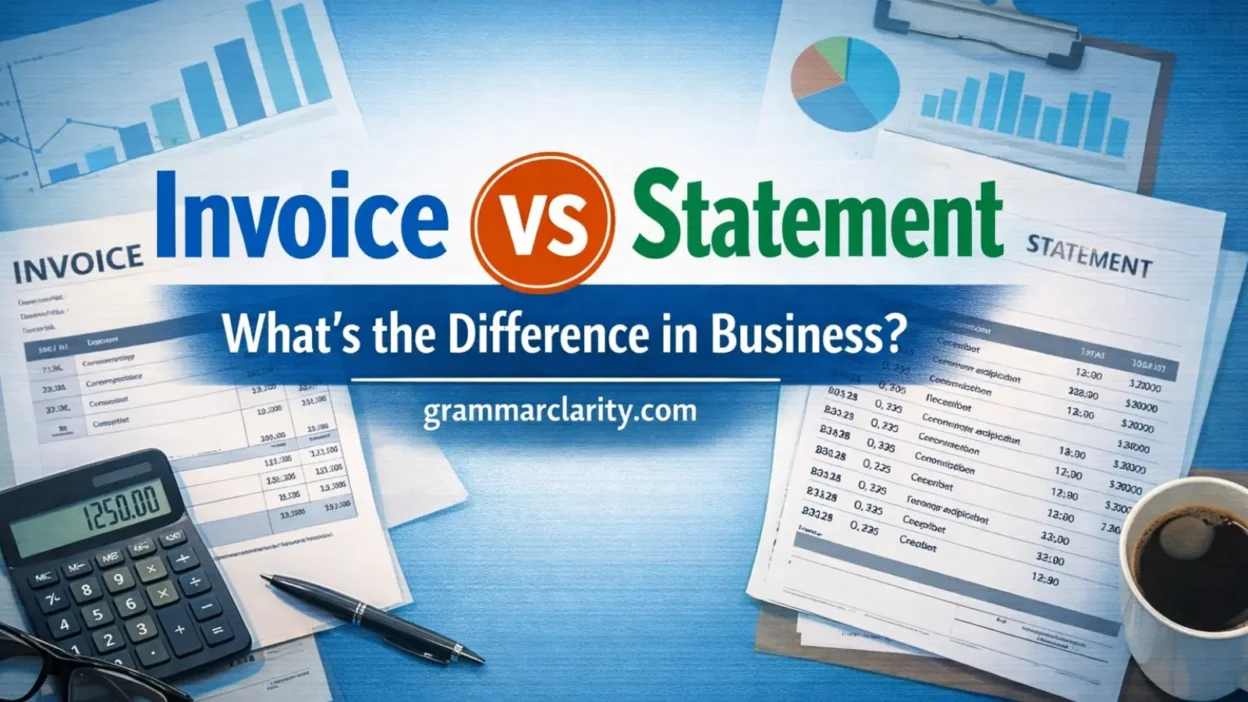
People often treat invoice and statement as if they mean the same thing, but they do not. In business English, an invoice is usually a request for payment tied to a specific sale or service, while a statement is usually a summary of account activity over a period of time. That distinction matters because using the wrong word can confuse payment expectations, records, and client communication.
Quick Answer
Use invoice when you mean a document asking for payment for a particular job, order, or transaction. Use statement when you mean a summary showing charges, payments, credits, and any remaining balance across a set period, such as a month. In plain terms, people usually pay from an invoice and review a statement.
Why People Confuse Them
The confusion is easy to understand. Both documents deal with money owed, both may show balances, and both may be sent by a business to a customer. On top of that, some companies send monthly statements that include unpaid invoices, which makes the two documents look closely related. They are related, but they still serve different jobs.
Key Differences At A Glance
| Context | Best Choice | Why |
| You completed one design project and want payment | Invoice | It requests payment for that specific piece of work |
| You want to show everything a customer owes this month | Statement | It summarizes account activity over a date range |
| You need to include payment terms for one sale | Invoice | Invoices normally show due dates and transaction details |
| You want to remind a customer about several unpaid items | Statement | Statements often gather multiple open items in one summary |
| You are referring to a single billed transaction | Invoice | The focus is one transaction, not the whole account |
| You are referring to an account summary | Statement | The focus is the broader account picture |
Meaning and Usage Difference
An invoice is tied to a particular transaction. It usually itemizes what was sold or what service was provided, shows the amount due, and often includes payment terms and a due date. A statement, by contrast, gives an overview of activity in an account over time. It may list invoices, payments, credits, adjustments, and the remaining balance.
That is why these two words do different work in a sentence. If you are referring to the original payment request for one job, invoice is the better word. If you are referring to a periodic account summary, statement is the better word.
| Feature | Invoice | Statement |
| Main purpose | Requests payment | Summarizes account activity |
| Time focus | One transaction or job | A date range or billing period |
| Typical contents | Items sold, price, due date, terms | Charges, payments, credits, balances |
| Usual timing | After goods or services are provided | At regular intervals, often monthly |
| Reader action | Pay this amount | Review account status |
Tone, Context, and Formality
Invoice sounds more direct and transactional. It tells the reader that payment is being requested for a defined piece of work or sale. In business writing, it often appears in phrases such as “Please see attached invoice” or “The invoice is due on April 15.”
Statement sounds broader and more informational. It often appears in phrases such as “monthly statement,” “account statement,” or “billing statement.” It is common when a business wants to show overall account activity rather than bill one new item.
In formal business English, both words are standard. The main issue is not formality. It is precision.
Which One Should You Use?
Use invoice when the message is about a specific charge that should be paid.
Use statement when the message is about an account summary, especially over a month or another billing cycle.
Here is a simple test:
If the document answers “What do you owe for this job or order?”, use invoice.
If the document answers “What happened on this account during this period?”, use statement.
For most everyday business writing, that test will keep you on the right term.
When One Choice Sounds Wrong
Sometimes one word is not just less precise. It sounds plainly wrong.
If a freelancer says, “I’ll send you a statement for the logo project,” many readers will expect an account summary, not the actual payment request for that one job. Invoice sounds natural there.
If a credit card company says, “Your April invoice is ready,” that sounds off in standard usage. Customers expect a statement, because the document summarizes transactions, fees, payments, and balances for a billing period.
The wrong choice usually becomes obvious when the reader expects either a single payment request or a period summary and gets the opposite term instead.
Common Mistakes (and Quick Fixes)
A common mistake is using statement as a catch-all word for any money document.
Quick fix: use invoice when one transaction is being billed.
Another common mistake is calling a monthly account summary an invoice.
Quick fix: use statement when the document covers a period of account activity.
Some writers also assume a statement always demands payment in the same way an invoice does. In practice, a statement may show what is owed, but its main role is usually to summarize activity and balances, not to stand in for the original transaction-level billing document.
Everyday Examples
“The consultant emailed the invoice right after the training session.”
“Our accounting team sends a monthly statement to customers with open balances.”
“I paid the invoice for the website update yesterday.”
“The statement shows two unpaid invoices and one credit from February.”
“Please review the attached statement for activity from March 1 to March 31.”
“Once the work is approved, we will issue an invoice.”
These examples show the core pattern: invoice points to a specific billed item, while statement points to a broader financial summary.
Dictionary-Style Word Details
Verb
Invoice: As a verb, invoice means to bill someone or issue an invoice for goods or services. Example: “The firm will invoice the client at the end of the week.” Dictionaries and business references recognize this verb use.
Statement: Statement is not commonly used as a standard business verb in everyday US English. People normally say “issue a statement,” “send a statement,” or “prepare a statement” instead.
Noun
Invoice: A noun meaning a document that itemizes a sale or service and requests payment.
Statement: A noun meaning a summary of account activity over a set period, often including transactions, payments, and balances.
Synonyms
Invoice: bill, request for payment, sales invoice, charge document
Statement: account summary, billing statement, account statement, monthly summary
These are not perfect substitutes in every context, but they point in the right direction. In particular, bill can overlap with invoice in some contexts, while billing statement is a close match for a periodic statement.
Example Sentences
Invoice: “Please pay the attached invoice within 15 days.”
Invoice: “The repair shop sent an invoice with labor and parts listed separately.”
Statement: “Your monthly statement includes all charges and payments for June.”
Statement: “The customer asked for a statement before processing the outstanding balance.”
These examples reflect the standard business distinction supported by current accounting and payments guides.
Word History
Invoice: The word has long been used in commerce for a list or record of goods sent or services charged, and modern business use keeps that transaction-based meaning.
Statement: The broader word statement has many meanings in English, but in financial use it developed the sense of a formal summary or report of account activity.
For this topic, the key point is not the deep historical path of each word. It is that modern US business usage keeps them separate by function: one is transaction-level billing, the other is period-level summary.
Phrases Containing
Invoice: sales invoice, outstanding invoice, invoice number, invoice date, invoice due date
Statement: account statement, billing statement, monthly statement, statement period, statement balance
These phrases reinforce the same difference. Invoice clusters around one billed event. Statement clusters around account overview and reporting period.
Conclusion
Choose invoice for a specific payment request. Choose statement for a summary of account activity over time. That is the cleanest and most reliable distinction.
When in doubt, ask what the document is doing. If it is billing one transaction, call it an invoice. If it is summarizing an account, call it a statement. In business writing, that small choice makes your meaning clearer and more professional.