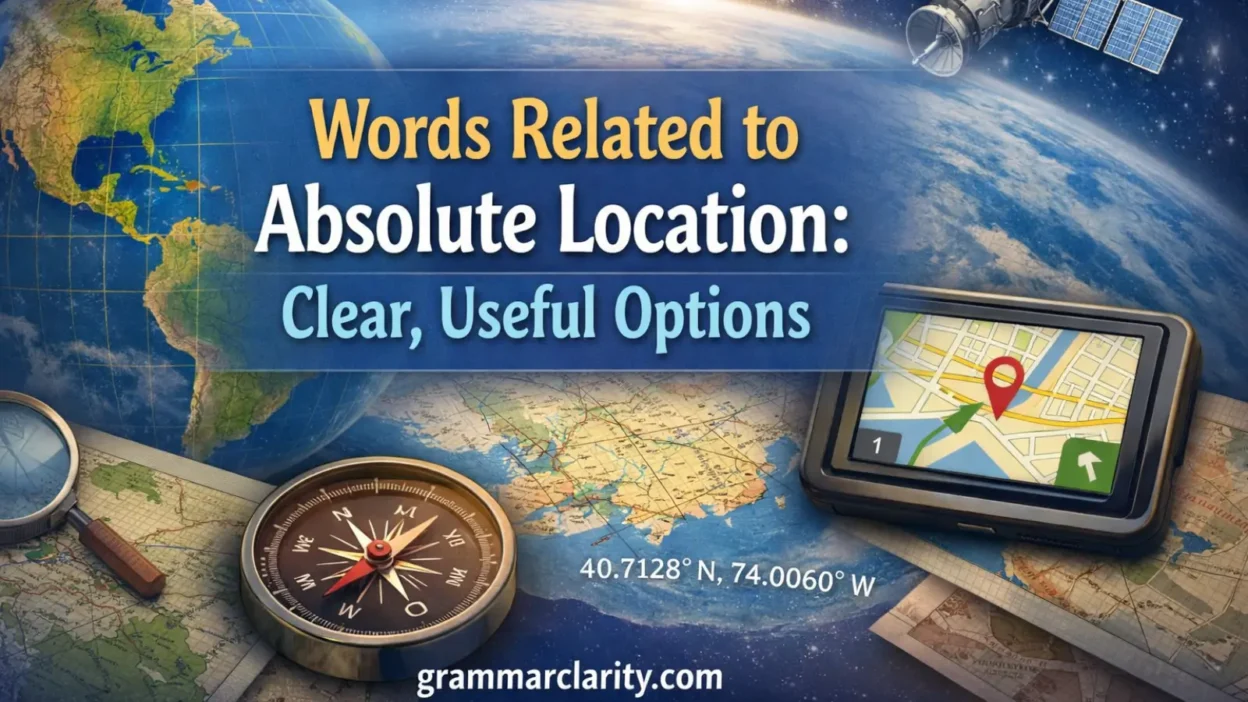
If you need words related to absolute location, the strongest choices are words that point to an exact, fixed place rather than a vague area. In geography, absolute location means the exact position of a place on Earth, often expressed with latitude and longitude or another coordinate system. That is why terms like coordinates, latitude, longitude, exact position, and grid reference fit better than broad words like area or region.
Quick Answer
The best related words for absolute location are coordinates, latitude, longitude, exact position, geographic position, fixed point, grid reference, address, pinpoint location, and geospatial reference. Use coordinates, latitude, and longitude for geography and mapping. Use address for everyday land-based locations. Use geographic position or geospatial reference when the writing is more formal or technical.
What The Topic Means
Absolute location is about precision. It tells you exactly where something is, not just where it is compared with something else. A place can be described by coordinates on a globe or map, while relative location describes it in relation to nearby places, such as “west of downtown” or “next to the river.” That distinction matters when choosing related words: the best vocabulary should suggest measurable position, not just general place.
This also explains why absolute location does not have many perfect one-word synonyms. It is a specific geography term. Most useful alternatives are either close equivalents, such as exact position, or supporting terms, such as latitude and longitude, that help express the idea.
Core Related Words
| Word | How It Relates | Best Use |
| coordinates | Numbers or markers that identify an exact point | Maps, GPS, geography class |
| latitude | Shows north-south position | Globe and map explanations |
| longitude | Shows east-west position | Globe and map explanations |
| exact position | Plain-English equivalent of fixed placement | General writing |
| geographic position | Formal phrase for exact place on Earth | Academic or formal writing |
| fixed point | Emphasizes that the place is specific and not approximate | Explanatory writing |
| grid reference | Map-based way to locate a point | Printed maps, classroom work |
| address | Exact civic location for a building or property | Everyday language |
| pinpoint location | Informal way to stress accuracy | General audiences |
| geospatial reference | Technical way to describe location data | Mapping and data contexts |
Related Words By Meaning Group
One useful way to choose vocabulary is to group the words by how they function.
Coordinate terms include coordinates, latitude, longitude, and spatial coordinates. These are the strongest choices when you are talking about maps, globes, navigation, or Earth science. Latitude and longitude are part of a coordinate system used to describe the position of any place on Earth.
Plain-English equivalents include exact position, exact location, fixed point, and pinpoint location. These work well when you want normal, readable wording without sounding technical.
Map and reference terms include grid reference, map coordinates, and geographic point. These are useful when the discussion involves printed maps, worksheets, or directions tied to a map system.
Technical and formal terms include geographic position, geospatial reference, and spatial reference. These fit better in research, surveying, mapping systems, or data-heavy writing.
Close Synonyms Vs Broader Related Words
A few terms are close to the meaning of absolute location, but many others are only loosely related.
Close choices include exact position, exact location, geographic position, and sometimes coordinates. These all keep the idea of precision.
Broader related words include location, place, site, locale, and position. These connect to the topic, but they do not automatically mean an exact, measurable point. A site can be a specific spot, and location can mean a position or site, but neither one alone guarantees the level of precision that absolute location implies.
Address is a special case. It can function like absolute location in everyday life because it identifies a specific property or building. But it does not replace coordinates in every context. An address works for a house, school, or store. It does not work as well for a desert landmark, a point in the ocean, or a place with no street system.
Words By Context
Use coordinates, latitude, and longitude when writing for school geography, maps, globes, or navigation.
Use address, exact location, and site when writing for everyday readers who care about a home, office, event venue, or property.
Use grid reference when the context is a paper map, workbook, atlas, or emergency map-reading situation.
Use geographic position, geospatial reference, or spatial coordinates when the audience expects more technical language.
Use pinpoint location when you want a natural phrase that sounds clear without becoming too formal.
Example Sentences
The report listed the mountain’s absolute location using latitude and longitude.
Please enter the coordinates before you save the map point.
For everyday directions, the address is enough, but for fieldwork we need the exact position.
The worksheet asks for the town’s absolute location, not its relative location.
The app stores each trail marker as a geospatial reference.
That site is easy to describe generally, but its pinpoint location still needs map data.
Common Mistakes When Choosing Related Words
One common mistake is treating related words as if they all mean exactly the same thing. They do not. Coordinates and latitude are tightly connected to precision. Area and region are not.
Another mistake is picking a word that is too broad. Place, spot, and location may sound close, but they often feel too loose unless the sentence already makes the precision clear.
Writers also mix up absolute location and relative location. Words like near, beside, north of, across from, and next to belong to relative location, not absolute location.
A final mistake is overusing technical wording in simple sentences. In most everyday writing, exact location or address sounds more natural than geospatial reference.
Quick Reference List
Strongest all-purpose related words
- coordinates
- latitude
- longitude
- exact position
- exact location
Good context-specific choices
- geographic position
- grid reference
- address
- pinpoint location
- fixed point
More technical choices
- geospatial reference
- spatial coordinates
- spatial reference
Best Picks for Everyday Use
For most readers, the best picks are coordinates, latitude, longitude, exact location, and address.
If you want the clearest plain-English replacement, use exact location or exact position.
If you are writing for geography class, use coordinates, latitude, and longitude first.
If you are writing for a map, atlas, or worksheet, grid reference is a strong supporting term.
If you are writing for technical mapping or data work, geographic position and geospatial reference are stronger than casual alternatives.
Conclusion
The best words related to absolute location are the ones that preserve the idea of a precise, fixed place. Coordinates, latitude, longitude, exact position, and geographic position are the strongest overall choices. Address works well in everyday land-based contexts, while grid reference and geospatial reference fit more specialized uses. The key is simple: if the term sounds exact and measurable, it probably fits. If it sounds broad or approximate, it is probably too far from the real meaning.