
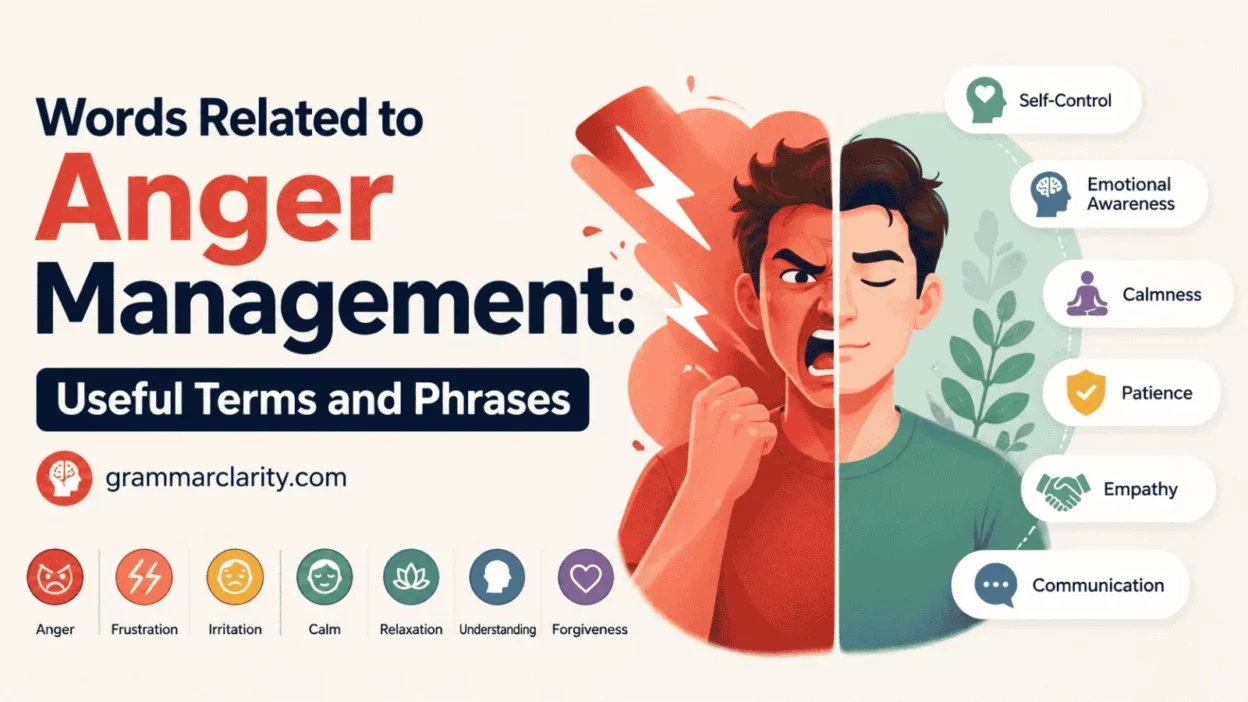
If you are looking for words related to anger management, the best choices are not just words that mean anger. They are words connected to emotional control, self-regulation, communication, triggers, coping, and conflict.
That distinction matters.
A useful related-words list should help you describe the emotion, the response to it, and the skills used to handle it well. That is why words like frustration, irritation, self-control, de-escalation, and coping are often more helpful than a long list of dramatic anger synonyms.
Quick Answer
Words related to anger management include terms for the emotion itself, the process of controlling it, and the skills used to respond well. Strong choices include anger, temper, frustration, rage, irritation, self-control, restraint, coping, trigger, de-escalation, regulation, calmness, patience, assertiveness, and conflict resolution.
If you need the most practical everyday options, start with anger, frustration, temper, self-control, trigger, calmness, and de-escalation.
What The Topic Means
Anger management usually refers to the ability, process, or support system used to recognize anger, understand what causes it, and respond in a healthier way.
So related words fall into a few clear groups:
- words for anger itself
- words for levels or forms of anger
- words for control and regulation
- words for communication and resolution
- words for situations that spark anger
That is why rage is related, but so are patience and self-awareness. They all connect to the same topic from different angles.
Core Related Words
Here are the strongest core words related to anger management:
| Word | How It Relates | Best Use |
| anger | The central emotion | General discussion |
| temper | Everyday word for anger response | Casual, natural writing |
| frustration | A common lead-in to anger | Daily situations |
| irritation | Mild anger or annoyance | Lower-intensity contexts |
| rage | Extreme anger | Strong emotional writing |
| self-control | Ability to manage reactions | Advice and skill-based writing |
| restraint | Holding back harmful response | Formal or reflective writing |
| trigger | Something that sets anger off | Practical explanation |
| coping | Methods for handling emotion | Supportive or educational writing |
| regulation | Managing emotional response | Formal or clinical tone |
| de-escalation | Reducing emotional intensity | Conflict situations |
| patience | Opposite skill that supports control | Everyday and personal growth writing |
| assertiveness | Calm, direct expression without aggression | Communication advice |
| conflict resolution | Working through disputes productively | Workplace, family, or counseling contexts |
Related Words By Meaning Group
Not all related words do the same job. It helps to sort them by meaning.
Words for the emotion
anger, temper, rage, fury, irritation, annoyance, resentment, hostility
These work when you want to name the feeling or describe its intensity.
Words for emotional control
self-control, restraint, regulation, discipline, composure, calmness, patience
These fit when the focus is on managing reactions rather than naming the emotion.
Words for causes and patterns
trigger, stress, pressure, provocation, buildup, impulse, escalation
These help explain why anger happens or how it grows.
Words for healthy response
coping, de-escalation, reflection, communication, assertiveness, problem-solving, conflict resolution
These are especially useful when the topic is practical improvement.
Close Synonyms Vs Broader Related Words
This is where many lists go wrong.
A close synonym tries to stay near the meaning of the original term. For anger management, close synonym-like choices include anger control, anger regulation, emotional control, and self-regulation.
A broader related word connects to the topic without meaning exactly the same thing. Examples include trigger, patience, communication, stress, and assertiveness.
That difference matters because readers often search for “related words” when they do not want exact replacements. They want vocabulary that belongs to the same topic area.
So if you are building a word bank, a class worksheet, or a paragraph, broader related words are often more useful than strict substitutes.
Words By Context
The best word depends on where you are using it.
For everyday conversation
Use simple, familiar words like anger, temper, frustration, calm down, trigger, and self-control.
For school or educational writing
Use clearer topic words like emotional regulation, coping skills, conflict resolution, self-awareness, and de-escalation.
For workplace settings
Use terms such as professionalism, composure, impulse control, communication, and tension management.
For counseling or personal growth topics
Use words like triggers, processing, regulation, reflection, coping strategies, and healthy expression.
For stronger emotional description
Use rage, hostility, resentment, or outburst carefully, because these words sound more intense and specific.
Example Sentences
Here are natural ways to use related words connected to anger management:
She started noticing the triggers that made her lose patience in traffic.
Learning self-control helped him respond without shouting.
The workshop focused on de-escalation and better communication during conflict.
Her frustration built up after a long week, but she handled it calmly.
He confused assertiveness with aggression, which made conversations harder.
The goal is not to erase anger but to improve regulation.
Taking a pause gave him the composure to speak more clearly.
Their team training covered stress, conflict, and coping skills.
Common Mistakes When Choosing Related Words
One common mistake is listing only extreme emotion words like rage, wrath, and fury. Those are related, but they create a narrow and dramatic picture of the topic.
Another mistake is treating anger management as if it only means “not being angry.” In real use, the topic usually includes recognizing feelings, handling triggers, communicating clearly, and avoiding escalation.
A third mistake is using words that sound related but are too vague. For example, emotion is connected to the subject, but by itself it is too broad to be especially helpful. A more precise choice like frustration, impulse, or regulation usually works better.
A final mistake is confusing aggression with assertiveness. They are not the same. One suggests hostile or forceful behavior. The other suggests calm, direct expression.
Quick Reference List
Here is a practical list of strong related words:
anger, temper, frustration, irritation, rage, resentment, hostility, trigger, stress, pressure, impulse, self-control, restraint, regulation, composure, calmness, patience, coping, de-escalation, assertiveness, communication, reflection, conflict resolution, problem-solving, self-awareness
That list gives you a balanced mix of emotion words, process words, and response words.
Best Picks for Everyday Use
For most readers, these are the most useful choices:
anger for the main idea
frustration for a common early-stage feeling
temper for everyday conversation
trigger for the cause
self-control for the skill
calmness for the desired response
de-escalation for tense situations
assertiveness for healthy communication
These words are practical, clear, and flexible. They work in conversation, articles, school writing, and self-help contexts without sounding forced.
Conclusion
The best words related to anger management are not just words for anger. They include words for emotional intensity, self-control, triggers, communication, and resolution.
That is why the strongest vocabulary set mixes feeling words like frustration and rage with skill words like self-control, coping, de-escalation, and assertiveness.
If you want a simple starting point, use this core group: anger, temper, frustration, trigger, self-control, calmness, and de-escalation. Those choices cover the topic clearly and naturally without stretching beyond what the phrase usually means.