
Last Updated: MAY 18, 2026
Commercial and sales are common words in business English. They are closely related, but they do not mean exactly the same thing.
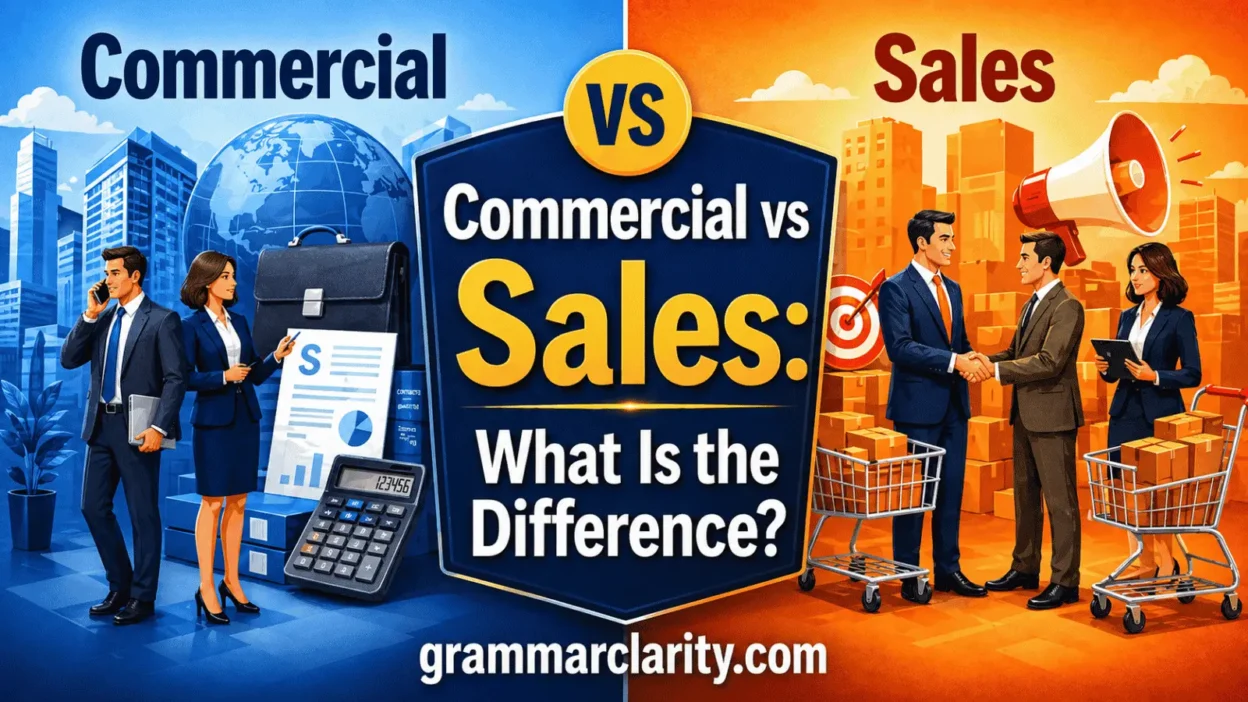
The main difference is simple: sales refers directly to selling products or services, while commercial has a broader business meaning.
Use sales when you are talking about selling, sales teams, sales targets, revenue, deals, customers, or the number of products or services sold.
Use commercial when you are talking about business activity, profit, strategy, contracts, business use, property, partnerships, or advertisements.
Understanding the difference between commercial and sales can help you write more clearly in business emails, reports, resumes, job descriptions, and professional communication.
Quick Answer: Commercial vs Sales
Sales means selling activity or the results of selling.
Commercial means related to business, trade, profit, business use, or advertising.
For example:
- Sales team means the team responsible for selling products or services.
- Sales target means the goal a person or team must reach through selling.
- Commercial strategy means a wider business plan focused on growth, profit, and market success.
- Commercial property means property used for business purposes.
- Commercial can also mean an advertisement, such as a TV commercial.
So, if your sentence is mainly about selling, use sales.
If your sentence is about business in a wider sense, use commercial.
Why Commercial and Sales Are Confusing
Many people confuse commercial and sales because both words are connected to business. In many companies, especially large or international companies, commercial appears in job titles and department names.
For example:
- commercial manager
- commercial director
- commercial team
- commercial operations
- commercial strategy
Because of these phrases, some writers think commercial is just a more formal word for sales. However, this is not always correct.
Sales is more direct. It clearly refers to selling products or services, speaking with customers, closing deals, reaching targets, and increasing revenue.
Commercial is broader and more formal. It may include sales, but it can also include pricing, contracts, partnerships, profitability, business planning, market strategy, and legal business terms.
Another reason for confusion is that commercial can also mean an advertisement. For example, a TV commercial is an ad, not a sales department.
Main Difference Between Commercial and Sales
The main difference between commercial and sales is scope.
Sales is narrow and specific. It refers to selling activity, the people who sell, the sales department, or the amount sold.
Commercial is broader. It refers to business activity, profit, trade, business use, strategy, property, contracts, or advertisements.
For example:
- Sales performance means how well a person, team, or company is selling.
- Commercial performance can include sales, profit, pricing, margins, partnerships, and overall business results.
This means sales is usually the better word when you are talking about direct selling. Commercial is better when you are talking about the wider business side of an activity.
Commercial vs Sales: Key Differences
| Situation | Better Word | Reason |
|---|---|---|
| A team that sells products or services | Sales | It directly describes the selling function. |
| Monthly results from sold products | Sales | This refers to selling results. |
| A broad business strategy | Commercial | It covers more than selling alone. |
| Business use instead of personal use | Commercial | This is the standard phrase in business and legal English. |
| Property used for business | Commercial | “Commercial property” is the correct phrase. |
| A TV, radio, or podcast ad | Commercial | In this case, commercial means advertisement. |
Simple Comparison
Sales means selling activity, sales results, salespeople, and sales departments.
Commercial means business-related, profit-focused, formal, or connected to commerce.
In short:
Sales = selling and revenue.
Commercial = business, profit, strategy, business use, or advertising.
Meaning and Use of Sales
Sales is mainly used as a noun. It can refer to the act of selling, the department that sells, or the amount of goods or services sold.
Examples:
- She works in sales.
- Our sales increased last month.
- The sales team is hiring new staff.
- Online sales were strong in December.
- They missed their sales target.
In all these examples, sales is the correct choice because the meaning is directly connected to selling.
Use sales when talking about:
- sales teams
- sales managers
- sales representatives
- sales calls
- sales reports
- sales targets
- sales goals
- sales quotas
- sales growth
- sales revenue
- sales performance
- sales pipelines
Meaning and Use of Commercial
Commercial is usually used as an adjective. It describes something related to business, trade, profit, or commerce.
Examples:
- The company is improving its commercial strategy.
- This building is approved for commercial use.
- They signed a commercial agreement.
- The product became a commercial success.
- The company is expanding its commercial operations.
In these examples, commercial is correct because the meaning is wider than direct selling. It refers to business activity, profit, legal use, strategy, or business value.
Use commercial when talking about:
- commercial strategy
- commercial operations
- commercial agreements
- commercial partnerships
- commercial risk
- commercial property
- commercial real estate
- commercial use
- commercial success
- commercial purposes
- commercial license
Commercial as an Advertisement
One important point is that commercial can also be a noun. As a noun, commercial often means an advertisement on TV, radio, streaming platforms, or podcasts.
Examples:
- I saw a funny commercial during the game.
- The company released a new car commercial.
- That commercial was shown before the video.
- The brand created a short commercial for social media.
In this meaning, commercial does not mean sales activity. It means an advertisement.
For example:
We made a new commercial for the product.
This means the company made a new advertisement for the product. It does not mean the company made a new sales department.
Tone and Formality
Sales sounds clear, direct, and practical. It is the better word for everyday business writing when the meaning is connected to selling.
Examples:
- sales team
- sales report
- sales target
- sales manager
- sales growth
Commercial sounds more formal, strategic, and corporate. It is common in legal, executive, financial, and business-planning contexts.
Examples:
- commercial strategy
- commercial agreement
- commercial risk
- commercial partnership
- commercial model
In general, sales sounds more operational, while commercial sounds more strategic.
A sales manager usually focuses on selling, leads, customers, quotas, and revenue.
A commercial manager may focus on pricing, contracts, profitability, partnerships, business terms, and strategy.
The exact meaning can change from company to company, but this general difference is useful in most business writing.
When to Use Sales
Use sales when your sentence is directly about selling.
Choose sales for:
- people who sell
- teams that sell
- departments that sell
- sales goals and quotas
- revenue from selling
- customer deals
- sales reports
- sales pipelines
- monthly or yearly selling results
Examples:
- He works in sales.
- The sales team reached its goal.
- Our sales dropped in January.
- She has five years of sales experience.
- The company wants to increase sales this year.
- The sales department needs better customer follow-up.
- Strong sales growth helped the company expand.
When to Use Commercial
Use commercial when your sentence is about business in a broader sense.
Choose commercial for:
- business strategy
- profit-focused decisions
- business use
- contracts and agreements
- partnerships
- property and real estate
- legal or formal business language
- advertisements
Examples:
- The company needs a stronger commercial plan.
- This space is for commercial use only.
- They signed a commercial agreement.
- The product was a commercial success.
- We watched a commercial during the match.
- The commercial terms of the deal are still under review.
- The company is exploring new commercial opportunities.
Easy Test to Choose the Right Word
Here is a simple test:
Use sales if the sentence is directly about selling.
Use commercial if the sentence is about wider business activity, profit, strategy, property, contracts, business use, or advertising.
Examples:
She works with customers and closes deals.
Better word: sales
The building is used for business purposes.
Better word: commercial
The company wants to increase the number of products sold.
Better word: sales
The company is reviewing business terms in a contract.
Better word: commercial
Correct Usage Examples of Sales
Here are clear examples of sales in sentences:
- She works in sales and speaks with customers every day.
- The sales team exceeded its monthly target.
- Our sales increased after the new marketing campaign.
- He has strong sales experience in the software industry.
- The company is hiring a new sales manager.
- Online sales were higher during the holiday season.
- The sales report shows steady growth.
- The business wants to improve its sales pipeline.
- Good customer service can support stronger sales.
- The sales department is responsible for bringing in new customers.
Correct Usage Examples of Commercial
Here are clear examples of commercial in sentences:
- The company is developing a new commercial strategy.
- This building is approved for commercial use.
- They bought a commercial property in the city center.
- The product became a commercial success.
- The company reviewed the commercial terms of the contract.
- A commercial agreement was signed between the two companies.
- The team is looking for new commercial opportunities.
- The project has strong commercial potential.
- We watched a commercial before the video started.
- The company created a commercial for its new product launch.
Side-by-Side Examples
Compare these examples to understand the difference more clearly:
- The sales team contacted new customers.
- The commercial team reviewed pricing and contract terms.
- Our sales improved this quarter.
- The product achieved commercial success this quarter.
- She has experience in sales and customer relationships.
- She has strong commercial judgment and understands business value.
- The company wants to increase sales.
- The company wants to improve its commercial strategy.
- They launched a new commercial for the product.
- The campaign helped increase sales.
These examples show that sales is usually about selling, while commercial is about wider business activity, profit, strategy, property, contracts, or advertisements.
Word Forms
Sales
Sales is mainly a noun.
Examples:
- sales team
- sales manager
- sales report
- sales growth
- sales target
The related verb is sell.
Examples:
- They sell software.
- She sells cars.
- The company sells products online.
Do not use sales as a verb in standard English. The correct verb is sell.
Incorrect:
The company sales furniture online.
Correct:
The company sells furniture online.
Commercial
Commercial is usually an adjective.
Examples:
- commercial use
- commercial property
- commercial strategy
- commercial agreement
- commercial success
It can also be a noun meaning an advertisement.
Examples:
- a TV commercial
- a radio commercial
- an online commercial
- a product commercial
Commercial is not normally used as a verb in everyday English.
Synonyms of Sales
Depending on the sentence, words close to sales include:
- selling
- selling activity
- business development
- dealmaking
- revenue generation
However, these words are not always perfect replacements. In many sentences, sales is still the clearest and most natural word.
Example:
The sales team reached its target.
This is more natural than:
The revenue generation team reached its target.
Synonyms of Commercial
Depending on the sentence, words close to commercial include:
- business-related
- profit-focused
- trade-related
- corporate
- market-oriented
- business-focused
These are only near synonyms. The best word depends on the sentence.
Example:
The company reviewed the commercial terms of the contract.
In this sentence, commercial sounds more natural and professional than business-related.
Common Phrases with Sales
Here are common phrases with sales:
- sales team
- sales manager
- sales target
- sales quota
- sales report
- sales growth
- sales pipeline
- sales call
- sales department
- sales performance
- sales revenue
- sales forecast
Examples:
- The sales team closed the deal.
- She prepared the monthly sales report.
- The company set a new sales target.
- Sales growth was strong this year.
Common Phrases with Commercial
Here are common phrases with commercial:
- commercial use
- commercial property
- commercial real estate
- commercial agreement
- commercial success
- commercial strategy
- commercial operations
- commercial risk
- commercial model
- commercial partnership
- commercial purposes
- commercial license
Examples:
- This image is not free for commercial use.
- They signed a commercial agreement.
- The product was a commercial success.
- The company changed its commercial strategy.
Commercial vs Sales in Job Titles
Job titles can make these words confusing because companies use them in different ways.
A sales manager usually manages selling activity, salespeople, customers, targets, and revenue goals.
A commercial manager usually has a wider business role. This person may handle pricing, contracts, negotiations, profitability, partnerships, business terms, and commercial strategy.
A sales director usually leads the sales department.
A commercial director may lead broader business growth, pricing strategy, commercial planning, revenue strategy, and market opportunities.
In general:
Sales roles are directly connected to selling.
Commercial roles are broader and more strategic.
Commercial vs Sales in Business Reports
In business reports, use sales when you are reporting selling results.
Examples:
- Sales increased by 15%.
- The sales team closed 50 new deals.
- December sales were higher than expected.
- The company’s sales improved after the product launch.
Use commercial when you are discussing wider business value, profit, strategy, or market success.
Examples:
- The product achieved commercial success.
- The new pricing model improved commercial performance.
- The company reviewed the commercial terms of the agreement.
- The project has strong commercial potential in international markets.
Using the correct word makes your report clearer, more accurate, and more professional.
Common Mistakes to Avoid
Mistake 1: Using Commercial When You Mean Sales
Incorrect:
Our commercial increased last month.
Correct:
Our sales increased last month.
Use sales when you are talking about the amount sold.
Mistake 2: Using Sales When You Mean Commercial
Incorrect:
This building is for sales use only.
Correct:
This building is for commercial use only.
Use commercial use when something is used for business purposes.
Mistake 3: Using Sales as a Verb
Incorrect:
She sales cars.
Correct:
She sells cars.
The verb form is sell, not sales.
Mistake 4: Forgetting That Commercial Can Mean Advertisement
Correct:
I saw a commercial for a new phone.
Here, commercial means an advertisement, not a business department.
FAQs
Is commercial the same as sales?
No, commercial and sales are not exactly the same. Sales refers directly to selling products or services. Commercial has a broader meaning and can refer to business activity, profit, strategy, contracts, property, business use, or advertisements.
Does commercial mean selling?
Sometimes commercial can include selling, but it does not only mean selling. It often refers to wider business matters such as pricing, profitability, contracts, partnerships, and strategy.
What is the difference between a sales team and a commercial team?
A sales team focuses directly on selling products or services to customers. A commercial team may have a broader role that includes sales, pricing, contracts, market strategy, partnerships, and profitability.
What does commercial mean in business?
In business, commercial means related to trade, business activity, profit, or business use. For example, commercial strategy means a business strategy focused on growth and profit.
What does sales mean in business?
In business, sales means the activity of selling products or services. It can also refer to the amount of goods or services sold during a certain period.
Is a TV commercial related to sales?
A TV commercial is related to marketing or advertising, not directly to the sales department. However, the purpose of a commercial is often to promote a product and help increase sales.
Should I say commercial target or sales target?
In most cases, sales target is the correct phrase. It means a goal related to selling. Commercial target is less common and may refer to a broader business goal, depending on the company.
Should I say commercial property or sales property?
The correct phrase is commercial property. It means property used for business purposes, such as offices, shops, warehouses, or restaurants.
Final Rule
Use sales when the sentence is about selling.
Use commercial when the sentence is about broader business activity, profit, business use, contracts, property, strategy, or advertisements.
Conclusion
The difference between commercial and sales is mainly about meaning and scope.
Sales is specific. It refers to selling activity, sales teams, salespeople, sales targets, revenue, and the amount sold.
Commercial is broader. It refers to business activity, profit-making, business strategy, business use, contracts, property, commercial success, or advertisements.
Choose sales when you are talking about direct selling, salespeople, sales departments, sales numbers, or sales goals.
Choose commercial when you are talking about wider business strategy, formal business use, property, legal terms, profitability, or ads.
In simple terms, sales is about selling, while commercial is about business in a wider sense.