For and since are both correct words, but they do different jobs in time expressions.
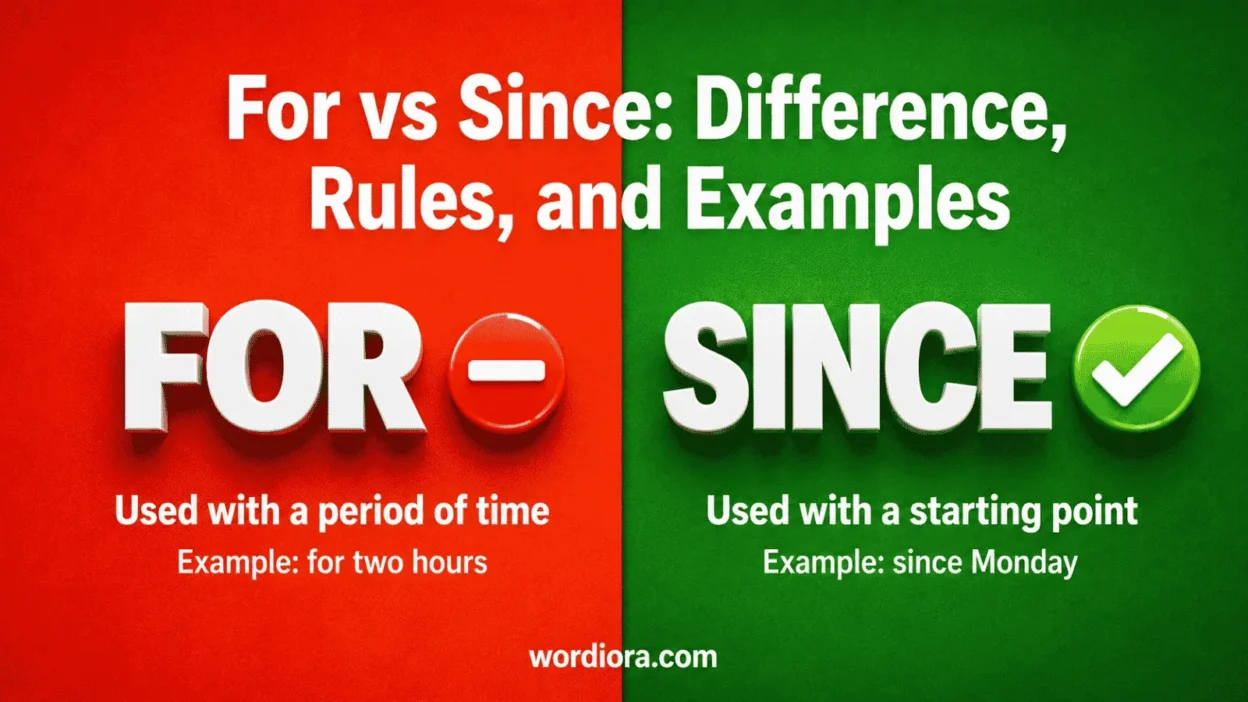
Use for when you mean a length of time: for three days, for two years, for a few minutes.
Use since when you mean the starting point: since Monday, since 2020, since I moved here.
So the main difference is simple: for tells how long; since tells when it started.
Quick Answer
Use for with a period of time.
Correct: I have lived here for six months.
Correct: We waited for 20 minutes.
Correct: She will be in Chicago for a week.
Use since with a point in time.
Correct: I have lived here since October.
Correct: We have been waiting since 8:30.
Correct: She has worked there since she graduated.
If you can answer “how long?” use for.
If you can answer “starting when?” use since.
Why People Confuse Them
People confuse for and since because both words can talk about time that began earlier and may still be continuing.
These two sentences are close in meaning:
I have worked here for five years.
I have worked here since 2021.
Both describe the same kind of situation. The difference is what the sentence names. For five years gives the length. Since 2021 gives the starting point.
The confusion also happens because since has another common meaning: “because.”
Example: Since it was raining, we stayed home.
That sentence is not about a starting time. It gives a reason.
Key Differences At A Glance
| Feature | for | since |
|---|---|---|
| Main time meaning | Length of time | Starting point |
| Answers | How long? | Since when? |
| Common pattern | for + duration | since + date, time, event, or clause |
| Works with future time? | Yes | Usually no, when used this way |
| Other common meanings | purpose, benefit, support | because, from then until now |
Meaning and Usage Difference
For points to duration. It measures time.
Examples:
I studied for two hours.
They lived in Austin for a year.
The store will be closed for three days.
In these sentences, for does not tell you when the action started. It only tells you the length of time.
Since points to the starting point of a time period.
Examples:
I have studied English since January.
They have lived in Austin since 2022.
The store has been closed since Monday.
In these sentences, since tells when the situation began.
A strong clue is the word after it. A length of time usually takes for: for a week, for years, for ten minutes. A starting point usually takes since: since noon, since last summer, since the meeting ended.
Tone, Context, and Formality
There is no strong formality difference between for and since. Both are normal in casual, business, school, and formal writing.
The real difference is grammar and meaning, not tone.
In everyday speech, for is common because people often talk about how long something lasted.
Example: I was on hold for half an hour.
In updates, resumes, and work writing, since is common when naming a start date.
Example: I have managed the account since March 2024.
Since can sound more specific because it points to a date, time, or event. For can sound more general because it gives the length.
Which One Should You Use?
| Context | Best Choice | Why |
|---|---|---|
| You name a duration | for | It answers “how long?” |
| You name a start date | since | It answers “starting when?” |
| You name a clock time | since | It marks the beginning point |
| You name an event that started the period | since | The event works as the starting point |
| You talk about a future length of time | for | It can describe how long something will last |
| You mean “because” | since | It introduces a reason |
| You mean “for the benefit of” | for | It shows purpose or recipient |
Choose for when the next words are a time amount: five minutes, three weeks, a long time, several years.
Choose since when the next words name the start: Friday, 2019, breakfast, we met, the office opened.
When One Choice Sounds Wrong
Since two years sounds wrong in standard US English when you mean duration.
Wrong: I have lived here since two years.
Right: I have lived here for two years.
For 2020 sounds wrong when you mean a start date.
Wrong: I have lived here for 2020.
Right: I have lived here since 2020.
But for 2020 can be correct in a different meaning.
Correct: This report is for 2020.
Here, for means “related to” or “intended for,” not duration.
Common Mistakes (and Quick Fixes)
Mistake: I have known her since five years.
Fix: I have known her for five years.
Mistake: We have been open for Monday.
Fix: We have been open since Monday.
Mistake: He worked there since three months.
Fix: He worked there for three months.
Mistake: I am waiting here since 9 a.m.
Fix: I have been waiting here since 9 a.m.
The last example also needs a tense fix. In standard English, when something started in the past and continues now, since often appears with the present perfect: have been waiting, has lived, have worked.
Everyday Examples
I’ve had this phone for two years.
I’ve had this phone since 2024.
She has been at the office for six hours.
She has been at the office since 8 a.m.
We dated for a year before getting engaged.
We have been together since college.
The kids played outside for 30 minutes.
The kids have been outside since lunch.
He will be in Denver for the weekend.
He has been in Denver since Friday night.
The difference stays the same: for measures the length; since names the start.
Dictionary-Style Word Details
Verb
for: Not commonly used as a verb in standard US English.
since: Not commonly used as a verb in standard US English.
Noun
for: Rare as a noun, but it can appear in phrases like the pros and cons or the fors and againsts. This is not the normal use in everyday US English.
since: Not commonly used as a noun in standard US English.
Synonyms
for: When it shows duration, the closest plain alternatives are during or throughout, but they do not always fit the same sentence. In I waited for an hour, for is the natural choice.
since: When it shows time, the closest plain alternatives are from or from the time that, but the sentence may need rewriting. When since means “because,” close alternatives include because and as.
Clear antonyms do not work well for this comparison because for and since are not opposites. They mark different time relationships.
Example Sentences
for:
I slept for nine hours.
We have rented this apartment for three years.
The meeting is scheduled for 2 p.m.
This gift is for you.
since:
I have lived here since May.
She has worked remotely since the office closed.
We haven’t talked since the conference.
Since you’re already here, let’s start.
Word History
for: The word has a long history in English and has carried several related meanings, including purpose, direction, support, and duration. For this comparison, the key use is duration.
since: The word also has a long history in English and developed around meanings tied to “after that time” and “from then.” Today, it can mark time or introduce a reason.
The exact history is not needed to choose correctly in modern writing. The practical rule matters more: for gives the length; since gives the starting point.
Phrases Containing
for:
for a while
for years
for now
for the first time
for good
for example
for sale
since:
since then
ever since
since when
since the beginning
since last week
since I was a kid
Conclusion
For vs since comes down to one main choice.
Use for when you are talking about a duration: for two hours, for six months, for a long time.
Use since when you are talking about the starting point: since noon, since 2021, since we moved.
A quick test usually solves it: how long? takes for. Starting when? takes since.