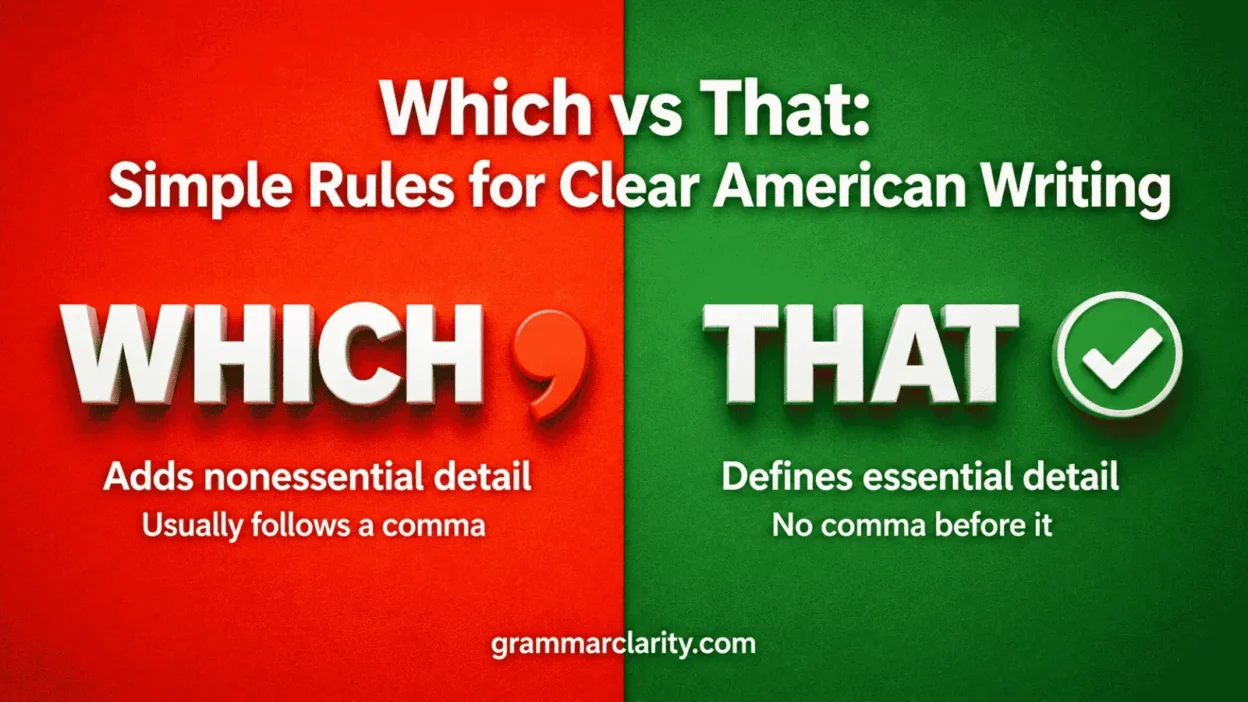
Which vs that is a choice between two words that often introduce extra information about a noun. In American English, the safest rule is simple: use that for essential information and which for nonessential information set off by commas.
The difference is not only about preference. It can change how a sentence is understood.
Compare these:
The files that were updated today are ready for review.
The files, which were updated today, are ready for review.
The first sentence means only the updated files are ready. The second sentence suggests all the files are ready, and they happened to be updated today.
Quick Answer
Use that when the information is necessary to identify the noun.
Use which when the information adds extra detail and could be removed without changing the main point.
A helpful shortcut:
Use that when the clause answers “Which one?”
Use which when the clause adds “by the way” information.
Examples:
The laptop that has the broken screen needs repair.
My laptop, which has a broken screen, needs repair.
In careful American editing, that usually appears without commas. Which often appears with commas when it introduces nonessential information.
Why People Confuse Them
People confuse which and that because both can point back to a noun.
Both words can introduce information about a thing, idea, place, document, object, or group. The confusion comes from the type of information being added.
If the information is essential, the sentence needs it.
If the information is extra, the sentence can live without it.
The comma is often the clue. Nonessential information is usually set off with commas. Essential information is not.
Key Differences At A Glance
| Context | Best Choice | Why |
|---|---|---|
| Essential detail that identifies the noun | that | The clause is needed to know exactly what is meant. |
| Extra detail about a noun already identified | which | The clause adds information but does not identify the noun. |
| Clause set off by commas | which | Commas signal nonessential information. |
| Clause with no commas in careful American usage | that | No commas often signal essential information. |
| Formal editing in the United States | that for essential, which for nonessential | This keeps meaning clear and avoids ambiguity. |
Meaning and Usage Difference
That introduces a restrictive clause. A restrictive clause limits or identifies the noun before it.
The books that are on the top shelf are mine.
This does not mean all the books are mine. It means only the books on the top shelf are mine.
Which introduces a nonrestrictive clause. A nonrestrictive clause adds information about a noun that is already clear.
The books, which are on the top shelf, are mine.
This suggests the books are mine, and their location is extra information.
The most important difference is whether the clause restricts the noun or merely comments on it.
Tone, Context, and Formality
In everyday speech, many people use which where formal editors would prefer that.
You may hear:
The movie which won the award is on tonight.
In polished American writing, this is usually cleaner as:
The movie that won the award is on tonight.
That does not mean every use of which without commas is impossible. You may see it in British English, older writing, legal writing, or less edited prose. Still, for modern American business, academic, and professional writing, the cleanest pattern is:
that for essential information
which for extra information with commas
This pattern helps readers understand the sentence on the first pass.
Which One Should You Use?
Choose that when the reader needs the clause to know which person, place, thing, or idea you mean.
The report that includes the revised budget is final.
The apartment that faces the park costs more.
The password that you created yesterday has expired.
Choose which when the noun is already identified and the clause simply adds more information.
The final report, which includes the revised budget, is attached.
My apartment, which faces the park, gets great light.
Your new password, which you created yesterday, has expired.
If removing the clause changes the basic meaning, use that.
If removing the clause leaves the main meaning intact, use which.
When One Choice Sounds Wrong
That sounds wrong when the clause is clearly nonessential.
Incorrect: My car, that I bought last year, needs new tires.
Correct: My car, which I bought last year, needs new tires.
The phrase “I bought last year” adds extra detail about “my car.” It does not identify which car unless the context includes several cars.
Which can sound weak or unclear when the clause is essential.
Less clear: The email which contains the invoice was sent this morning.
Better: The email that contains the invoice was sent this morning.
Here, the clause identifies the specific email.
Common Mistakes (and Quick Fixes)
One common mistake is using which with no commas when the clause is nonessential.
Incorrect: Our office which opened in May is already expanding.
Correct: Our office, which opened in May, is already expanding.
Another common mistake is using that after a comma.
Incorrect: The contract, that expires Friday, needs review.
Correct: The contract, which expires Friday, needs review.
Writers also sometimes add commas around an essential that clause.
Incorrect: The laptop, that has the missing charger, is mine.
Correct: The laptop that has the missing charger is mine.
The fix is to ask whether the clause identifies the noun or adds extra information.
Everyday Examples
I deleted the photos that were blurry.
This means I deleted only the blurry photos.
I deleted the photos, which were blurry.
This suggests I deleted the photos, and all of them were blurry.
The restaurant that opened downtown is already busy.
This identifies the restaurant.
The restaurant, which opened downtown, is already busy.
This adds extra information about a restaurant already known to the reader.
Please sign the form that is attached to this email.
The clause tells the reader which form.
Please sign the form, which is attached to this email.
The form is already clear; the attachment detail is extra.
Dictionary-Style Word Details
Verb
Neither which nor that is used as a verb in this comparison.
In which vs that, both words are being compared as relative words that connect a noun to more information.
Noun
Neither which nor that is normally a noun in this usage.
They function as connecting words. Which often introduces added information, while that often introduces identifying information.
Synonyms
There is no perfect one-word synonym for either which or that in this grammar choice.
In some sentences, the clause can be rewritten instead:
The phone that has the cracked case is mine.
The phone with the cracked case is mine.
The second version avoids the choice completely.
Example Sentences
The jacket that I left in your car has my keys in it.
The jacket, which I bought last week, is already on sale.
The policy that changed this year affects new employees.
The policy, which changed this year, affects new employees.
The chair that wobbles should be replaced.
The chair, which wobbles, should be replaced.
Word History
Both words have long histories in English and can serve several grammar roles. For this article, the important point is their use in clauses that describe or identify nouns.
Modern American usage often separates them by function: that for essential identifying clauses and which for nonessential added clauses.
Phrases Containing
Common patterns with that:
the one that
the file that
the issue that
the house that
the rule that
Common patterns with which:
in which
by which
for which
at which point
all of which
Conclusion
The clearest rule for which vs that is this: use that when the information is essential, and use which when the information is extra.
If the clause identifies the noun, choose that and skip the commas.
If the clause adds a side note, choose which and use commas.
That one distinction will solve most everyday problems with which and that in American English.