
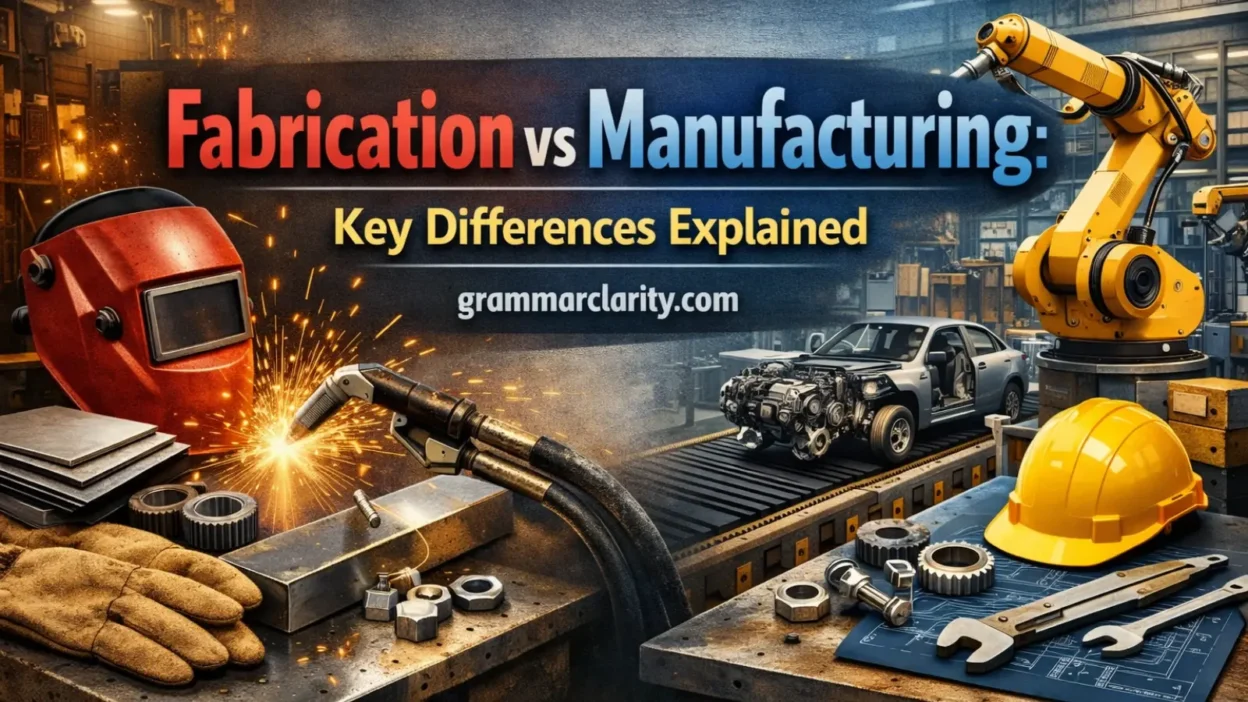
Fabrication vs Manufacturing is a true Word-Choice topic, not a general grammar topic. In most industrial and business writing, manufacturing is the broader term, while fabrication is narrower and usually refers to making parts, assemblies, or built components through processes such as cutting, shaping, bending, joining, or welding. In many settings, fabrication is part of manufacturing rather than a full replacement for it.
There is one more wrinkle: fabrication also has a separate everyday meaning of “something made up,” especially a false story or falsehood. That extra meaning is one reason readers can pause over the word outside technical contexts. Manufacturing does not carry that same common falsehood meaning in ordinary noun form.
Quick Answer
Use manufacturing when you mean the broader system of producing goods, especially organized production that leads to a finished product. Use fabrication when you mean the making of parts, structures, or assemblies, often in custom, shop, metalworking, or engineering contexts. If you are talking about a whole production operation, manufacturing is usually the safer choice. If you are talking about how specific parts or structures are made, fabrication is often more precise.
Why People Confuse Them
The confusion is understandable because the word families overlap. Dictionary definitions allow fabricate and manufacture to overlap in the broad sense of “make” or “construct,” and real-world writing often uses them near each other.
At the same time, industry usage tends to draw a sharper line. In engineering and production language, fabrication often points to part-making or assembly-building, while manufacturing covers the larger production process that can include fabrication, assembly, testing, and delivery. That is why a sentence can be technically understandable but still sound off to industry readers if the broader word and the narrower word are swapped carelessly.
Key Differences At A Glance
| Context | Best Choice | Why |
| A company producing finished appliances at scale | Manufacturing | The focus is broad production of finished goods. |
| A shop cutting, bending, and welding steel parts | Fabrication | The focus is on making parts or assemblies through specific processes. |
| A factory-wide process including assembly and testing | Manufacturing | The scope goes beyond part creation. |
| A custom railing, frame, or bracket job | Fabrication | The work is custom, process-specific, and build-focused. |
| General discussion of US industry output | Manufacturing | The term is broader and more standard in economics and business writing. |
| A semiconductor “fab” or wafer process | Fabrication | Some industries use fabrication as a specialized production term. |
Quick comparison
- Fabrication: narrower, process-focused, often custom or component-centered
- Manufacturing: broader, system-level, often finished-goods or full-production focused
Meaning and Usage Difference
In plain English, manufacturing usually suggests organized production. It works well when you mean factories, production systems, finished goods, or large-scale output. You can write about manufacturing costs, manufacturing capacity, manufacturing jobs, or a manufacturing plant without sounding too narrow.
Fabrication is more exact when the emphasis is on making a part, structure, or assembly from materials or standardized components. In metal and product-development contexts, it often points to shaping and joining work rather than the entire product lifecycle. That is why phrases like sheet metal fabrication, steel fabrication, and custom fabrication sound natural.
Tone, Context, and Formality
In general business writing, manufacturing usually sounds more natural and more widely understood. It fits reports, articles, operations summaries, and broad market descriptions.
In technical shop, engineering, and construction-adjacent writing, fabrication can sound more accurate because it names a narrower kind of making. It often signals hands-on process detail. Still, context matters. In semiconductors, for example, fabrication is not just a part-level shop term; it is a standard name for a specialized production process, as in wafer fabrication or chip fabrication.
Which One Should You Use?
Choose manufacturing when your subject is the whole production picture. That includes finished products, factory systems, organized output, and business-wide operations. If your sentence could comfortably take words like production, factory, or industry, manufacturing is often the better fit.
Choose fabrication when the sentence is really about how parts or structures are made. If the work involves cutting, shaping, welding, forming, or creating custom assemblies, fabrication is often the sharper word.
If you are unsure, ask yourself one question: Am I talking about the whole production system or the making of a specific part or structure? Whole system points to manufacturing. Specific build work points to fabrication.
When One Choice Sounds Wrong
If a company makes household refrigerators from start to finish, calling the whole operation refrigerator fabrication can sound too narrow. Readers may expect manufacturing because the process includes more than building a component or frame.
On the other hand, if a local metal shop cuts plate, bends sheet, and welds custom stair rails, calling that work metal manufacturing is not always wrong, but it sounds less exact than metal fabrication. In that context, the narrower term better matches the actual work.
Outside industry, be careful with fabrication because many readers first hear it as “made-up story” or “falsehood.” In a casual sentence, that meaning can create a split-second distraction.
Common Mistakes (and Quick Fixes)
A common mistake is using fabrication as a stylish substitute for manufacturing in every industrial sentence. Quick fix: use manufacturing for the broad category and save fabrication for part-making, metalwork, or custom-build contexts.
Another mistake is assuming fabrication always means small-scale work. It often does suggest custom or process-specific work, but some fields use it for highly advanced production, especially semiconductors. Quick fix: let the industry context lead the choice.
Writers also slip by ignoring the falsehood meaning of fabrication. Quick fix: in nontechnical writing, use fabrication carefully unless the context clearly points to making physical things.
Everyday Examples
The company expanded its manufacturing operations in Ohio last year.
We hired a local shop for the fabrication of custom steel brackets.
She works in manufacturing, not just final assembly.
The project required precise aluminum fabrication before installation.
The report covers domestic manufacturing trends across several industries.
The attorney called the document a complete fabrication.
Dictionary-Style Word Details
Verb
Strictly speaking, the keyword uses noun forms, not base verbs. The matching verbs are fabricate and manufacture. Fabricate can mean construct or assemble, but it can also mean invent something false. Manufacture can mean make from raw materials or produce according to an organized plan; dictionaries also record a less common sense meaning “invent” or “make up,” though that is not the main everyday noun meaning of manufacturing.
Noun
Fabrication is a noun for the act or result of fabricating, and in ordinary English it also commonly means a falsehood. Manufacturing is the noun form used for the broader activity or industry of making goods. When readers compare the two terms, they are usually comparing a narrower production activity with a broader production category.
Synonyms
These are not perfect synonyms. Manufacturing overlaps with production and sometimes making. Fabrication overlaps with construction, assembly, or part-making in technical contexts. In ordinary nontechnical English, fabrication can also overlap with falsehood or invented story.
Example Sentences
The manufacturer moved final assembly to a larger facility, but the precision fabrication stayed in the original shop.
Our state is trying to strengthen advanced manufacturing while supporting local metal fabrication businesses.
Word History
Fabrication comes through Latin roots related to shaping or constructing. Manufacture comes from a Latin expression meaning “made by hand,” which helps explain why the word historically centered on making products.
Phrases Containing
Common phrases include metal fabrication, sheet metal fabrication, custom fabrication, manufacturing process, manufacturing plant, and manufacturing industry. In specialized chip-making contexts, wafer fabrication is also standard.
Conclusion
Use manufacturing for the broader act of producing goods and fabrication for the more specific work of making parts, structures, or assemblies. That distinction will sound natural in most US business and industrial writing. The main exception is field-specific usage, where fabrication can be the standard technical term, as in semiconductors. And outside physical production, remember that fabrication can also mean a made-up story. If you keep scope in mind, the right choice becomes much easier.