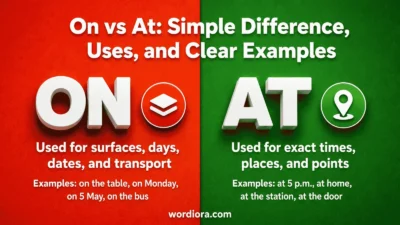
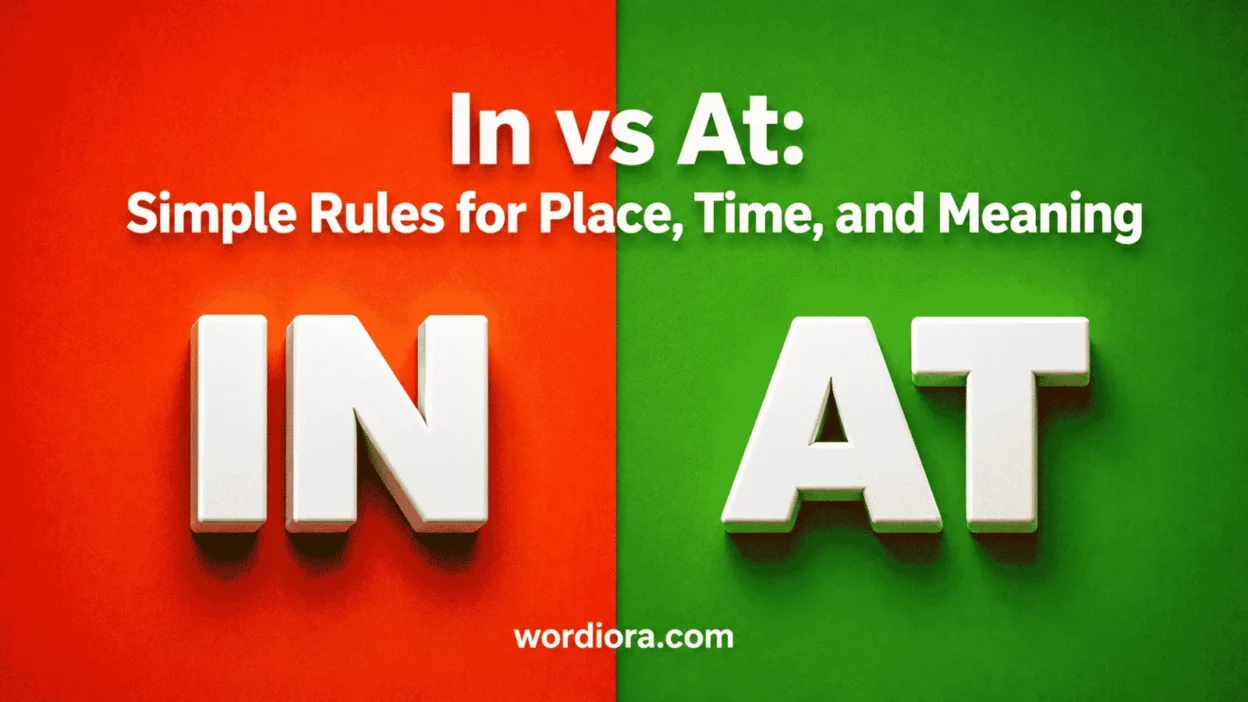
“In” and “at” can both be correct, but they do not mean the same thing. Use in when you mean inside a space, within an area, or during a longer period. Use at when you mean a point, exact place, exact time, event, or activity.
The simple idea is this: in feels more like “inside” or “within.” At feels more like “located at a point.”
That rule helps, but it is not the whole story. In real US English, the right choice often depends on how you picture the place, time, or event.
Quick Answer
Use in for larger areas, enclosed spaces, months, years, seasons, and general periods.
Use at for exact locations, exact times, addresses, events, and activity-based places.
Say:
“I’m in the car.”
“I’ll meet you at the car.”
Both can be correct, but they answer different questions. “In the car” means inside it. “At the car” means near that exact spot.
Why People Confuse Them
People confuse in and at because both can talk about place and time.
A person can be in a building or at a building. A meeting can happen in March or at 3 PM. A student can be in school or at school.
The difference is not always the object. It is often the speaker’s focus.
In focuses on being inside a space, group, period, or situation.
At focuses on a point, stop, event, task, or known location.
Key Differences At A Glance
| Context | Best Choice | Why |
|---|---|---|
| Inside a room | in | You are within the space |
| Exact address | at | The address is treated as a point |
| City, state, country | in | These are larger areas |
| Exact time | at | The time is a point |
| Month, year, season | in | These are longer periods |
| Event or activity | at | The focus is attendance or participation |
| Workplace as a location | at | The focus is the place or job site |
| Office as a room | in | The focus is being inside the room |
Meaning and Usage Difference
In usually means inside or within limits.
Use in for physical spaces:
“I left my laptop in the conference room.”
“She lives in Denver.”
“There’s coffee in the kitchen.”
Use in for longer time periods:
“We’re moving in June.”
“He graduated in 2025.”
“It gets cold in winter.”
At usually points to a specific place, time, event, or activity.
Use at for exact times:
“The call starts at 9:30.”
“Dinner is at seven.”
Use at for known points or locations:
“I’m at the front desk.”
“She’s at the airport.”
“Meet me at 45 West Main Street.”
Use at for events and activities:
“We met at a wedding.”
“He’s at practice.”
“She’s at a conference.”
Tone, Context, and Formality
Neither in nor at is more formal by itself. Both are normal in casual, business, and academic English.
The difference is context.
“I’m in the office” means inside the office room or workspace.
“I’m at the office” means at the work location.
“I’m in school” often means enrolled as a student.
“I’m at school” often means physically there.
“I’m in a meeting” means taking part in the meeting.
“I’m at a meeting” can also mean attending, but it may sound more like you are at the meeting location or event.
Compact comparison:
• In: inside, within, enclosed by, part of, during a period
• At: exact point, specific place, event, activity, target, rate, age
Which One Should You Use?
Choose in when the idea is “inside” or “within.”
Use it for rooms, cars, boxes, cities, states, countries, months, years, and situations.
Examples:
“She’s in the lobby.”
“They live in Florida.”
“We finished the project in April.”
“He’s in trouble.”
Choose at when the idea is “at that point” or “at that activity.”
Use it for exact times, addresses, stops, counters, desks, events, and work or school locations.
Examples:
“I’ll see you at noon.”
“She works at a hospital.”
“We’re meeting at the coffee shop.”
“He’s at soccer practice.”
When One Choice Sounds Wrong
Some uses are fixed enough that the other choice sounds wrong.
Say at 8 PM, not “in 8 PM.”
Say in July, not “at July.”
Say in 2026, not “at 2026.”
Say at the front door, not usually “in the front door.”
Say in the box, not “at the box,” when you mean inside it.
With places, both may work if the meaning changes.
“I’m in Target” means inside the store.
“I’m at Target” means at that store location.
“I’m in the hospital” often means admitted as a patient.
“I’m at the hospital” usually means physically there, perhaps visiting or working.
Common Mistakes (and Quick Fixes)
Mistake: “The meeting is in 10 AM.”
Fix: “The meeting is at 10 AM.”
Use at for exact clock times.
Mistake: “I was born at 1998.”
Fix: “I was born in 1998.”
Use in for years.
Mistake: “She lives at Chicago.”
Fix: “She lives in Chicago.”
Use in for cities.
Mistake: “I’m at the room.”
Fix: “I’m in the room.”
Use in when someone is inside an enclosed space.
Mistake: “We arrived in the station.”
Fix: “We arrived at the station.”
Use at when the place is treated as a travel point or stop.
Everyday Examples
“I’m in the kitchen making lunch.”
“I’ll meet you at the kitchen door.”
“She’s in class right now.”
“She’s at class until noon.”
“We stayed in Boston for the weekend.”
“We met at the Boston airport.”
“The files are in the folder.”
“The link is at the bottom of the page.”
“I started my job in March.”
“My interview is at 2 PM.”
“He’s in college.”
“He’s at college today.”
“They are in a meeting.”
“They met at a meeting last year.”
Dictionary-Style Word Details
Verb
• in: Not commonly used as a verb in standard US English. In everyday grammar, in is mainly a preposition or adverb.
• at: Not commonly used as a verb in standard US English. In the comparison in vs at, at is mainly a preposition.
Noun
• in: Rare as a noun in ordinary speech. It can appear as a word name, as in “There are two letters in ‘in.’” It can also refer informally to influence or access, as in “She has an in with the manager.”
• at: Rare as a noun in ordinary speech. It may refer to the word at itself or the “@” sign in email contexts, but that is not the main use in this comparison.
Synonyms
• in: Closest plain alternatives include inside, within, and during, depending on the sentence. These are not always exact replacements.
• at: Closest plain alternatives include near, by, located at, and during, depending on the sentence. These are not always exact replacements.
Clear antonyms do not fit every use because both words are prepositions with many meanings. For physical location, outside can oppose in in some sentences.
Example Sentences
• in: “The keys are in my backpack.”
• in: “We bought the house in 2024.”
• in: “She works in marketing.”
• at: “The keys are at the front desk.”
• at: “The appointment is at 4:15.”
• at: “She works at a marketing agency.”
Word History
• in: The word is very old in English and has long carried the idea of being inside, within, or into a place or state. Exact history details are not needed to choose it correctly today.
• at: The word is also very old in English and has long been used for location, direction, time, and relation. For modern use, the key point is that it often marks a point, target, or activity.
Phrases Containing
• in: in the morning, in class, in town, in the office, in a hurry, in trouble, in the end
• at: at night, at work, at school, at home, at the end, at the door, at the same time
Conclusion
The choice between in and at depends on meaning, not just habit.
Use in when you mean inside a space, within an area, part of a group, or during a longer period. Use at when you mean an exact point, place, time, event, or activity.
A good final test is this: if you can picture being inside something, in is often right. If you can point to a location, time, or event, at is often right.