
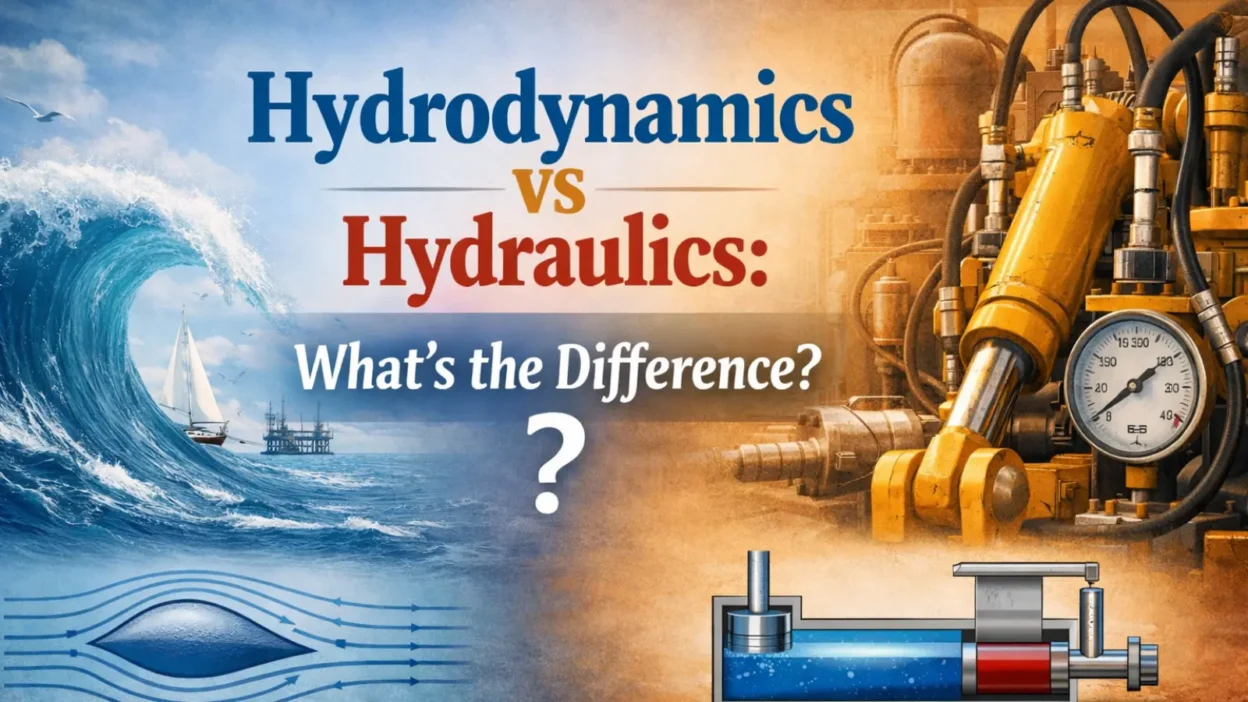
Hydrodynamics and hydraulics are closely related, but they are not the same word.
People often confuse them because both deal with liquids in motion. In real usage, though, hydrodynamics usually points to the science of how liquids move, while hydraulics usually points to the practical use of pressurized liquid in systems, machines, and engineering applications.
If you are choosing between the two, the right word depends on whether you are talking about fluid-motion theory or liquid-powered systems and applied engineering.
Quick Answer
Use hydrodynamics when you mean the study of liquids in motion and the forces involved.
Use hydraulics when you mean the practical application of liquid power, pressure, flow, pumps, cylinders, brakes, and similar systems.
A simple shortcut helps:
- Hydrodynamics = how liquids move
- Hydraulics = how liquid pressure gets used
Why People Confuse Them
The confusion makes sense.
Both words belong to the world of fluid mechanics. Both involve liquids. Both appear in engineering, physics, and technical writing. And in some broad discussions, the subjects overlap.
Still, they do not usually name the same thing in everyday technical English.
Someone studying water flow around a boat hull is more likely working in hydrodynamics. Someone repairing a lift that runs on fluid pressure is dealing with hydraulics.
That overlap in subject area leads people to treat them like substitutes when they usually are not.
Key Differences At A Glance
| Context | Best Choice | Why |
| Water flow around a ship, propeller, or underwater body | Hydrodynamics | The focus is liquid motion and forces in moving flow |
| Mathematical modeling of liquid behavior | Hydrodynamics | The topic is theory, analysis, and flow behavior |
| Brake systems, lifts, presses, or excavators | Hydraulics | The focus is liquid-powered machinery |
| Pumps, valves, cylinders, and fluid-pressure equipment | Hydraulics | The topic is applied pressure and mechanical operation |
| Civil or mechanical systems using liquid force | Hydraulics | The word fits practical engineering use |
| Research on drag, turbulence, and liquid flow patterns | Hydrodynamics | The emphasis is on motion, resistance, and flow effects |
Compact comparison
- Hydrodynamics is usually more theoretical or analytical.
- Hydraulics is usually more practical or mechanical.
- Hydrodynamics often appears in physics, naval design, and flow analysis.
- Hydraulics often appears in construction, machinery, and industrial systems.
Meaning and Usage Difference
Hydrodynamics refers to the branch of science that studies liquids in motion. The word is often used when the main concern is flow behavior, drag, pressure distribution, resistance, circulation, or motion through water.
Examples of natural use:
- hydrodynamics of a submarine
- hydrodynamic forces
- hydrodynamics research
- computational hydrodynamics
Hydraulics refers to the practical use of liquids, especially under pressure, to transmit force or control movement. It often appears in engineering and machine-related contexts.
Examples of natural use:
- hydraulic system failure
- truck hydraulics
- aircraft hydraulics
- hydraulic press
- hydraulic lift
So the difference is not just academic. It changes the meaning of the sentence.
Compare these:
- “The team studied the hydrodynamics of the racing hull.”
- “The mechanic checked the hydraulics on the dump truck.”
Both are about liquids, but the subject is completely different.
Tone, Context, and Formality
Both words are formal and technical, but they live in different kinds of writing.
Hydrodynamics sounds more academic, scientific, and research-based. You often see it in textbooks, engineering papers, naval architecture, and physics-heavy discussions.
Hydraulics is technical too, but it feels more applied and industry-facing. You often see it in manuals, equipment descriptions, maintenance writing, product specs, and engineering practice.
That means the tone shifts with the word choice.
If you are writing about fluid behavior in a lab, hydrodynamics sounds right. If you are writing about a machine that uses pressurized oil, hydraulics sounds right.
Which One Should You Use?
Choose hydrodynamics when your subject is:
- liquid motion
- flow behavior
- drag and resistance
- forces on bodies moving in water
- scientific or mathematical treatment of moving liquids
Choose hydraulics when your subject is:
- fluid-powered machinery
- pressure-driven mechanical systems
- pumps, pistons, cylinders, and valves
- applied engineering using liquids
- equipment operation or maintenance
A useful test is this:
Ask yourself whether you are describing how liquid behaves or how liquid power gets used.
If it is behavior, choose hydrodynamics.
If it is use, choose hydraulics.
When One Choice Sounds Wrong
Sometimes the wrong word does not make the sentence ungrammatical. It just makes it sound off.
These examples show the problem:
- “The crane’s hydrodynamics needed repair.”
This sounds wrong because cranes are not usually discussed in terms of flow theory. The natural choice is hydraulics. - “The paper explores the hydraulics of fish swimming.”
This sounds wrong because fish swimming is about liquid movement and forces, not liquid-powered machinery. Hydrodynamics fits better. - “She specializes in hydraulics and ship-hull drag.”
This may confuse readers unless the work is really about applied water systems. If the focus is drag and flow around hulls, hydrodynamics is more precise.
When readers know the field, they notice the mismatch fast.
Common Mistakes (and Quick Fixes)
One common mistake is using hydraulics for any topic involving moving water.
Quick fix: use hydrodynamics when the discussion is about flow, resistance, wake, or motion through water.
Another mistake is using hydrodynamics for machinery powered by oil or another liquid.
Quick fix: use hydraulics when the point is pressure, force transmission, or machine operation.
A third mistake is assuming one word is simply more advanced than the other. That is not the issue. The real issue is type of meaning.
Neither word is “better.” Each word fits a different kind of subject.
Everyday Examples
Here are natural, modern examples that show the difference clearly.
Hydrodynamics
- Engineers tested the hydrodynamics of the new ferry design.
- Her research focuses on coastal hydrodynamics during storms.
- The software models hydrodynamics in shallow water channels.
- Small changes to the hull improved the boat’s hydrodynamics.
Hydraulics
- The loader was out of service because of a hydraulics leak.
- He works on aircraft hydraulics and control systems.
- The shop replaced the hydraulics in the lift table.
- Good hydraulics allow the excavator arm to move smoothly.
Notice the pattern: hydrodynamics appears in analysis and performance; hydraulics appears in systems and equipment.
Dictionary-Style Word Details
Verb
Neither hydrodynamics nor hydraulics is normally used as a verb in standard American English.
You would not usually say someone “hydrodynamics” or “hydraulics” something. Instead, writers use related verbs such as model, analyze, power, pressurize, or operate.
Noun
Hydrodynamics is a noun that names the study of liquids in motion and the forces connected to that motion.
Hydraulics is also a noun. It can name the field itself, but in everyday use it very often refers to hydraulic systems or hydraulic equipment as a group, as in “the hydraulics on the machine.”
That second use matters because it is common in real-world speech:
- “The hydraulics are failing.”
- “We need to inspect the hydraulics before the job starts.”
Synonyms
These are not perfect substitutes, but they can point readers in the right direction.
For hydrodynamics, near-related terms include:
- fluid dynamics
- liquid-flow analysis
- flow mechanics
- water-motion analysis
For hydraulics, near-related terms include:
- hydraulic systems
- fluid power
- liquid-pressure systems
- hydraulic machinery
Do not treat these as exact one-for-one replacements in every sentence.
Example Sentences
Hydrodynamics
- The course covers basic hydrodynamics for marine engineering students.
- Better hydrodynamics helped the kayak move faster with less effort.
Hydraulics
- The bulldozer lost power when its hydraulics overheated.
- She designs hydraulics for heavy industrial equipment.
Word History
Both words are built from elements tied to water or liquid plus force or motion.
That shared background is one reason they look and sound related. But over time, standard usage separated them into different lanes: one more focused on motion and theory, the other more focused on application and force transmission.
Phrases Containing
Common phrases with hydrodynamics:
- marine hydrodynamics
- computational hydrodynamics
- hydrodynamics model
- hydrodynamics study
Common phrases with hydraulics:
- hydraulic system
- hydraulic pressure
- hydraulic pump
- mobile hydraulics
- industrial hydraulics
Conclusion
The difference between hydrodynamics and hydraulics comes down to focus.
Use hydrodynamics for the science of moving liquids, especially when you are talking about flow behavior, drag, or forces in water.
Use hydraulics for the practical use of liquid pressure in machines, systems, and engineering equipment.
If your sentence is about how liquid moves, choose hydrodynamics. If it is about how liquid power operates something, choose hydraulics.