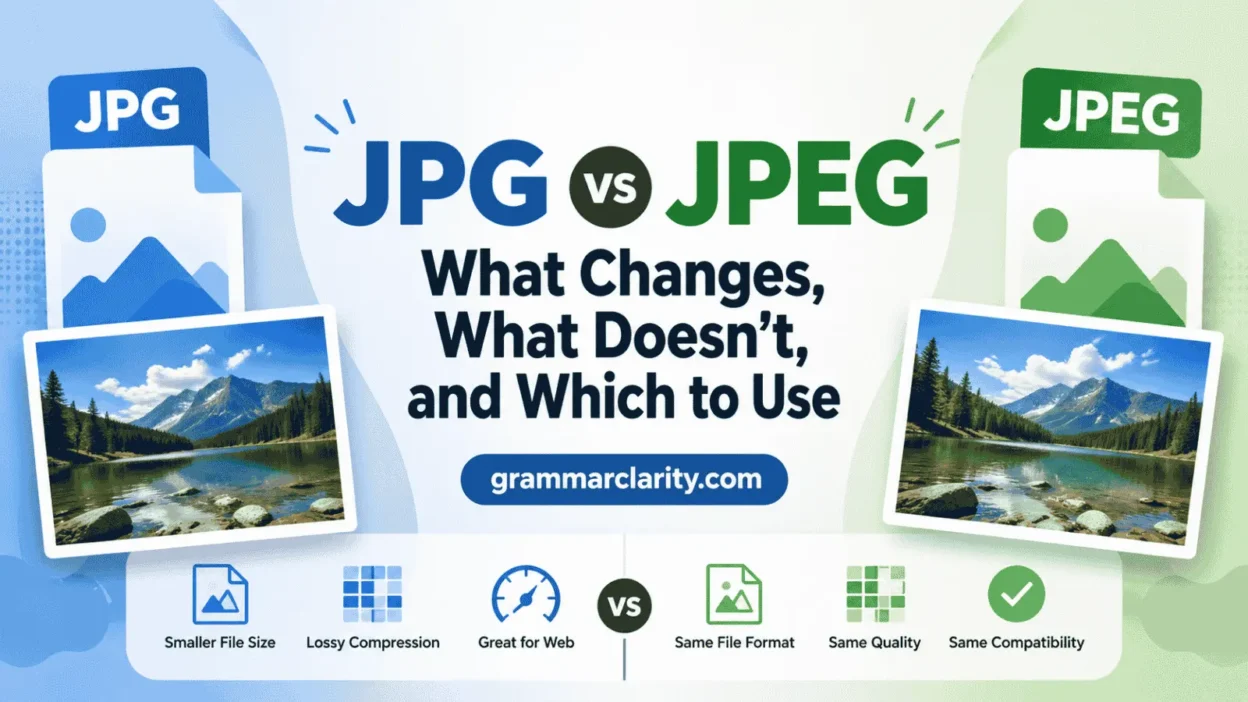
If you are choosing between JPG and JPEG, the most important thing to know is that this is a word-choice question about naming, not a quality question about two different image formats. In normal use, both labels point to the same JPEG image format. The real distinction is that JPEG is the full name and full extension form, while JPG is the shortened extension form that became common because older Windows and MS-DOS systems limited file extensions to three characters.
Quick Answer
Use JPEG when you are talking about the format by name. Use JPG when you are referring to the file extension someone actually sees in a filename, especially if the file ends in .jpg. On modern systems, neither choice gives you better quality by itself. MDN lists both .jpeg and .jpg under the same MIME type, image/jpeg, and Microsoft lists both as Windows file name extensions for the same photo file type.
Why People Confuse Them
People confuse these terms because they look like two competing formats, but they usually are not. One is the full form tied to the format name, and the other is the shorter extension form that stuck around for compatibility and habit. That makes the pair look more different than it really is. On top of that, websites, apps, and upload fields sometimes display one extension, sometimes the other, and sometimes both.
Key Differences At A Glance
Here is the short version readers usually need first.
- JPG: the shortened file extension form, widely used in filenames and older compatibility habits.
- JPEG: the full format name and the longer extension form.
- Practical result today: in ordinary use, both point to the same image type rather than two different quality levels.
Meaning and Usage Difference
In meaning, JPEG is the stronger term when you are naming the format itself. Merriam-Webster treats JPEG as the noun for the image format or an image stored in that format. That makes sentences like “Save it as a JPEG” or “JPEG compression works well for photos” sound standard and natural.
JPG is usually more specific to the visible extension in a filename. It sounds natural in sentences like “Upload a JPG,” “The site accepts JPG files,” or “Rename the file with a .jpg extension.” In other words, JPEG is usually the better format name, while JPG is usually the better extension label when that shorter ending is what a user actually sees. That distinction is practical rather than absolute.
Tone, Context, and Formality
JPEG usually sounds a little more standard and a little more formal because it reflects the full name of the format. It fits technical explanations, documentation, and edited prose better. JPG sounds more everyday, more interface-driven, and more tied to actual filenames, upload prompts, and folder views. Neither choice is wrong in normal American English. The better choice depends on whether you are naming the format or naming the extension users will encounter.
Which One Should You Use?
Use the table below as a practical default. It reflects how current platform and reference sources treat the format name and its common extension variants.
| Context | Best Choice | Why |
| Talking about the format in general | JPEG | It is the standard full name of the format. |
| Referring to a file named photo.jpg | JPG | It matches the extension the reader sees. |
| Writing a help article about uploads that allow both | JPEG or JPG | Both are understandable, but say both if the field accepts both. |
| Describing a filename extension rule | JPG or JPEG | Choose the one that matches the actual allowed extension. |
| General polished prose with no filename shown | JPEG | It usually sounds cleaner and more standard. |
| User-facing instructions tied to a visible .jpg file | JPG | It is more concrete and less abstract for the reader. |
As a rule of thumb, write JPEG for the format and JPG for the shorter extension when the extension itself is the point. If a platform accepts only one written ending in a form field, follow that platform’s wording exactly. MDN’s file-input guidance shows that upload rules can specify .jpg, .jpeg, or both.
When One Choice Sounds Wrong
JPG can sound too narrow when you are explaining the format itself. For example, “JPG compression standard” is understandable, but “JPEG compression standard” sounds more accurate and more polished. On the other hand, JPEG can sound slightly off when the real issue is a filename or an upload box that literally says .jpg only. In that situation, using JPEG can feel less precise because the reader is dealing with a visible extension, not an abstract format name.
Common Mistakes (and Quick Fixes)
A common mistake is assuming that JPG and JPEG produce different image quality. In normal use, they do not represent two quality tiers by themselves. Another mistake is treating the extension question as if it automatically changes the underlying image type. Modern references treat .jpg and .jpeg as forms associated with the same image/jpeg media type. A third mistake is forcing one term everywhere. Good writing is more precise when it follows the context: format name = JPEG, visible short extension = JPG.
Everyday Examples
If you are writing a general explanation, “JPEG is still a common format for photographic images” sounds natural.
If you are giving upload instructions, “Please upload a JPG or JPEG file” is clearer for everyday readers than naming only the format.
If you are talking about a specific file in a folder, “Send me the JPG from yesterday’s event” feels more natural than “Send me the JPEG,” especially when the actual filename ends in .jpg.
If you are writing a caption for a help center or style guide, “Export the image as a JPEG” usually sounds cleaner than “Export the image as a JPG.”
Dictionary-Style Word Details
Verb
Neither JPG nor JPEG is standard as a verb in careful American English. People do sometimes say things like “JPEG it” in casual speech, but that is informal shorthand, not the safest wording for polished writing. In edited prose, use verbs like save, export, compress, or convert instead.
Noun
JPEG is the stronger noun form in reference works. Merriam-Webster defines JPEG as a computer file format for the compression and storage of digital images and also as an image stored in that format. JPG is more often used as a filename label or extension reference in ordinary tech writing.
Synonyms
These are not perfect synonyms in every sentence. Still, in everyday tech use, readers often treat JPEG file, JPG file, and JPEG image as practical near-equivalents when they are talking about ordinary photo files. The cleanest distinction is this: JPEG is the format term, while JPG is the shorter extension term.
Example Sentences
Use JPEG when you mean the format: “This camera saves images in JPEG format.”
Use JPG when you mean the extension: “The application rejected the file because it wanted a JPG.”
Use either, with care, when both are accepted: “Please submit a JPG or JPEG image under 5 MB.”
Use JPEG in polished explanatory prose: “JPEG works well for photographs but is not always the best choice for graphics with sharp edges.”
Word History
JPEG comes from Joint Photographic Experts Group, the name behind the standard. JPG developed as the shortened extension form because older Windows and MS-DOS systems used three-character file extension limits. Even though modern systems do not need that limitation, the shorter form stayed common.
Phrases Containing
Common phrases include JPEG format, JPEG image, JPEG compression, JPG file, JPG upload, and JPG extension. In polished writing, these phrases work best when they match the real focus of the sentence: format language with JPEG, filename language with JPG.
Conclusion
JPG vs JPEG is not really a battle between two different image formats. It is mostly a matter of naming context. Choose JPEG when you are referring to the format in a general or polished way. Choose JPG when you are referring to the shorter file extension a reader will actually see. If a site, form, or app uses one version explicitly, match that wording. If not, remember the simplest rule: JPEG for the format, JPG for the extension, and no built-in quality difference between them just because the ending changed.