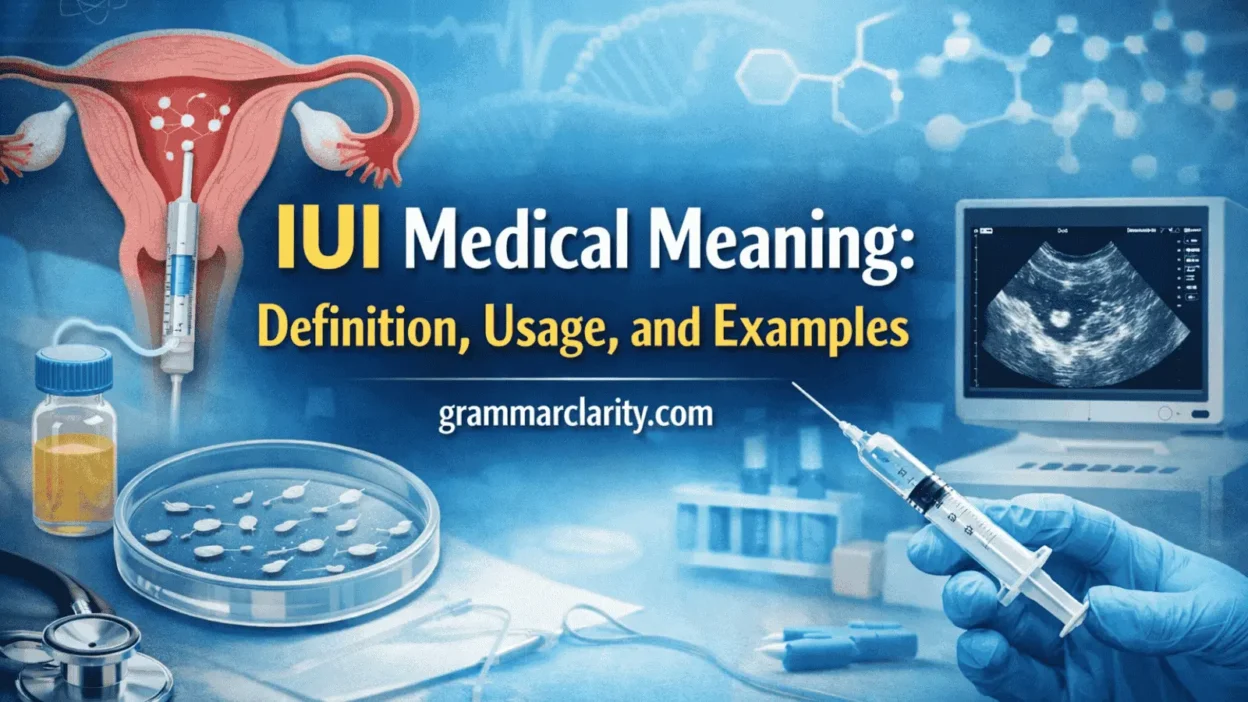
You may see IUI in a doctor’s note, a fertility clinic page, or a health article. In medical use, it is a common short form tied to infertility care and pregnancy planning. Major patient sources use it the same way: as the abbreviation for intrauterine insemination.
This matters because many readers first meet the term as a short, confusing set of letters. Once you know the full meaning, the rest becomes much easier to follow. In this guide, you will learn what IUI means, how people say it, how it is used in sentences, and how it differs from nearby terms like artificial insemination and IVF.
Quick Answer
IUI medical meaning is intrauterine insemination. It is a fertility treatment in which prepared sperm are placed directly into the uterus around ovulation to improve the chance of pregnancy.
TL;DR
• IUI stands for intrauterine insemination.
• It is a fertility treatment.
• Doctors place sperm directly into the uterus.
• It is often done around ovulation.
• People may also call it artificial insemination.
• IUI is different from IVF.
What IUI Means in Medical English
IUI is a medical abbreviation. The letters stand for intrauterine insemination. In patient-facing medical English, that is the standard meaning readers are most likely to see.
You can break the term into parts:
• intrauterine = inside the uterus
• insemination = placing sperm for fertilization in a reproductive context, as used in the clinical sources on IUI
So, in plain terms, IUI means placing sperm inside the uterus to help pregnancy happen.
Definition in Plain English
A simple definition is this: IUI is a fertility procedure that places prepared sperm directly into the uterus near the time of ovulation. That shortens the distance sperm need to travel.
People often search this term because they want the meaning first, not the full medical process. For everyday understanding, you can think of IUI as a clinic procedure that helps sperm get closer to the egg.
Pronunciation
Most people say IUI letter by letter:
• IUI = eye-you-eye
The full term is intrauterine insemination. A simple US-friendly guide is:
• intrauterine = IN-truh-YOO-ter-in
• insemination = in-sem-uh-NAY-shun
Cambridge gives the US pronunciation of intrauterine as /ˌɪn.trəˈjuː.t̬ɚ.ɪn/.
A common mistake is trying to say IUI as one word. In real medical and patient speech, people usually say each letter. Pronunciation directories also reflect that letter-by-letter pattern.
Part of Speech and Word Type
IUI is best understood as an abbreviation or medical acronym used as a noun.
Examples:
• “IUI is scheduled for Friday.”
• “Her doctor recommended IUI first.”
• “They are considering IUI with donor sperm.”
It is not usually used as a verb, adjective, or adverb in normal English. People do not usually say “to iui” or “an iui patient plan” in careful writing. Instead, they write IUI procedure, IUI cycle, or IUI treatment. This is supported by how medical sites frame the term.
How IUI Works
In IUI, sperm are prepared and then placed into the uterus through a thin catheter. The timing is usually linked to ovulation.
That does not guarantee pregnancy. It is simply meant to improve the chance of fertilization in certain situations. Major clinic sources describe it as a less invasive fertility option than IVF.
When People Use the Term IUI
People use IUI in medical, clinic, and patient contexts. You will often see it in:
• fertility clinic pages
• treatment plans
• infertility discussions
• donor sperm discussions
• patient support articles
Doctors may discuss IUI for unexplained infertility, some sperm-related issues, cervical factor infertility, or donor sperm use. Sources also note it for some single patients and same-sex female couples using donor sperm.
A common mistake is using IUI for any fertility treatment. That is too broad. IUI is one specific treatment, not a general label for all fertility care.
Is IUI the Same as Artificial Insemination?
Often, yes, in patient-friendly writing, IUI is called artificial insemination. Mayo Clinic and NHS both use that wording.
Still, there is a nuance worth knowing. In everyday use, artificial insemination can act as a broad, casual label, while IUI names a specific medical procedure done by placing sperm directly into the uterus. So the two are often treated as equivalents for beginners, but IUI is the more precise term.
IUI vs. IVF: Quick Context
Readers often see IUI beside IVF, so a short comparison helps.
| Context | Best Choice | Why |
|---|---|---|
| You want the exact meaning of IUI | IUI | It means intrauterine insemination |
| You want a broader fertility treatment term | fertility treatment | Safer and more general |
| You want to describe lab fertilization | IVF | Fertilization happens outside the body |
| You want the less invasive office procedure | IUI | Sperm is placed into the uterus |
Cleveland Clinic explains that IUI places sperm directly into the uterus, while IVF involves egg stimulation, retrieval, lab fertilization, and embryo transfer.
Examples of IUI in Sentences
Here are natural examples:
• “My doctor said IUI may help because we’re using donor sperm.”
• “She has an IUI scheduled next week.”
• “The clinic explained that IUI stands for intrauterine insemination.”
• “They tried IUI before moving on to IVF.”
Common mistake:
• Wrong: “We are doing an IVF, so that means an IUI.”
• Better: “We are discussing IVF and IUI as different treatment options.”
Related Terms, Synonyms, and Common Confusions
Related terms you may see with IUI:
• ovulation
• donor sperm
• fertility treatment
• IVF
• catheter
• uterus
Close synonym:
• artificial insemination — common and useful, but a little broader in casual use.
Exact antonym:
• There is no true direct antonym for IUI. It names a specific procedure, not a general quality with a clear opposite.
Common confusions:
• IUI is not the same as IVF.
• IUI is not a slang term. It is a medical abbreviation.
• IUI does not mean pregnancy itself. It means a procedure used to help achieve pregnancy.
Common Mistakes
One mistake is thinking IUI means “fertility treatment” in general. It does not. It names one specific type of treatment.
Another mistake is assuming the letters explain themselves. For beginners, it helps to write the full term once first: intrauterine insemination (IUI). That is the clearest style in educational writing. This mirrors how major medical sites introduce the term.
A third mistake is treating it like slang. IUI belongs to medical and fertility language, even if patients use it often in everyday conversation.
Mini Quiz
- What does IUI stand for?
- Is IUI a general fertility label or a specific procedure?
- Do most people say IUI as one word or letter by letter?
- Is IUI the same thing as IVF?
Answer key:
- Intrauterine insemination
- A specific procedure
- Letter by letter
- No
FAQ
What does IUI stand for?
It stands for intrauterine insemination. In medical English, that is the standard expansion of the abbreviation.
What does IUI mean in simple words?
It means a fertility procedure where prepared sperm are placed directly into the uterus. The goal is to improve the chance of pregnancy.
Is IUI the same as artificial insemination?
Often, yes, especially in beginner-friendly explanations. But IUI is the more exact medical label for the procedure described by major clinic sources.
How do you pronounce IUI?
Most people say it as eye-you-eye. The full phrase is intrauterine insemination.
Is IUI painful?
Sources describe IUI as usually not painful, though it can be uncomfortable and may cause brief cramping. Individual experiences can differ.
Who may use IUI?
Medical sources mention people with certain infertility issues, people using donor sperm, some single patients, and some same-sex female couples. Suitability depends on a clinician’s evaluation.
How is IUI different from IVF?
In IUI, sperm are placed into the uterus. In IVF, eggs are fertilized in a lab before embryo transfer.
Conclusion
IUI medical meaning is simple once you expand the letters: intrauterine insemination. It is a specific fertility procedure, not a broad label for every treatment.
When you see IUI again, you will know what it means, how people use it, and why it appears so often in fertility care