You may see DNA in school, health articles, crime shows, or family-history talks. Most of the time, it refers to the substance in living things that carries genetic information. Some people also meet the term in a very different way, as an abbreviation in forms or messages, so context matters.
This article explains the main meaning of DNA in clear American English. You will learn what DNA stands for, how to pronounce it, what it does, where people use the word, and how it differs from a gene or a chromosome. You will also see examples, common mistakes, and a short FAQ.
Quick Answer
DNA meaning is usually deoxyribonucleic acid, the material that carries genetic instructions in living things. It is the main code your cells use to grow, work, and pass traits from parents to children.
TL;DR
• DNA usually means deoxyribonucleic acid.
• It carries genetic information in living things.
• The word is mainly used as a noun.
• It is pronounced “dee-en-ay.”
• DNA is not the same as a gene.
• In texting, DNA can have other meanings.
What DNA Means in Plain English
In plain English, DNA is the body’s instruction code. It helps tell cells how to work and helps pass traits from one generation to the next.
A simple way to think about DNA is this: it is a set of directions stored inside your cells. Those directions help shape things like growth, body processes, and inherited features.
Definition and Full Form
DNA stands for deoxyribonucleic acid. Dictionaries and science references agree that it is the molecule that carries hereditary or genetic information.
In normal writing, DNA is usually written in all capital letters because it is an abbreviation. In meaning, though, people often treat it like a regular word: “DNA testing,” “DNA evidence,” or “human DNA.”
How to Pronounce DNA
DNA is usually pronounced “dee-en-ay.” Merriam-Webster also gives the letter-by-letter pronunciation, which matches everyday American use.
The full term deoxyribonucleic acid is much harder to say. In most everyday situations, people simply say DNA.
Part of Speech and How the Word Functions
DNA is mainly used as a noun. It names a thing: a specific molecule found in living organisms.
It also functions as an abbreviation. In other words, DNA is the shortened form of deoxyribonucleic acid. In common English, you can use it in both scientific and general sentences.
Example:
• “DNA carries genetic information.”
• “The lab tested the DNA sample.”
• “That value is part of the company’s DNA.”
That last example is figurative. It uses DNA to mean a deep, built-in quality. That meaning is common in business and culture writing, though it comes from the science meaning.
What DNA Does
DNA stores the instructions used to build and run living things. Those instructions help cells make proteins and carry out important jobs.
DNA also helps explain inheritance. Children receive DNA from their parents, which is why family traits can be passed down.
A common mistake is saying, “DNA is a trait.”
A better sentence is: “DNA carries the instructions that influence traits.”
What DNA Looks Like
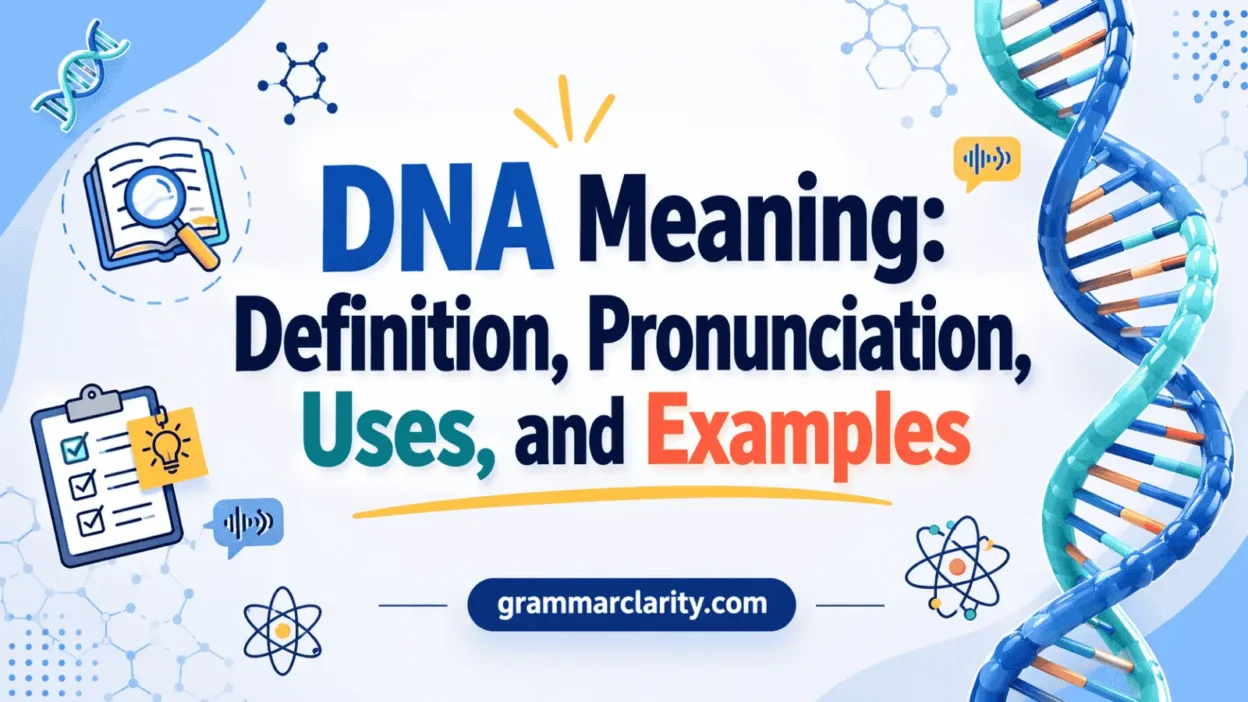
DNA is often described as a double helix. Many beginner sources compare it to a twisted ladder, which is a useful image for learners.
The “sides” of that ladder are made from sugar and phosphate. The “rungs” are base pairs, often shown as A, T, C, and G.
You do not need to memorize every chemical detail to understand the word DNA. For basic English use, it is enough to know that DNA is the information-carrying molecule inside living things.
Where People See the Word DNA
People often see DNA in:
• biology and health classes
• medical articles
• ancestry and family-history discussions
• crime and forensic shows
• news stories about science or medicine
You may also see DNA used in a metaphorical way. For example, “Service is in the brand’s DNA” means service is a core part of that brand’s identity. This is common, but it is still based on the idea of something fundamental.
Can DNA Mean Something Else?
Yes, in some contexts, DNA can mean something else. A few abbreviation sites list meanings such as Does Not Apply or Did Not Attend.
Still, the default meaning of DNA in general English is deoxyribonucleic acid. Unless the setting is clearly a form, schedule, or text shorthand, readers will usually understand the science meaning first.
A common mistake is assuming every use of DNA means biology.
Fix: check the sentence around it.
Examples:
• “Write DNA if the question does not apply to you.”
• “The patient DNA appointment line is unclear.”
• “DNA testing confirmed the match.”
DNA vs. Gene vs. Chromosome
These terms are related, but they are not the same. DNA is the material. A gene is a section of DNA. A chromosome is a larger structure that contains DNA.
| Context | Best Choice | Why |
|---|---|---|
| You mean the main genetic material | DNA | It names the molecule itself |
| You mean one instruction unit | Gene | A gene is part of DNA |
| You mean a packaged DNA structure | Chromosome | Chromosomes contain DNA |
This is one of the biggest points of confusion for learners. If you only remember one thing, remember this: genes are made of DNA.
Common Mistakes and Simple Fixes
Some learners mix up DNA and gene.
Correction: DNA is broader; a gene is one part of DNA.
Some writers use DNA for any family trait.
Correction: DNA is not the trait itself. It carries the instructions connected to traits.
Some readers think DNA always means science.
Correction: on forms or in some shorthand, it may mean something else. Context decides.
Examples of DNA in Sentences
Here are some natural examples:
• “DNA carries the instructions that help cells function.”
• “The detective asked the lab to test the DNA sample.”
• “Your DNA is not exactly the same as your brother’s.”
• “Trust is part of the company’s DNA.”
• “Please write DNA if this section does not apply.”
Related Terms, Synonyms, and Antonyms
Related terms include gene, chromosome, genome, and genetic information. These are linked ideas, but they are not perfect substitutes.
There is no exact everyday synonym for DNA in science writing. The closest match is the full form, deoxyribonucleic acid. In figurative writing, words like core, essence, or makeup may be close, but only in some sentences.
There is no true antonym for DNA in the scientific sense. It names a specific molecule, so an opposite word does not really fit.
Mini Quiz
- What does DNA stand for?
- Is DNA mainly used as a noun or a verb?
- Does DNA mean the same thing as a gene?
- How do you usually pronounce DNA?
- Can DNA mean something else outside science?
Answer Key
- Deoxyribonucleic acid.
- Noun.
- No. A gene is part of DNA.
- “Dee-en-ay.”
- Yes, in some contexts.
FAQ
What is DNA?
DNA is the molecule that carries genetic information in humans and most other living things. It helps store the instructions cells use to work and develop.
What does DNA stand for?
DNA stands for deoxyribonucleic acid. That is the full scientific name behind the abbreviation.
What is the meaning of DNA in simple words?
In simple words, DNA is the body’s instruction code. It helps explain how living things grow, function, and inherit traits.
Where is DNA found?
Most DNA is found in the cell nucleus. A smaller amount can also be found in mitochondria.
Is DNA a gene?
No. A gene is a section of DNA. DNA is the larger material that genes are made from.
How do you pronounce DNA?
Most people say it as “dee-en-ay.” That is the normal American English pronunciation.
Can DNA mean something else in text?
Yes. In some non-science contexts, DNA can mean things like Does Not Apply or Did Not Attend. Those meanings depend on context and are much less common than the science meaning.
Conclusion
The main DNA meaning is simple: it is the molecule that carries genetic instructions. It is usually a noun, it is pronounced “dee-en-ay,” and it is not the same as a gene.
Now that you know what DNA means, the next helpful step is learning how genes and chromosomes connect to it.