Last Updated: MAY 19, 2026
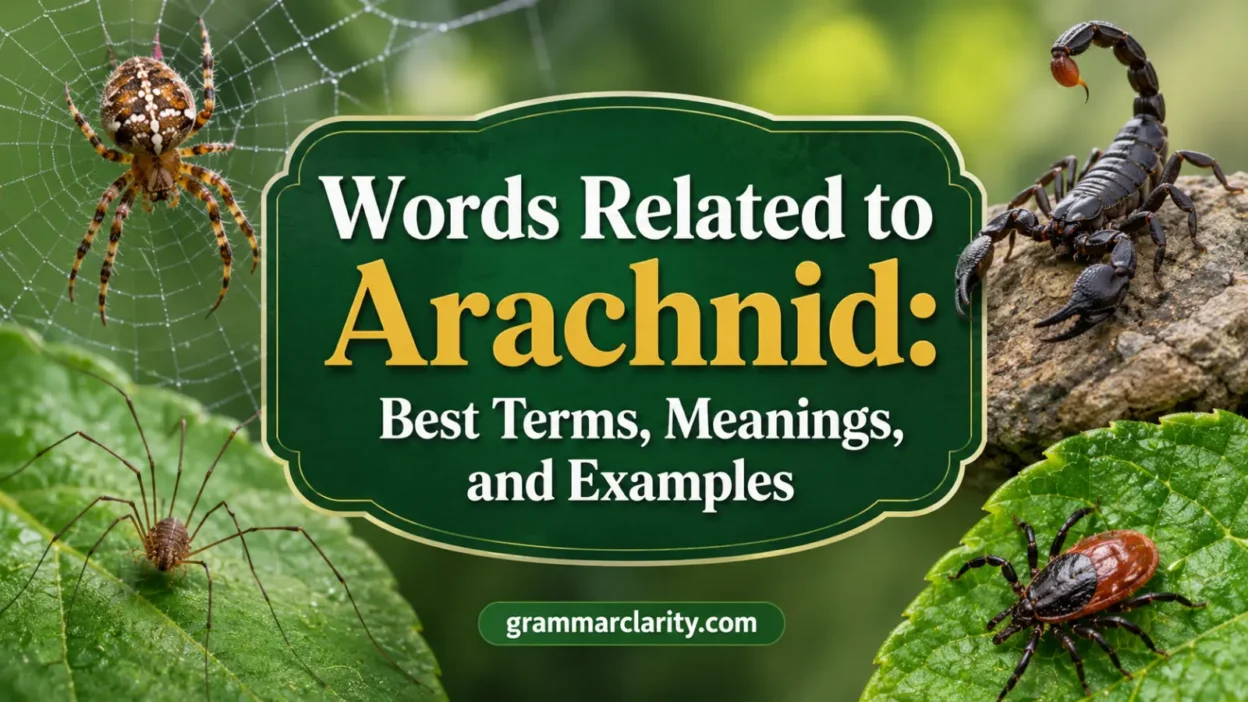
If you are looking for words related to arachnid, the best choices depend on the kind of connection you need. Some words are direct members of the arachnid group, such as spider, scorpion, tick, and mite. Others are broader scientific or descriptive words, such as arthropod, invertebrate, venom, web, and exoskeleton.
This distinction is important because a related word is not always an exact synonym. For example, a spider is an arachnid, but not every arachnid is a spider. In the same way, an arthropod can be an arachnid, but the word also includes insects, crustaceans, and other animals.
In this guide, you will learn the strongest words related to arachnid, how they connect to the topic, and how to use them correctly in writing.
Quick Answer
The best words related to arachnid include:
spider, scorpion, tick, mite, harvestman, pseudoscorpion, tarantula, arthropod, invertebrate, web, venom, fang, exoskeleton, pedipalp, predator, prey, bite, sting, and molt.
Use words like spider, scorpion, tick, and mite when you mean actual arachnids. Use broader words like arthropod, invertebrate, venom, web, and exoskeleton when you want scientific, descriptive, or contextual vocabulary.
What Does Arachnid Mean?
An arachnid is an animal that belongs to the class Arachnida. This group includes spiders, scorpions, ticks, mites, harvestmen, pseudoscorpions, and several other related animals.
Arachnids are part of the larger animal group called arthropods. Most adult arachnids have eight legs, no antennae, and a body structure different from insects. This is why spiders, ticks, and scorpions are not insects, even though people sometimes call them “bugs” in casual speech.
For a related-words article, vocabulary connected to arachnid usually falls into three groups:
- Direct members of the arachnid group
- Broader scientific classification words
- Context words connected to body parts, behavior, habitat, or description
This makes your word choice more accurate and useful.
Core Words Related to Arachnid
| Word | How It Relates | Best Use |
|---|---|---|
| Spider | One of the most familiar arachnids | Everyday writing, nature writing |
| Scorpion | A major type of arachnid | Desert, danger, wildlife, and science contexts |
| Tick | A parasitic arachnid | Outdoor, medical, and animal-related writing |
| Mite | A very small arachnid | Household, scientific, and pest-related contexts |
| Harvestman | An arachnid often called daddy longlegs | Precise animal writing |
| Pseudoscorpion | A small arachnid that resembles a tailless scorpion | Technical or educational writing |
| Tarantula | A large type of spider | Wildlife, pet, and descriptive writing |
| Arthropod | The larger animal group that includes arachnids | Scientific classification |
| Invertebrate | A broad animal category that includes arachnids | Educational writing |
| Web | Strongly associated with many spiders | Descriptive and everyday writing |
| Venom | Linked to some spiders and scorpions | Defense, hunting, and danger contexts |
| Exoskeleton | A hard outer body covering | Anatomy and science writing |
These words are stronger than random animal or “creepy” words because they have a clear connection to arachnids.
Words Related to Arachnid by Category
The easiest way to understand arachnid-related vocabulary is to group the words by meaning.
Direct Arachnid Members
These words refer to animals that belong to the arachnid group:
spider, scorpion, tick, mite, harvestman, pseudoscorpion, tarantula, whip spider, whip scorpion
These are the most direct words related to arachnid because they name actual arachnids.
Scientific Classification Words
These words are useful in school, biology, and educational writing:
Arachnida, arthropod, invertebrate, chelicerate, species, class, order
Use these when explaining how arachnids are classified or how they fit into the animal kingdom.
Body and Anatomy Words
These words describe the body parts or physical structure of arachnids:
exoskeleton, fang, pedipalp, abdomen, cephalothorax, leg, segment, chelicerae, spinneret
Some of these words apply more strongly to spiders than to all arachnids, so use them carefully.
Behavior and Survival Words
These words describe how arachnids move, hunt, feed, or protect themselves:
predator, prey, hunt, trap, crawl, molt, bite, sting, venom, ambush
These are useful when describing arachnids in nature or science writing.
Spider-Related Context Words
Because spiders are the most familiar arachnids, many related words come from spider behavior:
web, silk, spinneret, fang, venom, prey, web-building
These words are strongly connected to spiders, but they should not always be used for every arachnid.
Close Synonyms vs. Broader Related Words
One common mistake is treating every related word as a synonym. The word arachnid does not have many perfect everyday synonyms.
A word like spider is closely related, but it is not an exact synonym. A spider is one type of arachnid, but arachnids also include scorpions, ticks, mites, harvestmen, and others.
The same is true for scorpion, tick, and mite. These words name specific arachnids, not the whole group.
Broader words work differently. Arthropod and invertebrate are related to arachnid, but they are wider categories. An arachnid is an arthropod and an invertebrate, but not every arthropod or invertebrate is an arachnid.
Here is the safest way to think about it:
| Level | Example Words | Meaning |
|---|---|---|
| Exact topic word | arachnid | The main category |
| Direct member words | spider, scorpion, tick, mite | Specific animals within the group |
| Broader category words | arthropod, invertebrate, chelicerate | Larger scientific groups |
| Context words | web, venom, fang, exoskeleton | Related features or descriptions |
If you want the most familiar related word, spider is usually the best choice. However, it should only replace arachnid when the animal being discussed is actually a spider.
Words Related to Arachnid by Context
Different situations need different word choices. Here are the best arachnid-related words for common writing contexts.
For School or Science Writing
Use:
arachnid, Arachnida, arthropod, invertebrate, chelicerate, exoskeleton, pedipalp, species
Example:
Arachnids are arthropods, but they are not insects.
For Wildlife or Nature Writing
Use:
spider, scorpion, tick, mite, predator, prey, venom, burrow, crawl
Example:
The scorpion waited under the rock for passing prey.
For Household or Outdoor Writing
Use:
spider, tick, mite, pest, bite, infestation, web, crawl
Example:
Ticks and mites are small arachnids that can appear in outdoor or household contexts.
For Descriptive or Creative Writing
Use:
web, silk, crawling, shadowy, venomous, stinging, predatory, eight-legged
Example:
A thin web stretched across the corner of the old wooden shed.
For Technical Animal Identification
Use:
harvestman, pseudoscorpion, whip spider, whip scorpion, pedipalp, cephalothorax, chelicerae
Example:
The guide identified the tiny creature as a pseudoscorpion, not a true scorpion.
Example Sentences Using Arachnid-Related Words
Here are natural examples that show how these words can be used correctly:
- The museum exhibit included several arachnids, including spiders and scorpions.
- A tick is an arachnid, even though many people mistake it for an insect.
- The spider built a web between two branches.
- Scorpions use their sting for defense and hunting.
- Mites are tiny arachnids that can live in many different environments.
- A harvestman is related to spiders, but it is not the same as a true spider.
- The animal’s exoskeleton helps protect its body.
- Arachnids belong to the larger group of animals known as arthropods.
- The researcher studied the arachnid’s legs, body segments, and feeding behavior.
- In desert writing, scorpion is often a stronger related word than spider because it gives clearer setting and mood.
Common Mistakes When Choosing Words Related to Arachnid
1. Using “Insect” as a Synonym for Arachnid
This is one of the biggest mistakes. Arachnids are not insects. Insects usually have six legs, while most adult arachnids have eight legs. Insects also have antennae, but arachnids do not.
You can mention insect when comparing the two groups, but it should not be used as a direct synonym for arachnid.
2. Treating “Spider” as a Perfect Replacement
A spider is an arachnid, but arachnid does not always mean spider. If you are talking about the whole group, use arachnid. If you are talking specifically about spiders, use spider.
3. Using Vague Words Like “Bug” or “Pest”
Words like bug, creepy-crawly, or pest may work in casual writing, but they are not strong scientific related words. They are vague and sometimes inaccurate.
For better writing, choose words with a clear biological or descriptive connection.
4. Mixing Up Broad and Specific Terms
Words like arthropod and invertebrate are broader than arachnid. They are related, but they do not mean exactly the same thing.
Use them when explaining classification, not when you need a precise replacement.
Quick Reference List of Arachnid-Related Words
Here is a clean list of useful words related to arachnid:
arachnid, Arachnida, spider, scorpion, tick, mite, harvestman, pseudoscorpion, tarantula, whip spider, whip scorpion, arthropod, invertebrate, chelicerate, exoskeleton, fang, pedipalp, cephalothorax, abdomen, chelicerae, web, silk, spinneret, venom, predator, prey, molt, bite, sting, crawl, hunt
This list includes direct arachnid names, scientific terms, body-part words, and descriptive vocabulary.
Best Everyday Words Related to Arachnid
For most readers, the best everyday words related to arachnid are:
spider, scorpion, tick, mite, arthropod, web, venom, and exoskeleton
These words are simple, accurate, and useful in many types of writing.
Use spider for the most familiar example.
Use scorpion for desert, danger, or wildlife contexts.
Use tick and mite for outdoor, medical, or household topics.
Use arthropod for scientific classification.
Use web, venom, and exoskeleton for description and supporting details.
FAQs
What is another word for arachnid?
There is no perfect everyday synonym for arachnid. The closest related words are spider, scorpion, tick, and mite, but these are specific types of arachnids, not exact replacements for the whole group.
Is a spider an arachnid?
Yes. A spider is an arachnid. Spiders belong to the class Arachnida, along with scorpions, ticks, mites, harvestmen, and pseudoscorpions.
Is a scorpion an arachnid?
Yes. A scorpion is an arachnid. Scorpions are closely related to spiders and share common arachnid features, such as eight legs as adults and no antennae.
Are ticks and mites arachnids?
Yes. Ticks and mites are arachnids. Many people mistake them for insects, but they belong to the arachnid group.
Is an arachnid the same as an insect?
No. Arachnids and insects are different animal groups. Most adult arachnids have eight legs and no antennae, while insects usually have six legs and antennae.
What are descriptive words for arachnids?
Good descriptive words for arachnids include eight-legged, venomous, web-building, predatory, crawling, small, nocturnal, and exoskeletal. However, not every description applies to every arachnid.
What is the most common word related to arachnid?
The most common related word is spider. It is the arachnid most people recognize first, but it should not be used as a synonym for all arachnids.
Conclusion
The best words related to arachnid depend on the meaning you want. Use spider, scorpion, tick, mite, harvestman, and pseudoscorpion for direct members of the arachnid group. Use arthropod, invertebrate, and chelicerate for scientific classification. Use web, venom, fang, exoskeleton, and predator for descriptive or contextual writing.
The key is to avoid confusing related words with exact synonyms. Spider is closely related to arachnid, but it does not mean the same thing in every sentence. Once you understand the difference between direct members, broader categories, and context words, choosing the right word becomes much easier.