Has vs have is a common grammar choice because both words come from the same verb: have. The difference is not about meaning. It is about the subject of the sentence.
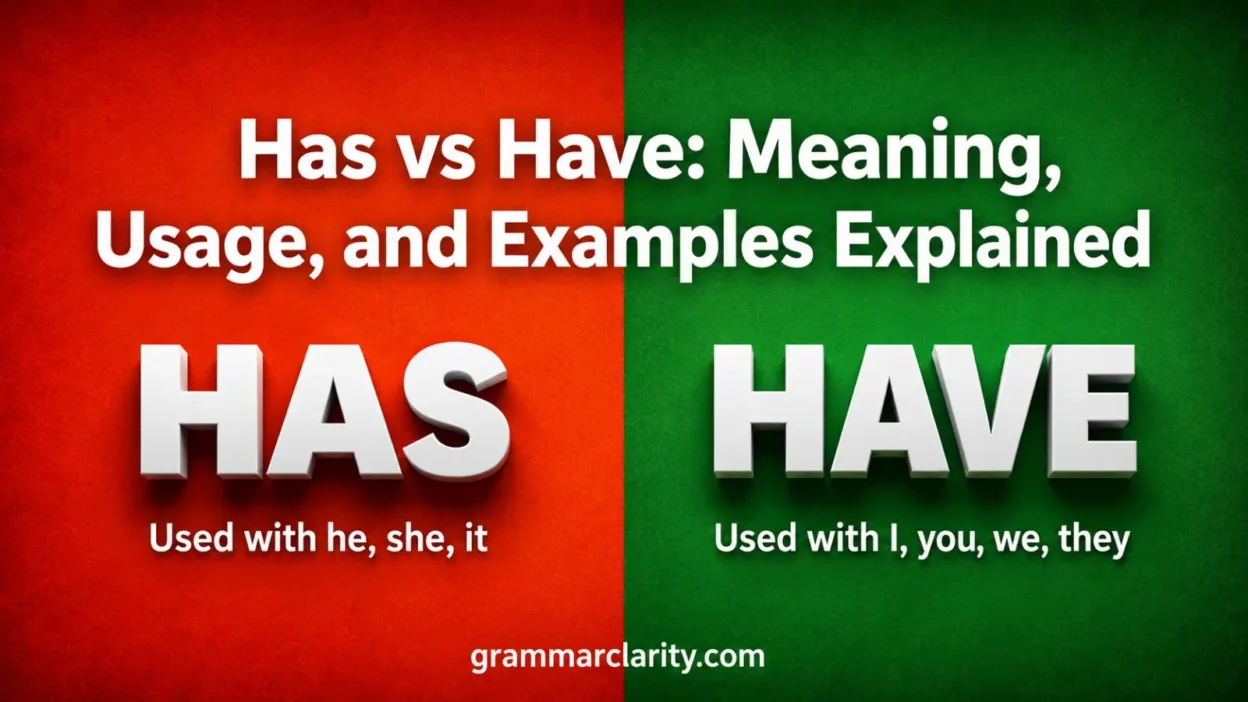
Use has with he, she, it, and singular nouns.
Use have with I, you, we, they, and plural nouns.
That simple subject rule solves most mistakes.
Quick Answer
Use has when the subject is third-person singular.
Examples:
- She has a meeting today.
- Mark has two dogs.
- The house has a large kitchen.
Use have with I, you, we, they, and plural subjects.
Examples:
- I have a question.
- You have a good point.
- We have enough time.
- The students have their books.
Why People Confuse Them
People confuse has and have because they express the same basic idea: possession, connection, experience, or completion.
For example:
- She has a car.
- They have a car.
Both sentences talk about possession. The only reason the verb changes is the subject.
The confusion also appears in perfect tense sentences:
- He has finished the report.
- They have finished the report.
Again, the meaning is similar, but the subject controls the verb form.
Key Differences At A Glance
| Context | Best Choice | Why |
|---|---|---|
| He, she, it | has | These are third-person singular subjects. |
| One person’s name | has | A single named person takes has. |
| One singular thing | has | A singular noun takes has. |
| I | have | I always takes have in the present tense. |
| You | have | You takes have whether singular or plural. |
| We, they | have | These are plural pronouns. |
| Plural nouns | have | More than one person or thing takes have. |
| Questions with do/does | have | Use the base form after do or does. |
| Negative sentences with don’t/doesn’t | have | Use have after don’t or doesn’t. |
Compact comparison:
- Has = used with one third-person subject.
- Have = used with I, you, we, they, and plurals.
- Has often appears after he, she, it, a name, or a singular noun.
- Have often appears after I, you, we, they, or plural nouns.
Meaning and Usage Difference
Has and have are present-tense forms of the verb have. They can show possession, relationships, qualities, experiences, duties, or completed actions.
Use has when the subject is singular and third person.
Examples:
- My sister has a new phone.
- The company has a strict policy.
- This recipe has six ingredients.
Use have with first person, second person, and plural subjects.
Examples:
- I have a new phone.
- You have several options.
- Our neighbors have a dog.
In present perfect sentences, has and have work as helping verbs.
Examples:
- She has visited Chicago.
- We have visited Chicago.
- The package has arrived.
- The packages have arrived.
Tone, Context, and Formality
There is no major tone difference between has and have. One is not more formal, casual, polite, or professional than the other.
The correct choice depends on grammar, not style.
In everyday speech:
- He has a cold.
- They have a cold.
In formal writing:
- The applicant has relevant experience.
- The applicants have relevant experience.
In professional communication:
- The client has approved the design.
- The clients have approved the design.
The tone changes because of the full sentence, not because of has or have alone.
Which One Should You Use?
Choose has when the subject means one person, one place, one thing, or one idea in the third person.
Use has with:
- he
- she
- it
- a person’s name
- a singular noun
- a singular collective idea treated as one unit
Examples:
- He has a dentist appointment.
- Jessica has the final copy.
- The store has a new manager.
- The plan has one problem.
Choose have with:
- I
- you
- we
- they
- plural nouns
Examples:
- I have the receipt.
- You have my full attention.
- We have a solution.
- The managers have the files.
When One Choice Sounds Wrong
Some mistakes sound wrong immediately because the subject and verb do not match.
Incorrect:
- She have a car.
Correct:
- She has a car.
Incorrect:
- They has a car.
Correct:
- They have a car.
Incorrect:
- The dog have a collar.
Correct:
- The dog has a collar.
Incorrect:
- The dogs has collars.
Correct:
- The dogs have collars.
A special mistake happens in questions and negatives. After does, use have, not has.
Incorrect:
- Does she has your number?
Correct:
- Does she have your number?
Incorrect:
- He doesn’t has a laptop.
Correct:
- He doesn’t have a laptop.
Common Mistakes (and Quick Fixes)
A common mistake is choosing the verb by meaning instead of subject.
Incorrect:
- My parents has a house in Texas.
Correct:
- My parents have a house in Texas.
Why: Parents is plural.
Another common mistake is using has after does.
Incorrect:
- Does the office has parking?
Correct:
- Does the office have parking?
Why: After does, the main verb stays in its base form.
Writers also make mistakes with long subjects.
Incorrect:
- The list of emergency contacts have been updated.
Correct:
- The list of emergency contacts has been updated.
Why: The main subject is list, not contacts.
Everyday Examples
- I have a few minutes before lunch.
- She has a doctor’s appointment at 3 p.m.
- They have two kids.
- The restaurant has outdoor seating.
- We have a lot to discuss.
- My brother has your charger.
- The files have already been uploaded.
- This phone has a better camera.
- You have every reason to ask.
- The neighbors have a security camera.
Dictionary-Style Word Details
Verb
Has is a present-tense form of have used with third-person singular subjects.
Examples:
- He has a plan.
- The school has a new principal.
Have is used with I, you, we, they, and plural nouns in the present tense.
Examples:
- I have a plan.
- The schools have new principals.
Noun
Have can also appear as a noun, usually meaning a person or group with wealth, power, or advantages. This use is much less common than the verb.
Example:
- The policy created tension between the haves and the have-nots.
Has is not normally used as a standard noun in everyday writing.
Synonyms
Depending on the sentence, has and have may mean:
- owns
- holds
- contains
- includes
- possesses
- experiences
- receives
Examples:
- She has a ticket.
She owns or holds a ticket. - The box has three cables.
The box contains three cables. - We have a problem.
We are experiencing a problem.
Example Sentences
- He has a strong work ethic.
- I have the address saved.
- The laptop has a cracked screen.
- The laptops have cracked screens.
- She has already called.
- They have already called.
- Does your apartment have a balcony?
- The apartment has a balcony.
Word History
Has and have are not separate words with separate meanings. They are different forms of the same verb. In modern English, the form changes based on the subject in the present tense.
For most everyday writing, the history matters less than the pattern:
- one third-person subject → has
- I, you, we, they, or plural subject → have
Phrases Containing
Common phrases with has:
- has to
- has been
- has got
- has no idea
- has a chance
- has the right to
Common phrases with have:
- have to
- have been
- have got
- have no idea
- have a chance
- have the right to
Examples:
- She has to leave early.
- We have to leave early.
- He has been waiting.
- They have been waiting.
FAQs
Is it “she has” or “she have”?
The correct phrase is she has.
Example:
- She has a new job.
Use has because she is third-person singular.
Is it “I has” or “I have”?
The correct phrase is I have.
Example:
- I have a question.
Even though I refers to one person, it takes have, not has.
Is it “you has” or “you have”?
The correct phrase is you have.
Example:
- You have a good idea.
Use have with you whether you are speaking to one person or more than one person.
Is it “does she has” or “does she have”?
The correct phrase is does she have.
Example:
- Does she have your phone number?
After does, use the base form have.
Is it “the team has” or “the team have”?
In American English, the team has is usually correct when the team is treated as one unit.
Example:
- The team has a new coach.
Use have only if the sentence clearly focuses on the individual members, but that is less common in standard US writing.
Is it “has been” or “have been”?
Both can be correct. The subject decides.
Examples:
- She has been busy.
- They have been busy.
- The report has been updated.
- The reports have been updated.
FAQs
Is it “has” or “have” with I?
Use have with I.
Example:
I have a question.
Do not write:
I has a question.
Is it “has” or “have” with you?
Use have with you.
Example:
You have a good idea.
This is true whether you means one person or more than one person.
Is it “has” or “have” with he, she, and it?
Use has with he, she, and it.
Examples:
- He has a meeting.
- She has a new phone.
- It has a small screen.
Is it “has” or “have” with they?
Use have with they.
Example:
They have two cars.
Do not write:
They has two cars.
Is it “does she has” or “does she have”?
The correct phrase is does she have.
Example:
Does she have your number?
After does, use have, not has.
Is it “the team has” or “the team have”?
In American English, the team has is usually correct because team is treated as one group.
Example:
The team has a new coach.
Is it “has been” or “have been”?
Both can be correct. The subject decides which one to use.
Examples:
- She has been busy.
- They have been busy.
- The report has been updated.
- The reports have been updated.
What is the easiest way to remember has vs have?
Use this simple rule:
- Has = he, she, it, singular noun
- Have = I, you, we, they, plural noun
Examples:
- Sarah has a laptop.
- We have a laptop.
- The cat has green eyes.
- The cats have green eyes.
Conclusion
The difference between has vs have depends on the subject, not the meaning.
Use has with he, she, it, and singular nouns.
Use have with I, you, we, they, and plural nouns.
For questions and negatives with do or does, use have:
- Does he have time?
- She doesn’t have a car.
Once you identify the subject, the choice becomes simple.