“Other” and “another” are two English words that look closely connected, and in many situations they seem almost interchangeable. Because of that, learners and even fluent speakers sometimes stop and ask: Should I use “other” or “another”?
The answer depends mainly on number and sentence structure.
In simple terms:
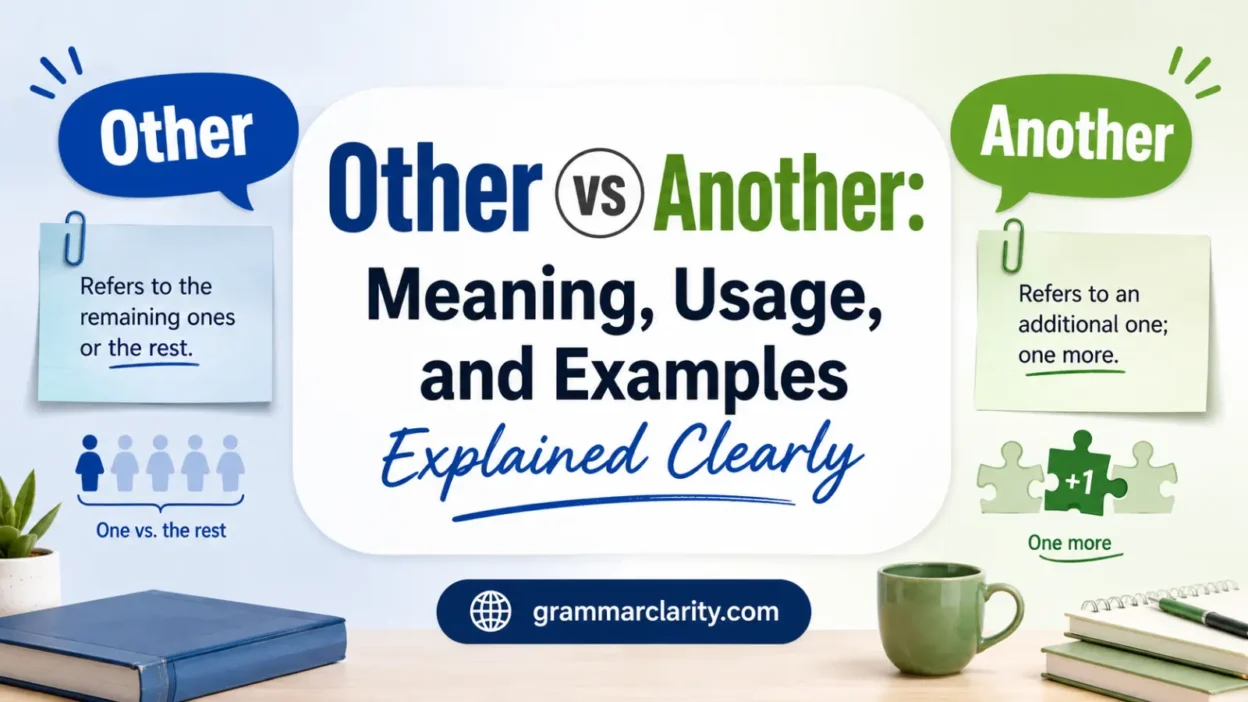
- Another usually means one more or a different single thing.
- Other usually means different, additional, or remaining people or things.
Compare these sentences:
- I need another pen. ✔
- I need other pens. ✔
Both are correct, but they do not mean the same thing.
The first sentence asks for one extra pen. The second talks about different pens or more than one pen.
Understanding this difference makes everyday English much easier because these words appear everywhere—in conversations, work emails, school writing, shopping, travel, and daily life.
This guide explains exactly how they work, when to use each one, and how to avoid common mistakes.
Quick Answer
Use another when talking about one additional item or one different item.
Examples:
- Can I have another cookie?
- Let’s choose another movie.
- I need another notebook.
Use other when talking about plural nouns, uncountable nouns, or different choices in general.
Examples:
- We looked at other apartments.
- Do you have other questions?
- We need other information.
A quick memory trick is:
another = one more
other = different or additional
Why People Confuse Them
People confuse these words because they come from the same idea of difference.
Look at these examples:
- another option
- other options
Both sentences talk about alternatives.
That overlap makes them easy to mix up.
The confusion becomes stronger because “another” actually developed from an + other. So visually they seem almost identical.
But grammar changes everything.
“Another” generally stays connected to one countable thing:
- another chair
- another day
- another idea
“Other” works more broadly:
- other chairs
- other ideas
- other advice
Because both words can refer to alternatives, many learners accidentally use one where the other belongs.
Examples:
❌ another books
✔ other books
❌ other cookie
✔ another cookie
The meaning may still be understood, but the grammar sounds wrong.
Key Differences At A Glance
| Context | Best Choice | Why |
|---|---|---|
| One extra object | another | Means one more |
| Different single item | another | Refers to one alternative |
| Multiple items | other | Works with plural nouns |
| Uncountable nouns | other | Fits non-count nouns |
| General alternatives | other | Refers to different choices |
| Extra single chance | another | Means one more opportunity |
Quick Comparison Block
Other
- Usually used with plural nouns
- Can work with uncountable nouns
- Means different, additional, remaining
- Broader usage
Another
- Usually used with singular countable nouns
- Means one more or different one
- Refers to a single item in most cases
- More limited structure
Meaning and Usage Difference
The biggest difference between these words is how many things they refer to.
Understanding “Another”
“Another” usually points to one thing.
It can mean:
1. One more
Examples:
- I’d like another cup of coffee.
- She bought another notebook.
- We ordered another pizza.
In these examples, the speaker already has one and wants an extra one.
2. A different one
Examples:
- Let’s try another restaurant.
- Pick another shirt.
- We need another plan.
The meaning changes slightly here.
Now it means a different choice, but still only one.
3. One additional opportunity or time
Examples:
- Give me another chance.
- Let’s meet another day.
- We can talk another time.
Again, the idea remains singul
Understanding “Other”
“Other” is more flexible.
It often means:
Different people or things
Examples:
- We visited other cities.
- She considered other careers.
- They explored other options.
Additional things
Examples:
- Do you have other questions?
- We discussed other topics.
- Bring other supplies.
Remaining items
Examples:
- One shoe is here. Where is the other shoe?
- I finished one half; you take the other half.
“Other” can describe things that are different, extra, or remaining.
That makes it wider in use than “another.”
Parts of Speech
These words do not behave exactly the same way.
Another
Usually works as:
- determiner
- pronoun
Examples:
Determiner:
- another sandwich
Pronoun
Other
Can work as:
- determiner
- pronoun in some structures
Examples:
Determiner:
- other people
Pronoun:
- One student stayed. The other left.
Tone, Context, and Formality
A common question is whether one word sounds more formal.
The answer is no.
Both words work naturally in:
- casual speech
- professional settings
- school writing
- business communication
- academic work
Examples in conversation:
“Want another slice?”
“Do you have other ideas?”
Professional example:
“We need another meeting next week.”
“We reviewed other proposals.”
Both sound normal.
The difference is grammar—not tone.
Formal Writing Example
Academic sentence:
Researchers examined other factors affecting results.
Correct because multiple factors are involved.
Academic sentence:
The team proposed another explanation.
Correct because only one explanation is added.
Workplace Example
Manager:
“We need another designer.”
Meaning: hire one more person.
Manager:
“We need other designers.”
Meaning: different designers or multiple additional designers.
Small grammar changes create different meanings.
Which One Should You Use?
Ask yourself one question:
Am I talking about one thing or more than one thing?
If it is one additional thing, use another.
Examples:
- another cookie
- another meeting
- another opportunity
- another notebook
If it is plural, use other.
Examples:
- other books
- other choices
- other employees
- other restaurants
If it is uncountable, use other.
Examples:
- other information
- other advice
- other evidence
- other furniture
Quick Test
Sentence:
I need ___ chair.
Correct:
another chair ✔
Because chair is singular.
Sentence:
I need ___ chairs.
Correct:
other chairs ✔
Because chairs is plural.
Sentence:
Do you have ___ information?
Correct:
other information ✔
Because information is uncountable.
When One Choice Sounds Wrong
Sometimes both words seem possible, but only one fits.
Example 1
❌ another books
✔ other books
Why?
Books = plural.
“Another” usually stays singular.
Example 2
❌ other cookie please
✔ another cookie please
Cookie = singular countable noun.
One extra cookie = another.
Example 3
❌ another information
✔ other information
Information cannot normally be counted.
So “another” does not fit.
Example 4
❌ another shoes
✔ other shoes
Shoes are plural.
Use “other.”
Example 5
❌ other chance please
✔ another chance please
One extra chance = another.
Example 6
❌ We need another employees.
✔ We need other employees.
Employees = plural.
Small grammar details create natural English.
Common Mistakes (and Quick Fixes)
Below are some of the most common mistakes.
Mistake 1: Using “another” with plural nouns
Wrong:
another books
Correct:
other books
Wrong:
another cars
Correct:
other cars
Rule:
Plural noun = other
Mistake 2: Using “other” for one additional thing
Wrong:
other coffee please
Correct:
another coffee please
Wrong:
other sandwich
Correct:
another sandwich
Rule:
One extra item = another
Mistake 3: Using “another” with uncountable nouns
Wrong:
another advice
Correct:
other advice
Wrong:
another furniture
Correct:
other furniture
Wrong:
another evidence
Correct:
other evidence
Mistake 4: Forgetting meaning changes
Sentence:
We need another manager.
Meaning:
Hire one more manager.
Sentence:
We need other managers.
Meaning:
Different managers.
Grammar changes meaning.
Mistake 5: Confusing “the other”
Example:
I have two bags.
One is blue. The other is black.
“The other” means the remaining one.
It is not the same as “another.”
Compare:
another bag = one more bag
the other bag = remaining bag
Everyday Examples
At a Coffee Shop
Customer:
Can I get another latte?
Barista:
We also have other flavors.
At Work
Manager:
Schedule another meeting.
Employee:
We also reviewed other plans.
At School
Teacher:
Try another example.
Student:
Can we discuss other topics too?
At Home
Parent:
Take another plate.
Child:
Where are the other plates?
Shopping
Customer:
Do you have another size?
Employee:
Yes, and we have other colors too.
Travel
Traveler:
Let’s visit another city tomorrow.
Friend:
We should also check other attractions.
Entertainment
Person:
Let’s watch another episode.
Friend:
We could also start other shows.
Sports
Coach:
Take another turn.
Player:
Can the other team practice now?
Technology
User:
I need another charger.
Store worker:
We also sell other accessories.
Daily Conversation
“Can I have another minute?”
“Do you have other suggestions?”
“Let’s pick another table.”
“What other restaurants are nearby?”
Dictionary-Style Word Details
Verb
other: Not commonly used as a verb in standard US English.
Example:
Modern English rarely uses it as a verb.
another: Not commonly used as a verb in standard US English.
It is not used as a regular verb.
Noun
other
Can function like a pronoun.
Examples:
- One child laughed; the other cried.
- This side is finished. Use the other.
Meaning:
Remaining person or thing.
another
Can function as a pronoun meaning one more.
Examples:
- I ate one cookie and wanted another.
- One laptop broke, so we bought another.
Meaning:
Additional item.
Synonyms
other
Closest plain alternatives:
- different
- alternative
- additional
- remaining
Possible opposite:
- same
another
Closest plain alternatives:
- one more
- extra
- additional one
- different one
Possible opposite:
- same one
These are not perfect replacements in every sentence, but they express similar ideas.
Example Sentences
Other
- We visited other neighborhoods.
- She explored other career paths.
- Do you have other ideas?
- We looked at other apartments.
- The company reviewed other options.
- Bring the other bag.
- We need other information.
Another
- I ordered another coffee.
- Let’s try another restaurant.
- He bought another phone charger.
- We need another volunteer.
- She asked for another chance.
- Pick another color.
- Can we meet another day?
Word History
Other
“Other” comes from older English forms connected to the idea of something different or remaining.
Its historical use is broad and developed across many stages of English.
Another
“Another” developed from combining an and other.
That origin helps explain why it usually refers to one additional item.
The idea of singular meaning remains visible today.
Phrases Containing
Other
- other people
- other options
- other than
- other side
- other things
- the other hand
- other information
Examples:
“Ask other people.”
“We discussed other options.”
Another
- another chance
- another day
- another time
- another story
- another example
- another opportunity
- another one
Examples:
“Give me another chance.”
“We’ll talk another time.”
FAQs
Is it “other” or “another” for one extra thing?
Use “another” for one extra thing.
Examples:
- Can I have another cookie? ✔
- We need another chair. ✔
“Another” means one more.
Can “other” and “another” mean the same thing?
They can both suggest something different, but they are not always interchangeable.
Compare:
- Let’s try another restaurant.
(one different restaurant) - Let’s try other restaurants.
(different restaurants, usually more than one)
The meaning changes with number.
Do I use “another” with plural nouns?
Usually, no.
Wrong:
❌ another books
Correct:
✔ other books
“Another” normally goes with singular countable nouns.
Examples:
- another pen
- another idea
- another meeting
Can “other” be used with uncountable nouns?
Yes.
Examples:
- other information
- other advice
- other evidence
- other furniture
Since these nouns are uncountable, “other” is the correct choice.
What is the difference between “another” and “the other”?
Another means one more or a different one.
Example:
- I need another notebook.
The other means the remaining one.
Example:
- I have two bags. One is blue; the other is black.
Is “another information” correct?
No.
Incorrect:
❌ another information
Correct:
✔ other information
“Information” is uncountable, so use other.
Can “another” be used without a noun?
Yes.
“Another” can work as a pronoun.
Examples:
- I finished one slice and wanted another.
- One battery died, so I bought another.
Here, the noun is understood from context.
Which is correct: “another day” or “other day”?
Both exist, but they mean different things.
Another day = one more day or a different day
Example:
- Let’s meet another day.
The other day = recently, a few days ago
Example:
- I saw him the other day.
Can I say “other one”?
Yes.
Examples:
- This phone is broken. Use the other one.
- I like the blue shirt better than the other one.
“Other one” usually means the remaining or alternative item.
What is the easiest rule to remember for other vs another?
Use this quick rule:
another = one more
other = different or additional
Examples:
- another cup ✔
- other cups ✔
- another chance ✔
- other ideas ✔
Conclusion
The difference between other and another becomes much easier once you focus on number.
Use another when talking about:
- one more item
- one different thing
- one extra opportunity
Examples:
- another coffee
- another day
- another idea
Use other when talking about:
- plural nouns
- uncountable nouns
- different or remaining things
Examples:
- other books
- other advice
- other people
Remember this quick rule:
another = one more
other = different or additional
That single idea will help you choose correctly in most everyday situations.