Many English learners and native speakers pause when choosing between another and the other.
Both words talk about something additional, but they do not mean the same thing.
This confusion usually appears in sentences like:
Should I say “another coffee” or “the other coffee”?
Is it “another shoe” or “the other shoe”?
The answer depends on what you mean.
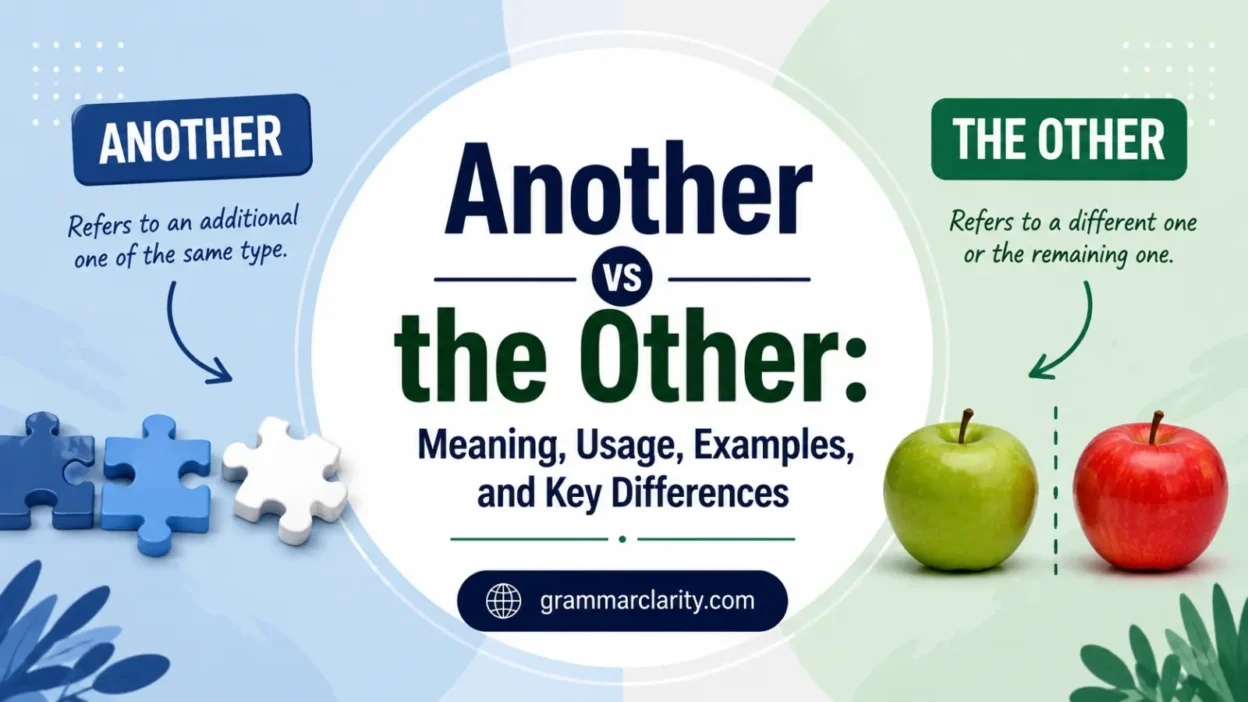
Use another when talking about one more, an extra one, or a different one.
Use the other when talking about the remaining one or a specific second choice.
That difference may seem small, but it changes the meaning of the sentence completely.
Understanding this rule helps you sound more natural and avoid common mistakes.
Quick Answer
The short answer is easy:
Another = one more / an additional one / a different one
The other = the remaining one / the second specific item
Examples:
- Can I have another cookie?
- One cookie is gone, but the other cookie is still here.
Compare these:
- I need another pen.
- I found one pen. The other pen is missing.
The first sentence asks for an extra pen.
The second sentence talks about the remaining pen.
Why People Confuse Them
People confuse these words because both refer to something additional.
At first glance, they seem similar.
Look at these sentences:
- I want another sandwich.
- I want the other sandwich.
They sound close, but the meaning changes.
The first sentence means:
I want one more sandwich.
The second sentence means:
I want the specific sandwich that remains or the second option.
The confusion often happens because English uses both words around quantity and choice.
But the key difference is this:
Another is general.
The other is specific.
Think about it this way:
If you are adding something, use another.
If you are pointing to something already known, use the other.
Key Differences At A Glance
| Context | Best Choice | Why |
|---|---|---|
| Asking for one more item | another | Means additional |
| Referring to the remaining item | the other | Means what is left |
| Talking about a second known option | the other | Refers to a specific item |
| Asking for extra quantity | another | Means one more |
| Choosing between two items | the other | Refers to the second choice |
Quick Comparison
| Feature | another | the other |
|---|---|---|
| Main meaning | one more | remaining one |
| Type | general | specific |
| Quantity idea | additional | remaining |
| Common use | extra item | known item |
| Example | another book | the other book |
Meaning and Usage Difference
The biggest difference between another and the other is meaning.
Meaning of “another”
Another means:
- one more
- an additional one
- a different one
Examples:
- I need another cup of tea.
- Let’s try another route.
- Can you give me another example?
In all these examples, the speaker wants something extra.
Nothing specific is being pointed out.
Meaning of “the other”
The other means:
- the remaining one
- the second known item
- the specific alternative
Examples:
- One glove is wet and the other is dry.
- I finished one chapter yesterday. I’ll read the other tonight.
- One child laughed while the other stayed quiet.
Here, we already know what is being discussed.
The speaker points to a particular remaining thing.
Grammar Role
These expressions can work as determiners and pronouns.
Another:
- another idea
- another arrived later
The other:
- the other book
- the other stayed home
Examples:
- One student left and another came in.
- One student left while the other remained seated.
Tone, Context, and Formality
There is no major formality difference between these expressions.
Both are standard in everyday American English.
You can use them in:
- school writing
- business communication
- daily conversation
- emails
- professional settings
The difference comes from meaning.
Another feels open and flexible.
Example:
- I’d like another opportunity.
This means one more opportunity.
The other feels definite.
Example:
- We looked at two houses and bought the other one.
Now the speaker refers to a known option.
Compare:
- Let’s visit another store.
- Let’s visit the other store.
The first means a different store.
The second means the remaining store.
Which One Should You Use?
Use another when you mean:
One more
Examples:
- Can I get another slice of pizza?
- She ordered another drink.
- We need another chair.
An extra item
Examples:
- Please bring another towel.
- I bought another notebook.
- He opened another file.
A different choice
Examples:
- Let’s choose another movie.
- Try another color.
- Pick another answer.
Use the other when you mean:
The remaining item
Examples:
- One sock is blue and the other is black.
- One shoe is here. The other is missing.
The second known option
Examples:
- We visited one café yesterday and the other today.
- One road was closed, so we took the other road.
A specific alternative
Examples:
- I liked one jacket but bought the other.
- One idea worked while the other failed.
When One Choice Sounds Wrong
Some sentences become incorrect when these words are switched.
Example 1:
Wrong:
I lost one glove and another is under the bed.
Correct:
I lost one glove and the other is under the bed.
Reason:
Only one glove remains.
Example 2:
Wrong:
Can I have the other coffee?
Correct:
Can I have another coffee?
Reason:
The speaker wants more coffee.
Example 3:
Wrong:
There are two laptops. Use another one.
Correct:
There are two laptops. Use the other one.
Reason:
Only one alternative remains.
Example 4:
Wrong:
Let’s visit the other restaurant.
Correct:
Let’s visit another restaurant.
Reason:
The speaker means a different restaurant, not a known remaining one.
Common Mistakes (and Quick Fixes)
Mistake 1: Using “another” for the remaining item
Wrong:
One key is mine and another is yours.
Correct:
One key is mine and the other is yours.
Quick fix:
If only one item remains, use the other.
Mistake 2: Using “the other” when asking for more
Wrong:
I’d like the other soda.
Correct:
I’d like another soda.
Quick fix:
If you mean extra quantity, use another.
Mistake 3: Forgetting specificity
Wrong:
We visited one park and then the other park.
Correct:
We visited one park and then another park.
Quick fix:
Use another if the second item is not specific.
Mistake 4: Confusing “different” and “remaining”
Wrong:
Let’s try the other idea.
Correct:
Let’s try another idea.
Reason:
The speaker means a different idea.
Everyday Examples
At home
- Can you bring another blanket?
- One pillow is clean and the other needs washing.
- We need another spoon.
- One plate broke and the other survived.
At school
- The teacher gave us another assignment.
- One student answered first and the other followed.
- I need another pencil.
- One notebook is full and the other is empty.
At work
- Let’s schedule another meeting.
- One report is complete and the other still needs edits.
- We need another copy.
- One manager approved it and the other requested changes.
Shopping
- I’d like another size.
- One pair fits and the other feels tight.
- Show me another color.
- One bag is expensive and the other is cheaper.
Travel
- Let’s take another route.
- One road is blocked and the other remains open.
- We booked another hotel.
- One flight was canceled and the other departed on time.
Dictionary-Style Word Details
Verb
another: Not commonly used as a verb in standard American English.
the other: Not used as a verb in standard American English.
Noun
another: Can function like a pronoun meaning an additional person or thing.
Examples:
- One guest left and another arrived.
- I finished one task and started another.
the other: Can function like a pronoun meaning the remaining person or thing.
Examples:
- One cookie is yours and the other is mine.
- One player scored while the other defended.
Synonyms
another
Closest plain alternatives:
- one more
- extra
- additional
- different one
the other
Closest plain alternatives:
- remaining one
- second one
- alternate one
- remaining item
Strong antonyms do not naturally apply here.
Example Sentences
another
- She ordered another coffee.
- We need another volunteer.
- Try another option.
- He bought another jacket.
- Let’s watch another episode.
the other
- One shoe fits and the other does not.
- One phone works while the other is broken.
- I liked one painting but bought the other.
- One child slept while the other played.
- One light was on and the other was off.
Word History
Another developed from older English forms meaning an other and gradually came to mean one more or an additional one.
The other has long been used to refer to the remaining or second item in a group.
Exact historical dates are not needed to understand the modern distinction.
Phrases Containing
another
- another day
- another chance
- another time
- another example
- another story
the other
- the other hand
- the other side
- the other person
- the other one
- the other team
FAQs
Is “another” the same as “the other”?
No.
Another means one more or an additional one.
The other means the remaining one or a specific second item.
Can I use “another” for two items?
Usually no.
When talking about two known items, the other is usually correct.
Example:
One shoe is here and the other is missing.
Is “another” always singular?
Yes, it commonly works with singular countable nouns.
Example:
- another book
- another chair
- another idea
When should I use “the other”?
Use the other when referring to the remaining item or second known choice.
Example:
One ticket is mine and the other is yours.
Which sounds more formal?
Neither.
Both are standard and natural in American English.
Can “another” mean “different”?
Yes.
Example:
Let’s try another restaurant.
Here, another means a different restaurant.
What is an easy rule to remember?
Use this:
another = one more
the other = the remaining one
Conclusion
The difference between another and the other becomes easy once you remember one rule.
Use another for one more, extra, or different.
Use the other for the remaining one or the second known choice.
Remember this shortcut:
another = additional
the other = remaining
Examples:
- I need another notebook.
- One notebook is full and the other is empty.
That small difference makes your writing clearer and more natural.