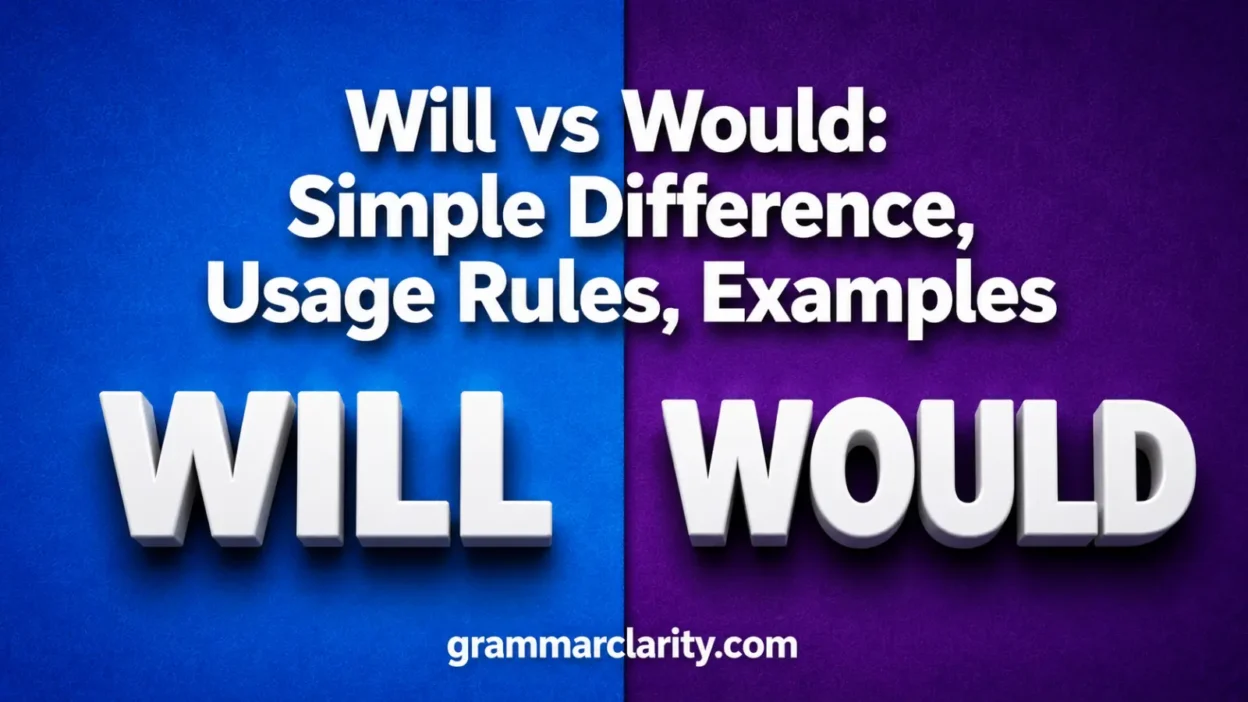
Will vs would is a common grammar choice because both words can point to the future, both can appear in requests, and both work as helping verbs. The difference is not random.
Use will for real future actions, promises, predictions, decisions, and direct requests. Use would for imagined situations, polite requests, preferences, reported speech, and future ideas viewed from the past.
The easiest way to choose is to ask: Is this real and likely, or imagined, polite, or reported from the past?
Quick Answer
Use will when something is expected, intended, promised, or decided.
Use would when something is conditional, hypothetical, softer, more polite, or connected to a past point of view.
Examples:
- I will call you after work.
- I would call you if I had your number.
- Will you send me the file?
- Would you send me the file when you get a chance?
Both sentences can be correct, but they do not create the same tone.
Why People Confuse Them
People confuse will and would because would is historically and grammatically connected to will, but it has developed several uses of its own.
The confusion usually happens in three places.
First, both words can talk about future time. Will points to a real or expected future. Would often points to a future that depends on a condition.
Second, both can form requests. Will you help me? is direct. Would you help me? sounds softer and more polite.
Third, would can report a future statement from the past. If someone said, “I will be there,” you can later say, “She said she would be there.”
Key Differences At A Glance
| Context | Best Choice | Why |
|---|---|---|
| Real future plan | will | The action is expected or intended. |
| Promise | will | The speaker is committing to something. |
| Quick decision | will | The choice is being made now. |
| Polite request | would | It sounds less direct and more courteous. |
| Imagined situation | would | The action depends on an unreal or uncertain condition. |
| Reported future from the past | would | It shifts “will” into a past reporting frame. |
| Preference | would | It appears in phrases like “would like” and “would rather.” |
| Refusal in the past | would not | It shows unwillingness in a past situation. |
Meaning and Usage Difference
Will is most often used as a modal verb for future actions, predictions, willingness, promises, offers, and direct requests.
Would is also a modal verb, but it usually makes the idea less direct, less certain, more polite, conditional, or connected to the past.
Compact comparison:
- will = real, direct, expected, promised, or decided
- would = imagined, polite, conditional, preferred, or reported from the past
Use will when you are talking from the present toward a likely future.
- The meeting will start at 9.
- I will send the receipt today.
- She will probably take the later flight.
Use would when the action depends on something else.
- The meeting would start at 9 if everyone arrived on time.
- I would send the receipt today, but the system is down.
- She would take the later flight if it were cheaper.
Tone, Context, and Formality
Will often sounds direct and certain. That is useful when you want to be clear.
- I will handle the update.
- We will review your application tomorrow.
- The store will close at 8 p.m.
Would often sounds softer. That is useful in emails, service conversations, invitations, and polite requests.
- Would you mind checking this?
- I would appreciate your feedback.
- Would you like to join us for lunch?
In American English, would is often the better choice when you want to avoid sounding too blunt. Still, will is not rude by itself. Tone depends on the full sentence.
“Will you close the door?” can sound normal between friends. “Would you close the door?” sounds more courteous, especially with someone you do not know well.
Which One Should You Use?
Use will when the sentence is about a real future action.
- I will be home by six.
- They will announce the results Friday.
- We will replace the broken part.
Use would when the sentence is about an imagined result.
- I would be home by six if traffic were lighter.
- They would announce the results Friday if the review were finished.
- We would replace the broken part, but it is no longer available.
Use will for direct offers.
- I will drive you to the airport.
- We will help you set up the account.
Use would for polite offers, invitations, and preferences.
- Would you like a ride to the airport?
- I would prefer the earlier appointment.
When One Choice Sounds Wrong
Will sounds wrong when the sentence clearly describes an unreal condition.
Incorrect: I will buy a house if I won the lottery.
Correct: I would buy a house if I won the lottery.
The word won creates an imagined condition, so would fits better.
Would sounds wrong when the speaker is making a firm promise about the future.
Weak: I would call you tomorrow.
Clear: I will call you tomorrow.
The first sentence may sound incomplete because readers expect a condition: “I would call you tomorrow if…”
Would can also sound unnatural when you mean a scheduled future fact.
Unnatural: The train would leave at 7:30 tonight.
Natural: The train will leave at 7:30 tonight.
Use would there only if you are reporting from a past viewpoint: “The agent said the train would leave at 7:30.”
Common Mistakes (and Quick Fixes)
One common mistake is using will after an unreal condition.
Incorrect: If I had more time, I will help.
Correct: If I had more time, I would help.
Another mistake is using would for a firm promise.
Incorrect: I would send the report by noon.
Correct: I will send the report by noon.
A third mistake is using would for past states when used to is better.
Incorrect: I would live in Denver when I was a kid.
Correct: I used to live in Denver when I was a kid.
Use would for repeated past actions, not usually for past states.
Natural: Every summer, we would visit my grandparents.
Unnatural: Every summer, we would own a small cabin.
Everyday Examples
Here are natural examples that show the difference in real use.
- I will text you when I arrive.
- I would text you, but my phone is dead.
- She will speak at the conference.
- She said she would speak at the conference.
- Will you grab some coffee on your way in?
- Would you grab some coffee if you stop by the café?
- We will move forward with the plan.
- We would move forward if the budget allowed it.
- I will take the 3 p.m. appointment.
- I would rather take the 3 p.m. appointment than wait until next week.
Notice that will usually feels firmer. Would usually adds distance, politeness, condition, or preference.
Dictionary-Style Word Details
Verb
Will is used as a modal verb before the base form of another verb.
Examples:
- will go
- will call
- will help
- will decide
It can show future time, willingness, promises, offers, requests, or likely results.
Would is also used as a modal verb before the base form of another verb.
Examples:
- would go
- would call
- would help
- would decide
It can show imagined results, polite requests, preferences, repeated past actions, or a future idea reported from the past.
Noun
Will can also be a noun, but that is a separate meaning from this comparison.
Examples:
- a legal will
- strong will
- the will to succeed
Would is not used as a standard noun in modern everyday English.
For the choice will vs would, the main issue is their use as modal verbs, not the noun meaning of will.
Synonyms
Because will and would are helping verbs, they do not always have simple one-word synonyms. Their meaning depends on the sentence.
Close ideas for will include:
- intend to
- be going to
- be willing to
- promise to
- expect to
Close ideas for would include:
- might
- could
- prefer to
- used to
- be willing to, in a conditional sense
These are not perfect replacements in every sentence. For example, will and be going to can both point to the future, but they do not always carry the same tone.
Example Sentences
- I will bring dessert tonight.
- She will be ready in ten minutes.
- They will contact you after the interview.
- I would bring dessert if I had time to bake.
- She would be ready sooner if the printer worked.
- They said they would contact you after the interview.
- Would you like another cup of coffee?
- When we were kids, we would ride bikes until sunset.
Word History
Would developed as the past form of will. That connection explains why would often appears when a sentence moves into the past, becomes conditional, or feels less direct.
This does not mean would is only past tense today. In modern English, it also has important uses in polite requests, imagined situations, preferences, and conditional statements.
Phrases Containing
Common phrases with will:
- I will
- we will
- will do
- will be
- will have
- will not
- won’t
- if you will
Common phrases with would:
- I would
- would like
- would rather
- would prefer
- would have
- would not
- wouldn’t
- would you mind
These phrases are useful because they show how each word behaves in natural sentences. Will often commits. Would often softens, imagines, or depends on a condition.
FAQs
Is “would” more polite than “will”?
Yes. Would usually sounds softer and more polite than will, especially in requests. “Would you help me?” feels more courteous than “Will you help me?”
Can “will” and “would” both talk about the future?
Yes, but not in the same way. Will usually refers to a real or expected future action. Would often refers to a future action that is imagined, conditional, or reported from the past.
Which is correct: “I will like” or “I would like”?
Use I would like when making a polite request or stating a preference.
Example: I would like a cup of coffee.
“I will like” is possible in some contexts, but it usually means you expect to enjoy something in the future.
Is “would” the past tense of “will”?
In many cases, yes. Would can work as the past form of will, especially in reported speech.
Example: She said she would call later.
But would also has other uses, including polite requests and hypothetical situations.
Should I say “I will help” or “I would help”?
Use I will help when you are actually offering help. Use I would help when there is a condition.
Example: I will help you move Saturday.
Example: I would help you move, but I’ll be out of town.
Is “would” always conditional?
No. Would is often conditional, but it can also show politeness, preference, repeated past actions, or reported speech.
Example: Would you like some tea?
Example: When we were kids, we would play outside after dinner.
What is the easiest way to remember will vs would?
Use will for real, direct, or likely situations. Use would for polite, imagined, conditional, or past-reported situations.
Conclusion
The difference between will and would is mainly about certainty, time, tone, and condition.
Use will for real future actions, promises, decisions, predictions, and direct requests. Use would for polite requests, imagined situations, preferences, repeated past actions, and future ideas reported from the past.
A simple rule works in most cases: will is direct and likely; would is softer, conditional, or imagined.