The difference between some and any looks simple at first, but many English learners still hesitate when choosing between them.
Should you say:
- I need some help.
or - I need any help?
Should it be:
- Do you have some water?
or - Do you have any water?
The answer depends on the type of sentence and what the speaker means.
In most cases, some appears in positive statements, while any appears in questions and negative sentences. However, everyday English includes exceptions, especially in requests, offers, and situations where the speaker expects a positive answer.
Learning these patterns makes English sound smoother and more natural.
This guide explains the real difference with examples, common mistakes, and practical usage.
Quick Answer
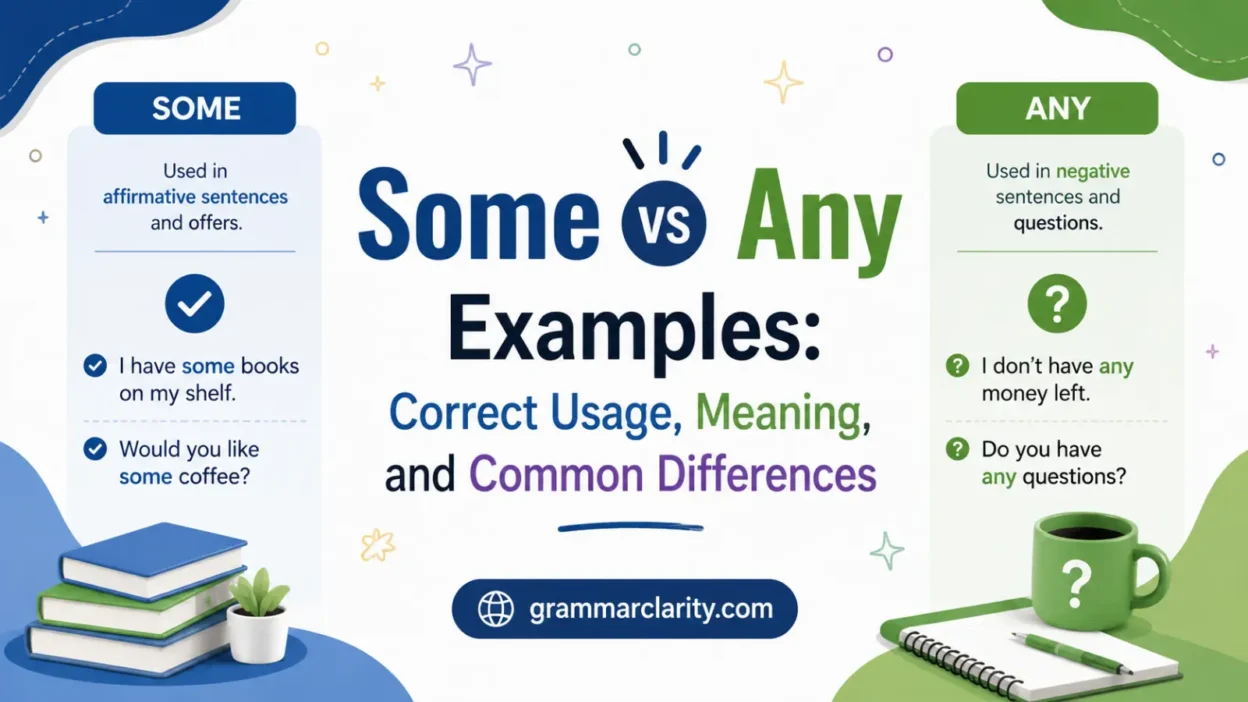
Use some mainly in positive statements and polite offers or requests.
Use any mainly in questions, negative sentences, and open-choice situations.
Examples:
- We bought some fruit.
- Do you have any fruit?
- We do not have any fruit.
Quick comparison:
| Context | Best Choice | Why |
|---|---|---|
| Positive statement | Some | Shows an unspecified amount exists |
| Negative sentence | Any | Standard negative structure |
| General question | Any | Checks existence |
| Offer | Some | Expects a positive response |
| Request | Some | Sounds natural and polite |
| Unlimited choice | Any | Means no restriction |
This pattern works in most everyday situations.
Why People Confuse Them
People confuse these words because both refer to an unspecified amount, number, or quantity.
Compare these examples:
- I bought some cookies.
- Did you buy any cookies?
The topic stays the same: cookies.
The difference is the sentence purpose.
The first sentence gives information.
The second asks for information.
That small change affects the word choice.
Another reason for confusion is that some sometimes appears in questions:
- Would you like some coffee?
- Could I have some water?
Many learners expect any because these are questions. But these examples are offers and requests, so some sounds more natural.
English depends on meaning as much as grammar.
Key Differences At A Glance
| Feature | Some | Any |
|---|---|---|
| Typical sentence type | Positive statements | Questions and negatives |
| Main meaning | Existing but unspecified amount | Unspecified amount or possibility |
| Questions | Used in offers and requests | Used in neutral questions |
| Tone | More expected or positive | More open or neutral |
| Negative sentences | Rare | Standard choice |
| Open choice meaning | Usually not used | Common |
Think of it this way:
Some = there is probably something
Any = is there something?
Meaning and Usage Difference
Both some and any function mainly as determiners and pronouns.
Determiner examples:
- I bought some bread.
- We do not have any bread.
Pronoun examples:
- I need some.
- I do not need any.
Even though they are similar, they do not behave the same way.
Using “Some”
Some usually means an unspecified amount that exists.
Examples:
- We ordered some pizza.
- She bought some flowers.
- They found some extra tickets.
The exact amount is unknown or unnecessary.
The speaker simply knows the amount exists.
Examples with uncountable nouns:
- some water
- some milk
- some coffee
- some information
Examples with countable nouns:
- some books
- some apples
- some friends
- some chairs
Both noun types work naturally with some.
Using “Any”
Any usually appears when asking whether something exists or when saying something does not exist.
Examples:
- Do you have any sugar?
- We do not have any sugar.
- Did they find any evidence?
The exact amount is still unknown.
The difference is the sentence purpose.
“Any” For Unlimited Choice
Any also has another important meaning.
It can mean no restriction.
Examples:
- Choose any seat.
- Pick any color.
- Visit any store.
This meaning is different from some.
Compare:
- Pick some books.
(only certain books) - Pick any books.
(no restrictions)
That difference matters.
Questions With “Some”
Questions usually take any, but not always.
Use some when making offers or expecting a positive answer.
Examples:
- Would you like some cake?
- Could I get some napkins?
- Do you want some coffee?
The speaker assumes the answer may be yes.
That expectation changes the word.
Tone, Context, and Formality
Neither word is more formal.
Both appear in casual speech, business writing, school assignments, and professional communication.
Context matters more than formality.
Compare these examples:
Neutral question:
- Do you have any questions?
Friendly offer:
- Would you like some cookies?
The grammar changes because the tone changes.
Business Context
Examples:
- We received some customer feedback.
- We did not receive any complaints.
- Do you have any updates?
These all sound natural in workplace English.
Everyday Conversation
Examples:
Friend 1:
“Do you have any cash?”
Friend 2:
“Yes, I have some.”
Both words appear naturally in the same conversation.
Positive Expectation
Compare:
- Do you have any coffee?
Neutral question.
- Can I have some coffee?
Expected result.
That emotional expectation influences the choice.
Which One Should You Use?
Choose some when:
✓ Making positive statements
✓ Giving information
✓ Making offers
✓ Asking politely
✓ Expecting agreement
Examples:
- We bought some snacks.
- She sent some photos.
- Would you like some pizza?
- May I have some water?
Choose any when:
✓ Asking neutral questions
✓ Making negatives
✓ Expressing unlimited choice
✓ Talking generally
Examples:
- Do you have any questions?
- We do not have any milk.
- Choose any color.
- Take any seat.
Easy memory trick:
Some = existing amount
Any = unknown possibility
When One Choice Sounds Wrong
Sometimes grammar may look correct but still sound unnatural.
Example 1
Less natural:
- Would you like any tea?
Better:
- Would you like some tea?
Offers usually prefer some.
Example 2
Incorrect:
- We do not have some bread.
Correct:
- We do not have any bread.
Negatives normally require any.
Example 3
Less natural:
- Pick some seat.
Better:
- Pick any seat.
Because there is no restriction.
Example 4
Incorrect feeling:
- Did you buy some apples?
Possible in special situations.
But neutral questions usually prefer:
- Did you buy any apples?
Common Mistakes (and Quick Fixes)
Mistake 1: Using “Some” In Negatives
Wrong:
- I do not have some money.
Correct:
- I do not have any money.
Quick fix:
Negative sentence → usually use any
Mistake 2: Using “Any” In Offers
Less natural:
- Would you like any coffee?
Better:
- Would you like some coffee?
Quick fix:
Offer or request → usually use some
Mistake 3: Forgetting The Open Choice Meaning
Sentence:
- Choose any movie.
Meaning:
All choices are available.
Replacing it changes the meaning:
- Choose some movies.
Now only certain movies are selected.
Mistake 4: Treating Them As Fully Interchangeable
Wrong idea:
“Some and any mean exactly the same thing.”
Reality:
They overlap but serve different sentence purposes.
Context changes everything.
Mistake 5: Using “Any” In Positive Statements Without Reason
Less common:
- I bought any books.
Better:
- I bought some books.
Positive statements usually prefer some.
Everyday Examples
Positive Statements With “Some”
- I bought some groceries after work.
- She took some pictures at the park.
- We ordered some tacos.
- They brought some snacks.
- He shared some advice.
- I found some old photos.
- She saved some money.
- We have some extra chairs.
Questions With “Any”
- Do you have any batteries?
- Are there any seats left?
- Did you receive any emails?
- Is there any coffee?
- Do they have any openings?
- Did you see any mistakes?
Negative Sentences With “Any”
- We do not have any milk.
- She did not buy any fruit.
- They found any evidence? No, they did not find any.
- I do not have any cash.
- We saw hardly any traffic.
- He made no effort and showed hardly any interest.
Offers And Requests With “Some”
- Would you like some soup?
- Can I get some ketchup?
- Could I have some water?
- Do you want some fries?
- Would you like some dessert?
Open Choice With “Any”
- Pick any shirt.
- Choose any movie.
- Take any notebook.
- Sit in any available seat.
- Visit any store nearby.
Dictionary-Style Word Details
Verb
Some: Not commonly used as a verb in standard US English.
Any: Not commonly used as a verb in standard US English.
Neither word normally functions as a verb.
Noun
Some: Can work as a pronoun meaning an unspecified amount.
Example:
- I need some.
Any: Can work as a pronoun meaning an unspecified amount or quantity.
Example:
- I do not need any.
Both often replace repeated nouns.
Example:
- Do you have sugar?
“Yes, I have some.”
Synonyms
Some — closest plain alternatives
- several
- a few
- certain
- a little
- part of
Examples:
- some people → several people
- some water → a little water
Any — closest plain alternatives
- whichever
- whatever amount
- whichever one
- every possible
Examples:
- any color → whichever color
- any seat → whichever seat
Clear antonyms depend on context, so exact opposites are limited.
Example Sentences
Some
- We bought some fruit for the trip.
- She gave me some helpful advice.
- Could I get some water?
- We found some extra tickets.
- They brought some dessert.
Any
- Do you have any questions?
- We do not have any milk.
- Choose any seat you want.
- Did they find any evidence?
- Pick any color.
Word History
Some is an old English word long used to express an unspecified quantity or number.
Any also has a long history in English and developed meanings connected with unspecified quantity, possibility, and unrestricted choice.
Precise historical details are not necessary for understanding this usage difference.
Phrases Containing
Some
- some time
- some day
- some people
- some more
- some place
Examples:
- Give me some more coffee.
- Some people prefer tea.
Any
- any time
- any place
- any day now
- any longer
- any way
Examples:
- Visit any place you like.
- I cannot wait any longer.
Frequently Asked Questions
Is it “some” or “any” in questions?
Usually use any in questions.
Example:
- Do you have any coffee?
But use some in offers and requests.
Example:
- Would you like some coffee?
Can “some” and “any” be interchangeable?
Sometimes both are possible, but the tone changes.
Example:
- Did you buy any apples?
(neutral) - Did you buy some apples?
(expecting yes)
Why is “Would you like some coffee?” correct?
Because it is an offer.
Offers usually use some because the speaker expects acceptance.
Can “any” be used in positive sentences?
Yes.
Example:
- Choose any color.
Here any means unrestricted choice.
Can “some” be used with uncountable nouns?
Yes.
Examples:
- some milk
- some water
- some advice
- some information
Which word is used in negative sentences?
Usually any.
Examples:
- I do not have any money.
- We did not buy any bread.
Conclusion
The difference between some and any becomes easier once you focus on sentence purpose.
Use some for positive ideas, offers, requests, and situations where something already exists.
Use any for questions, negatives, and unrestricted choices.
Remember this simple rule:
Some = existing amount or expected yes
Any = unknown amount or open possibility
Examples:
- I bought some apples.
- Do you have any apples?
- We do not have any apples.
That pattern covers most everyday English use and helps your sentences sound natural.