“Little” and “a little” may look almost identical, but they do not express the same idea.
The only visible difference is the article “a.” However, that small change creates a different meaning and often changes the tone of the sentence too.
Both expressions are usually used with uncountable nouns such as money, time, water, patience, information, and energy. Even though they refer to small amounts, they do not communicate the same message.
Many English learners use them interchangeably because they seem very close. In real usage, though, choosing the wrong one can change the meaning completely.
Compare these examples:
I have a little money.
This means some money exists.
I have little money.
This means there is almost no money.
The quantity may still be small in both cases, but the feeling is different.
Understanding this distinction helps you sound more natural and avoid common grammar mistakes.
Quick Answer
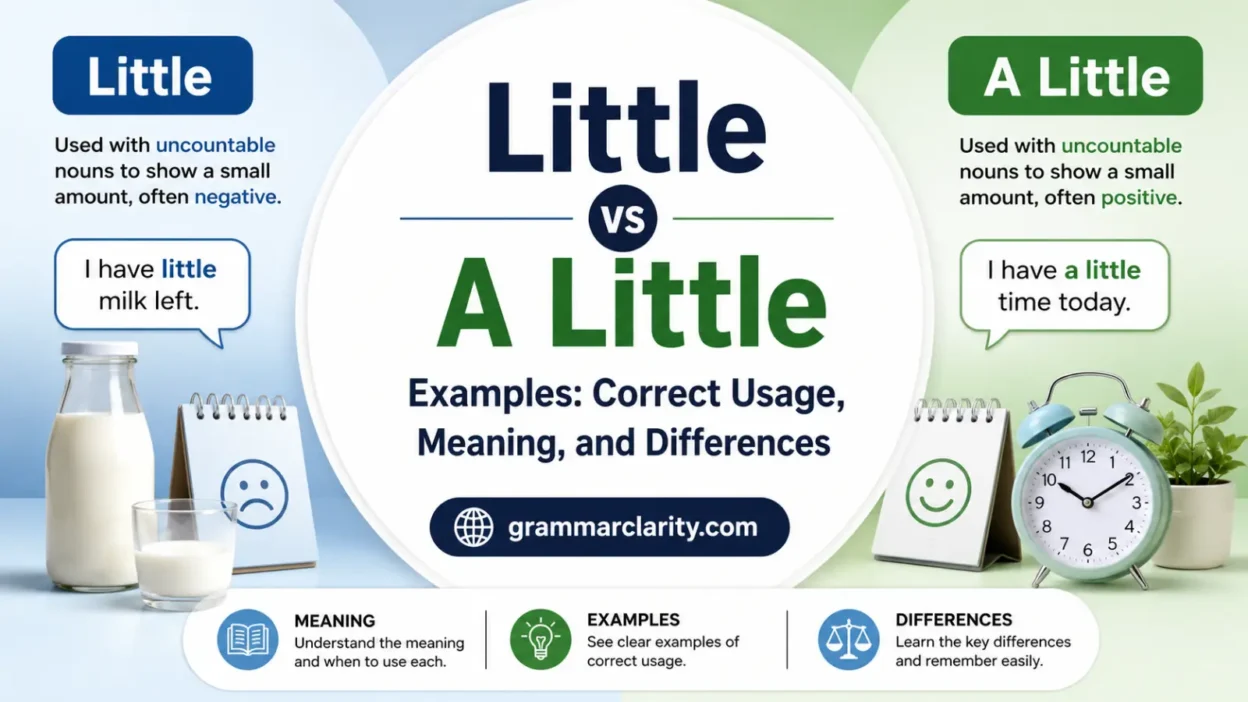
Use a little when you mean some amount exists.
Use little when you mean almost none, not much, or not enough.
Examples:
We still have a little milk.
Meaning: Some milk remains.
We have little milk left.
Meaning: There is almost no milk remaining.
Think of it this way:
a little = positive or neutral
little = negative or limited
That simple rule works in most everyday situations.
Why People Confuse Them
People confuse these expressions because both describe small amounts.
At first glance, they appear to mean exactly the same thing.
After all, both contain the word little.
The confusion grows because the quantity itself can still be small in both sentences.
Compare:
She has a little experience.
She knows something.
She has little experience.
She lacks experience.
The amount may still be limited, but the message changes.
Another reason for confusion is that many learners focus only on quantity and ignore tone.
In reality, tone is one of the biggest differences.
Look at these examples:
We have a little time left.
This sounds hopeful.
We have little time left.
This sounds stressful.
The article “a” changes the sentence from shortage to availability.
Key Differences At A Glance
| Context | Best Choice | Why |
|---|---|---|
| Some water remains | A little | Shows a small available amount |
| Almost no water remains | Little | Shows shortage |
| Small amount of money exists | A little | Positive meaning |
| Money is nearly gone | Little | Negative meaning |
| Enough time remains | A little | Suggests availability |
| Time is almost finished | Little | Suggests insufficiency |
Quick Comparison Block
little
- Means almost none
- Often sounds negative
- Focuses on lack
- Used with uncountable nouns
a little
- Means some amount exists
- Often sounds positive or neutral
- Focuses on availability
- Used with uncountable nouns
Meaning and Usage Difference
The main difference is meaning.
Meaning of “little”
“Little” means not much or almost none.
It usually emphasizes shortage.
Examples:
We had little information before the meeting.
The project received little support.
There was little hope of success.
In each example, the speaker highlights a lack.
The idea is not simply “small.”
The idea is insufficient.
Meaning of “a little”
“A little” means some amount exists.
Examples:
I have a little free time tonight.
She added a little salt.
We still have a little energy left.
These sentences show that something remains.
The amount may be small, but it is present.
Countability Rule
Both expressions usually work with uncountable nouns.
Correct examples:
- little water
- little patience
- little money
- a little sugar
- a little information
- a little time
Incorrect:
a little books
Use:
a few books
Books are countable.
Similarly:
little apples
Usually becomes:
few apples
Countable nouns use few and a few, not little and a little.
“Little” as an Adjective
“Little” also works as an adjective meaning small.
Examples:
They live in a little cabin.
She carried a little bag.
This adjective meaning is different from the quantity meaning discussed in this article.
Compare:
little money = not much money
little house = small house
The same word performs different jobs.
Tone, Context, and Formality
Tone matters a lot in this comparison.
The emotional feeling often changes depending on which phrase you choose.
“Little” Sounds More Negative
Examples:
The company showed little interest.
We had little warning.
He offered little help.
These examples feel limited or disappointing.
The speaker emphasizes what is missing.
“A Little” Sounds More Positive
Examples:
The company showed a little interest.
We still have a little time.
He offered a little help.
Now the message changes.
The speaker focuses on what exists.
Workplace Examples
Email:
We have little information about the update.
Meaning: Not enough information exists.
Email:
We have a little information already.
Meaning: Some information exists.
Everyday Conversation
Friend:
Do we have milk?
Reply:
We have a little milk left.
Natural meaning.
Reply:
We have little milk left.
This sounds more urgent.
Formality
Both forms work in formal and informal English.
Business:
There was little evidence.
Casual:
I have a little cash with me.
Neither expression sounds unnatural in standard American English.
Which One Should You Use?
Use a little when something still exists.
Examples:
I know a little Spanish.
She saved a little money.
We have a little coffee left.
I need a little help.
Use little when emphasizing shortage.
Examples:
He has little experience.
We had little preparation time.
The proposal received little attention.
There was little chance of winning.
A simple memory trick:
a little = some
little = hardly any
This rule works well in most situations.
When One Choice Sounds Wrong
Changing these expressions can completely change meaning.
Example:
I have little money, so let’s buy expensive tickets.
This sounds odd.
“Little money” suggests shortage.
Better:
I have a little money, so let’s buy tickets.
Another example:
We have a little time left. Hurry up!
Possible but less natural.
Better:
We have little time left. Hurry up!
Another example:
She has little experience, but she can handle the job easily.
This creates conflict.
Better:
She has a little experience, so she can manage.
Choosing the wrong form may not create grammar mistakes, but it often creates meaning problems.
Common Mistakes (and Quick Fixes)
Mistake 1
Incorrect:
I have a little books.
Correct:
I have a few books.
Reason:
Books are countable.
Mistake 2
Incorrect:
There are little apples left.
Correct:
There are few apples left.
Reason:
Apples are countable.
Mistake 3
Incorrect:
We have little time, so relax.
Correct:
We have a little time, so relax.
Reason:
Relaxing suggests enough time exists.
Mistake 4
Incorrect:
She has little experience and can easily lead the team.
Correct:
She has a little experience and can lead the team.
Reason:
The intended meaning is positive.
Mistake 5
Incorrect:
I need little help.
This usually means almost no help is needed.
Correct if meaning is:
I need a little help.
Meaning: Some help is needed.
Everyday Examples
Examples With “Little”
There was little traffic this morning.
He showed little enthusiasm.
The report provided little evidence.
We had little notice before moving.
She showed little concern.
The campaign gained little attention.
There is little hope of rain today.
The meeting produced little progress.
They had little success last year.
He spent little time preparing.
Examples With “A Little”
I need a little water.
She has a little experience.
We still have a little time.
He saved a little money.
Add a little cheese.
They need a little support.
I know a little French.
She felt a little tired.
We have a little patience left.
He offered a little advice.
Dictionary-Style Word Details
Verb
little:
Not commonly used as a verb in standard American English.
a little:
Not used as a verb.
Neither expression functions as a regular verb.
Noun
little:
Sometimes appears as a noun in limited literary or older expressions, but this is uncommon.
Example:
The little he knew helped him.
Modern everyday use is rare.
a little:
Usually works as a quantity expression rather than a noun.
Example:
A little goes a long way.
Synonyms
little
Closest plain alternatives:
- hardly any
- not much
- very little
- almost none
Possible opposite:
- plenty of
a little
Closest plain alternatives:
- some
- a small amount
- a bit of
- slightly
Possible opposite:
- none
Exact synonyms do not always exist because tone matters.
Example Sentences
little
We had little information before the event.
The idea received little support.
He showed little patience.
There was little chance of success.
She had little energy after work.
a little
I need a little rest.
She has a little experience.
We still have a little hope.
He added a little sugar.
They need a little help.
Word History
little
The word has existed in English for centuries and originally referred to small size or amount.
It later developed broader uses involving quantity and emphasis.
a little
The phrase developed naturally by combining the article “a” with little, changing the meaning from shortage to existence.
No exact historical distinction is necessary for everyday usage.
Phrases Containing
little
- little hope
- little time
- little chance
- little evidence
- little interest
- little support
- little energy
a little
- a little help
- a little patience
- a little money
- a little water
- a little time
- a little confidence
- a little support
Frequently Asked Questions
Is “little” always negative?
Not always, but it often carries a negative meaning when used as a quantifier.
Example:
We had little information.
This suggests not enough information.
Does “a little” always mean enough?
Usually it means some amount exists.
Whether it is enough depends on context.
Example:
We have a little milk left.
Milk exists, but the amount may still be small.
Can both be used with countable nouns?
No.
Use few and a few with countable nouns.
Correct:
few books
a few apples
Incorrect:
little books for quantity meaning.
Which sounds more positive?
“A little” usually sounds more positive because it focuses on what exists.
“Little” often emphasizes lack.
Is “little” the same as “small”?
Not always.
As an adjective:
little house
Means small house.
As a quantifier:
little money
Means not much money.
Can I say “a little bit”?
Yes.
Examples:
I need a little bit of help.
Add a little bit of salt.
It often sounds conversational.
Which is more common in everyday speech?
Both are common.
People choose based on meaning.
Use a little for availability.
Use little for shortage.
Conclusion
The difference between little and a little is not about size alone.
It is about meaning and attitude.
Little emphasizes shortage.
A little emphasizes availability.
Compare once more:
I have little money.
Almost none exists.
I have a little money.
Some exists.
That single article changes the message completely.
Remember this quick rule:
little = not much
a little = some amount exists
Using the correct form will make your English sound clearer and more natural.