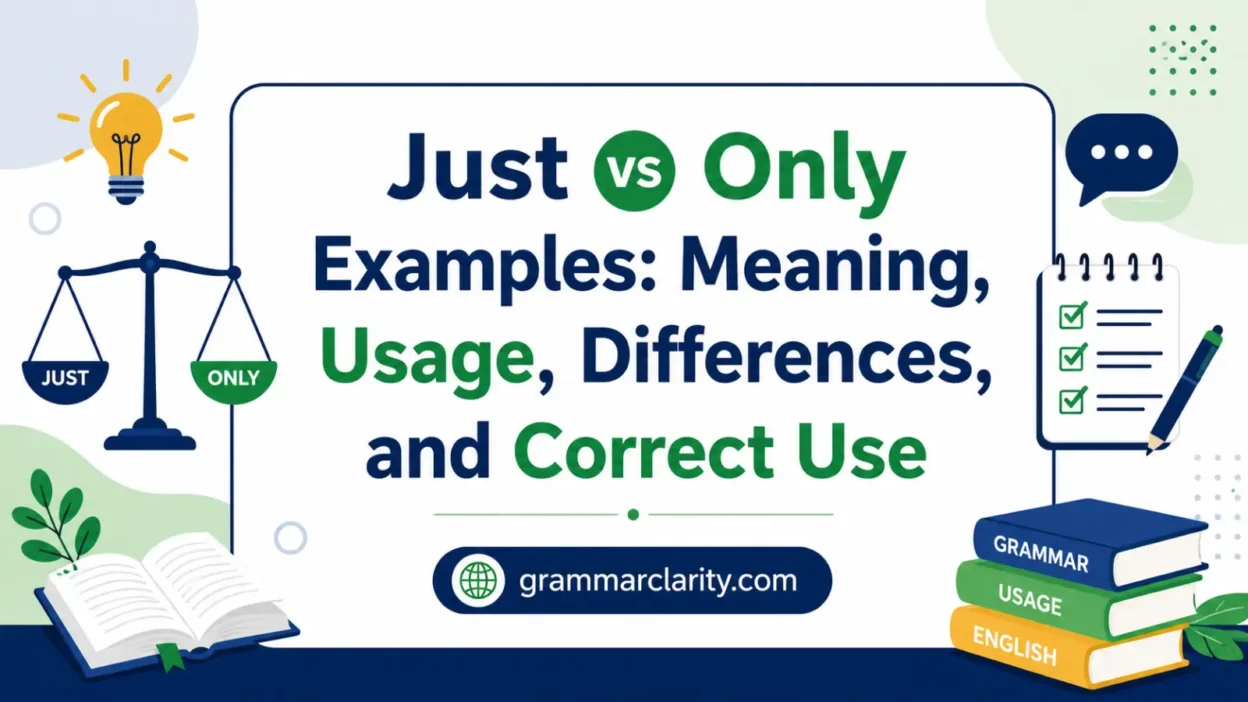
Many English learners and native speakers wonder whether they should use just or only in a sentence. The confusion is understandable because both words often express limitation or emphasis.
In some situations, they can mean nearly the same thing. In others, choosing the wrong one can change the tone, meaning, or clarity of a sentence.
Understanding when to use just and when to use only helps your writing sound more natural and precise. This guide explains the differences in plain English with practical examples and common usage patterns found in modern American English.
Quick Answer
If you need a simple rule, use this:
- Only usually means no more than, nothing else, or exclusively.
- Just can sometimes mean only, but it also has other meanings such as recently, exactly, simply, or fairly.
Examples:
- I only have ten dollars.
- I just have ten dollars.
Both sentences can mean the speaker has no more than ten dollars.
However:
- I just arrived.
- I only arrived.
These sentences do not mean the same thing.
In most cases, only is the clearer choice when expressing limitation, while just often sounds more conversational and flexible.
Why People Confuse Them
People confuse these words because they overlap in many everyday situations.
Consider these examples:
- It’s just a joke.
- It’s only a joke.
Both communicate that something should not be taken too seriously.
Because speakers regularly hear both forms, it is easy to assume they are always interchangeable. They are not.
The main problem is that just has several meanings, while only has a more focused function.
Compare:
- I just finished my homework.
- I only finished my homework.
The first means the homework was completed recently.
The second suggests homework was the only thing completed.
A small word choice creates a completely different meaning.
Key Differences At A Glance
| Context | Best Choice | Why |
|---|---|---|
| Expressing exclusivity | Only | Clearly means nothing else |
| Talking about something recent | Just | Means recently |
| Informal conversation | Just | Often sounds more natural |
| Formal writing | Only | Usually clearer and more precise |
| Emphasizing a small amount | Only | Directly expresses limitation |
| Softening a statement | Just | Creates a gentler tone |
| Giving an exact amount | Just | Can mean exactly |
| Avoiding ambiguity | Only | Usually clearer |
Quick Comparison
| Feature | Just | Only |
|---|---|---|
| Can mean recently | Yes | No |
| Can mean exactly | Yes | No |
| Can mean simply | Yes | No |
| Can show limitation | Yes | Yes |
| Common in conversation | Very common | Common |
| Usually more precise | No | Yes |
Meaning and Usage Difference
The biggest difference is that only mainly limits something, while just has several functions.
Using Only
Only focuses attention on one thing and excludes others.
Examples:
- Only Sarah knew the answer.
- We only sell online.
- He only drinks water.
- I only need five minutes.
In each example, the word limits what is being discussed.
Using Just
Just can mean several different things depending on context.
It may mean:
- recently
- simply
- exactly
- merely
- only
Examples:
- I just got home.
- That’s just my opinion.
- The store is just around the corner.
- It was just a misunderstanding.
Because just carries multiple meanings, readers sometimes need context to understand it correctly.
When Just Means Only
Sometimes the two words overlap.
Examples:
- It’s just a scratch.
- It’s only a scratch.
- I just need a minute.
- I only need a minute.
Both versions work because they express limitation.
However, only often sounds slightly clearer.
Position Matters
The position of only can change meaning dramatically.
Compare:
- Only John passed the test.
- John only passed the test.
- John passed only the test.
Each sentence emphasizes something different.
This is one reason many writers choose placement carefully when using only.
Just is generally more flexible and causes fewer shifts in meaning based on position.
Tone, Context, and Formality
Although both words are common, they create slightly different tones.
Just Sounds More Conversational
People frequently use just in everyday speech.
Examples:
- I’m just checking.
- I just wanted to ask.
- I’m just curious.
These sentences sound friendly and natural.
Only Sounds More Direct
Only often sounds more precise.
Examples:
- Only authorized personnel may enter.
- Only registered users can access the system.
- The offer is available only today.
These examples feel more formal and direct.
Softening Statements
One reason speakers use just so often is that it softens a message.
Compare:
- I want to ask a question.
- I just want to ask a question.
The second version sounds less demanding.
Similarly:
- I’m calling about my order.
- I’m just calling about my order.
The second feels more polite and relaxed.
Professional Writing
In business, academic, and technical writing, only is often preferred when limitation is the intended meaning.
Examples:
- Only approved vendors may participate.
- Only employees can access this section.
The message is clear and difficult to misunderstand.
Which One Should You Use?
Choose only when your goal is to limit or restrict something clearly.
Examples:
- I only bought one ticket.
- Only members can vote.
- She only works weekends.
Choose just when you mean:
- recently
- exactly
- simply
- merely
- politely softening a statement
Examples:
- I just arrived.
- It’s just a suggestion.
- That’s just what I needed.
- I just wanted to help.
When either word works, consider your audience.
For formal clarity, only is often safer.
For natural conversation, just often sounds more relaxed.
When One Choice Sounds Wrong
Sometimes substituting one word for the other creates an unnatural sentence.
Recently Meaning
Correct:
- I just finished lunch.
Unnatural:
- I only finished lunch.
The meanings differ completely.
Exclusive Meaning
Correct:
- Only employees may enter.
Less natural:
- Just employees may enter.
While understandable, the sentence sounds less standard.
Exact Meaning
Correct:
- The package weighs just two pounds.
Incorrect replacement:
- The package weighs only two pounds.
The meaning shifts. The first suggests exactness, while the second suggests a small amount.
Softening Meaning
Correct:
- I’m just asking.
Less natural:
- I’m only asking.
The second may sound defensive rather than polite.
Understanding these subtle shifts helps avoid awkward wording.
Common Mistakes (and Quick Fixes)
Mistake 1: Using Just for Every Situation
Incorrect:
- I just completed the requirements and just managers can approve them.
Better:
- I just completed the requirements and only managers can approve them.
Mistake 2: Replacing Recently with Only
Incorrect:
- I only got here.
Possible but different meaning.
Better:
- I just got here.
Mistake 3: Misplacing Only
Confusing:
- She only told Sarah yesterday.
Clearer:
- She told only Sarah yesterday.
Or:
- She told Sarah only yesterday.
Placement changes meaning.
Mistake 4: Overusing Just
Many people insert just unnecessarily.
Example:
- I just think that we should just take a just few minutes.
Better:
- I think we should take only a few minutes.
Reducing extra uses improves clarity.
Mistake 5: Assuming They Always Mean the Same Thing
Incorrect assumption:
- I just arrived.
- I only arrived.
These do not communicate the same idea.
Always check the intended meaning before choosing.
Everyday Examples
The best way to understand the difference is through realistic examples.
At Work
- I just sent the report.
- I only sent the report.
The first means recently.
The second means nothing else was sent.
At School
- Only students may enter the lab.
- I just entered the lab.
Different meanings entirely.
Shopping
- I only bought milk.
- I just bought milk.
The first means milk was the sole purchase.
The second means the purchase happened recently.
Family Conversation
- It’s just a movie.
- It’s only a movie.
Both are acceptable and mean nearly the same thing.
Travel
- We just arrived at the airport.
- We only arrived at the airport.
The first focuses on time.
The second suggests arrival was the only action completed.
Sports
- He only scored one point.
- He just scored one point.
The first emphasizes the low number.
The second often means the point was scored moments ago.
Customer Service
- I’m just calling to confirm my appointment.
- I’m only calling to confirm my appointment.
The first sounds friendlier.
The second sounds more defensive or restrictive.
Social Media
- I just posted a new photo.
- I only posted a new photo.
Again, the first refers to recent action.
The second limits what was posted.
Dictionary-Style Word Details
Verb
Just: Not commonly used as a verb in standard US English.
Only: Not commonly used as a verb in standard US English.
Noun
Just: Not commonly used as a noun in standard US English.
Only: Can occasionally function as a noun in specialized contexts, but this usage is uncommon in everyday English.
Synonyms
Just (when meaning merely or simply):
Closest plain alternatives:
- merely
- simply
- purely
- exactly
- recently (depending on context)
Only:
Closest plain alternatives:
- solely
- exclusively
- merely
- alone
- no more than
Possible antonyms in relevant contexts:
Just:
- excessively
- unnecessarily
Only:
- additionally
- broadly
- inclusively
Example Sentences
Just
- I just got your message.
- That’s just what I needed.
- She lives just across the street.
- I’m just trying to help.
- We arrived just in time.
Only
- I only have five dollars.
- Only members can vote.
- She only eats vegetarian food.
- The coupon works only online.
- Only one answer was correct.
Word History
Just
Derived from older forms related to fairness, correctness, and exactness. Over time, the word developed additional meanings, including recently, simply, and merely.
Only
Derived from older English forms meaning single, sole, or unique. Its core idea of exclusivity remains central in modern usage.
Phrases Containing
Just
- just in time
- just now
- just because
- just kidding
- just a minute
- just enough
Only
- only child
- only time will tell
- only if
- only then
- only one
- only available online
FAQs
Is just the same as only?
Not always. Sometimes they can express limitation in a similar way, but just also has meanings such as recently, exactly, or simply.
Which is more formal, just or only?
Only is generally more precise and often preferred in formal writing when expressing limitation.
Can I replace only with just?
Sometimes. For example, “I just need a minute” and “I only need a minute” are both acceptable. However, replacement is not always possible because the meanings may change.
Why does only change meaning based on position?
The word often modifies whatever follows it. Moving it to another location in the sentence can shift emphasis and meaning.
Is just more common in conversation?
Yes. Everyday spoken English uses just very frequently because it sounds natural and often softens statements.
Which word is clearer?
When expressing restriction or exclusivity, only is usually clearer because it has a more specific meaning.
Conclusion
The difference between just and only comes down to meaning and purpose. Only primarily limits or restricts, while just has several meanings, including recently, exactly, simply, and sometimes only.
When you want maximum clarity, especially in formal writing, only is often the better choice. When speaking casually or softening a statement, just often sounds more natural.
The easiest way to choose is to ask yourself what message you want to send. If you’re expressing exclusivity, use only. If you’re talking about time, exactness, simplicity, or a gentle tone, just is usually the right choice.