
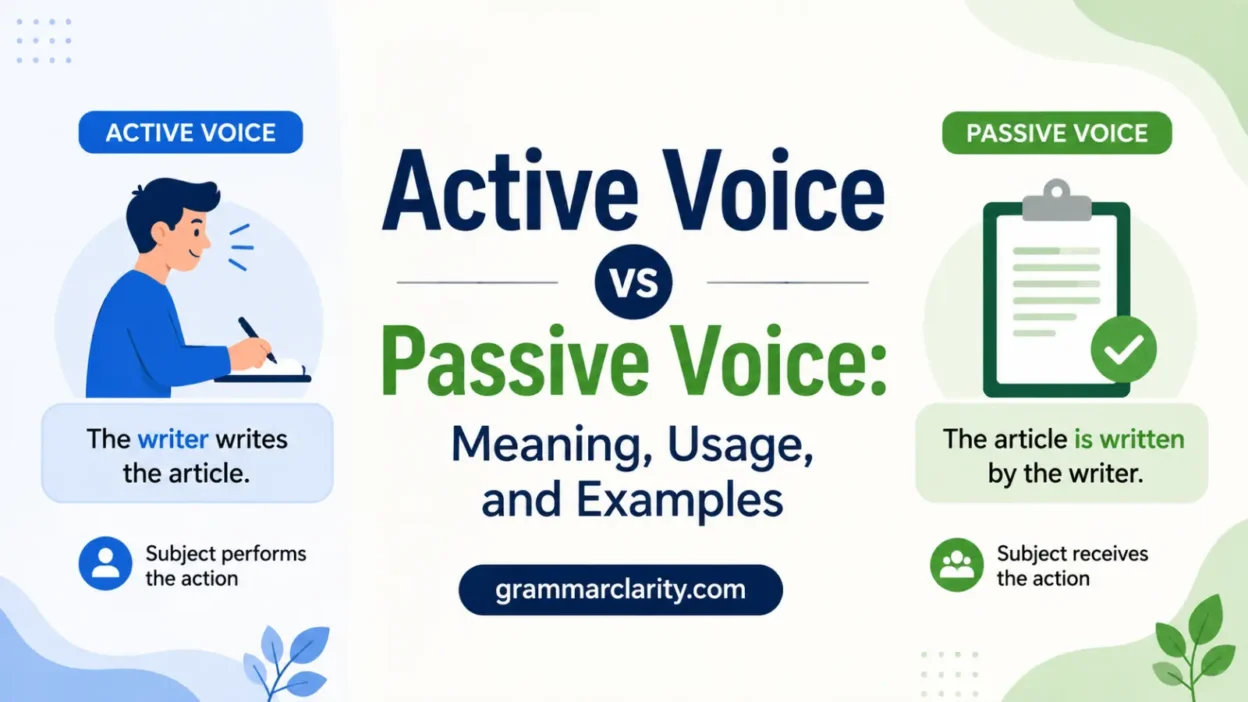
Many writers struggle with the choice between active voice and passive voice. Both are grammatically correct, but they create different effects in writing.
The key difference is simple:
- Active voice emphasizes the person or thing performing the action.
- Passive voice emphasizes the person or thing receiving the action.
Understanding when to use each one can make your writing clearer, stronger, and more effective.
Whether you are writing emails, academic papers, business reports, or everyday messages, knowing the difference between active voice and passive voice helps you communicate more clearly.
Quick Answer
If you want your writing to sound direct, clear, and engaging, use active voice.
If you want to emphasize the result of an action rather than the person performing it, use passive voice.
Examples:
Active Voice:
- The manager approved the proposal.
- Sarah completed the project.
Passive Voice:
- The proposal was approved by the manager.
- The project was completed by Sarah.
In most everyday writing, active voice is the preferred choice because it is easier to read and understand.
Why People Confuse Them
People often confuse active and passive voice because both forms can describe the same event.
Consider these examples:
- The chef prepared the meal.
- The meal was prepared by the chef.
Both sentences communicate the same basic information. However, the focus changes.
In the first sentence, attention goes to the chef.
In the second sentence, attention goes to the meal.
Another reason for confusion is that passive voice is not always easy to recognize. Many writers mistakenly assume that any sentence containing a form of “to be” is passive. This is not true.
For example:
- The car is red.
This sentence is not passive because no action is being performed.
True passive voice requires:
- A form of the verb “to be” (or similar helping verb)
- A past participle
- A receiver of the action
Key Differences At A Glance
| Feature | Active Voice | Passive Voice |
|---|---|---|
| Focus | Person doing the action | Person receiving the action |
| Clarity | Usually clearer | Sometimes less direct |
| Length | Often shorter | Often longer |
| Tone | Strong and direct | Formal or detached |
| Common Usage | Everyday writing | Academic, scientific, formal writing |
| Readability | Easier to read | Can be harder to read |
| Responsibility | Clearly identified | May be hidden |
Quick Comparison
- Active voice highlights the actor.
- Passive voice highlights the action or result.
- Active voice usually sounds stronger.
- Passive voice can sound more formal.
- Both are grammatically correct when used appropriately.
Meaning and Usage Difference
The distinction between active voice and passive voice is based on sentence structure.
Active Voice
In active voice, the subject performs the action.
Structure:
Subject + Verb + Object
Examples:
- Emily wrote the report.
- The company launched a new product.
- The dog chased the ball.
In each sentence, the subject performs the action.
Passive Voice
In passive voice, the subject receives the action.
Structure:
Subject + Helping Verb + Past Participle
Examples:
- The report was written by Emily.
- A new product was launched by the company.
- The ball was chased by the dog.
Here, the action happens to the subject.
Why Writers Prefer Active Voice
Active voice often makes sentences:
- Shorter
- Clearer
- More energetic
- Easier to understand
Compare:
- The committee approved the budget.
- The budget was approved by the committee.
The first sentence feels more direct and natural.
Why Passive Voice Still Matters
Passive voice is useful when:
- The actor is unknown.
- The actor is unimportant.
- The result matters more than the actor.
Examples:
- The package was delivered yesterday.
- Several mistakes were discovered.
- The building was completed in 2025.
The focus stays on the event rather than the person responsible.
Tone, Context, and Formality
Voice choice can affect the tone of your writing.
Active Voice Tone
Active voice typically sounds:
- Direct
- Confident
- Professional
- Engaging
Examples:
- We solved the problem.
- Our team achieved the goal.
- The engineer designed the system.
These sentences clearly identify responsibility.
Passive Voice Tone
Passive voice often sounds:
- Formal
- Neutral
- Objective
- Detached
Examples:
- The problem was solved.
- The goal was achieved.
- The system was designed.
The actor becomes less important.
Common Contexts for Active Voice
Active voice works well in:
- Blog posts
- Marketing content
- Emails
- Journalism
- Business communication
- Everyday writing
Common Contexts for Passive Voice
Passive voice often appears in:
- Scientific reports
- Research papers
- Legal documents
- Formal reports
- Technical writing
The choice depends on what deserves emphasis.
Which One Should You Use?
For most situations, active voice is the better choice.
Use active voice when:
- You want clarity.
- You want strong writing.
- You want readers to understand quickly.
- You want to show responsibility.
Examples:
- The teacher graded the exams.
- The company released the update.
- The customer submitted a complaint.
Use passive voice when:
- The actor is unknown.
- The actor is irrelevant.
- The result is more important.
Examples:
- The wallet was stolen.
- The decision was announced yesterday.
- The bridge was completed ahead of schedule.
A good writer knows how to use both voices strategically.
When One Choice Sounds Wrong
Sometimes passive voice sounds awkward.
Consider:
- The cake was eaten by John.
Most native speakers would naturally say:
- John ate the cake.
The active version is simpler and more natural.
Likewise, active voice can sound awkward when the actor is unknown.
Example:
- Someone stole my bike.
This works if the unknown person matters.
But often people simply say:
- My bike was stolen.
The passive version sounds more natural because the focus is on the bike.
The best choice depends on context and emphasis.
Common Mistakes
Mistake 1: Thinking Passive Voice Is Always Wrong
Many writers believe passive voice should never be used.
That’s incorrect.
Passive voice has legitimate purposes.
Fix: Use it when emphasis belongs on the receiver of the action.
Mistake 2: Overusing Passive Voice
Too much passive voice can make writing dull.
Example:
- The report was written.
- The findings were reviewed.
- The recommendations were approved.
This sequence feels repetitive.
Fix: Mix in active constructions.
Mistake 3: Hiding Responsibility
Passive voice can obscure who performed an action.
Example:
- Mistakes were made.
Who made them?
The sentence avoids responsibility.
Fix: Use active voice when accountability matters.
- Our team made mistakes.
Mistake 4: Creating Wordy Sentences
Passive structures often require more words.
Example:
- The proposal was reviewed by the director.
Shorter:
- The director reviewed the proposal.
Fix: Prefer active voice when clarity is the goal.
Everyday Examples
| Context | Best Choice | Why |
| Business email | Active voice | Clear and direct |
| Marketing content | Active voice | More persuasive |
| News headline | Usually active voice | Faster understanding |
| Scientific paper | Often passive voice | Focus on process |
| Unknown actor | Passive voice | Actor unavailable |
| Product description | Active voice | Stronger communication |
| Formal report | Either | Depends on emphasis |
| Customer support | Active voice | Easier to understand |
Workplace Examples
Active:
- Our team completed the project ahead of schedule.
- The manager approved the budget.
Passive:
- The project was completed ahead of schedule.
- The budget was approved.
School Examples
Active:
- The student submitted the assignment.
Passive:
- The assignment was submitted by the student.
Everyday Conversation Examples
Active:
- I washed the car.
- She cooked dinner.
- They organized the event.
Passive:
- The car was washed.
- Dinner was cooked.
- The event was organized.
Dictionary-Style Word Details
Verb
Active Voice:
A grammatical construction in which the subject performs the action of the verb.
Example:
- Lisa wrote the article.
Passive Voice:
A grammatical construction in which the subject receives the action of the verb.
Example:
- The article was written by Lisa.
Noun
Active Voice:
A noun phrase referring to a sentence structure where the subject acts.
Example:
- The editor recommended using active voice.
Passive Voice:
A noun phrase referring to a sentence structure where the subject receives an action.
Example:
- Passive voice is common in some academic writing.
Synonyms
Active Voice:
Closest plain alternatives:
- Direct construction
- Subject-centered structure
- Actor-focused sentence
Passive Voice:
Closest plain alternatives:
- Indirect construction
- Receiver-focused structure
- Action-centered sentence
Helpful Contrast
- Active voice emphasizes the actor.
- Passive voice emphasizes the receiver.
Example Sentences
Active Voice
- The firefighter rescued the child.
- The company launched a new service.
- Jennifer prepared the presentation.
- The mechanic fixed the engine.
- Our team achieved the target.
Passive Voice
- The child was rescued by the firefighter.
- A new service was launched by the company.
- The presentation was prepared by Jennifer.
- The engine was fixed by the mechanic.
- The target was achieved by our team.
Word History
Active Voice:
The term comes from traditional grammatical descriptions that identify the subject as actively performing an action.
Passive Voice:
The term developed from grammatical traditions describing situations where the subject receives an action rather than performs it.
Both terms have been used in grammar instruction for centuries, although exact historical details vary across linguistic traditions.
Phrases Containing
Active Voice
- Write in active voice
- Use active voice
- Active voice sentence
- Active voice construction
- Active voice writing
Passive Voice
- Write in passive voice
- Passive voice sentence
- Passive voice construction
- Passive voice form
- Passive voice structure
FAQs
Is active voice always better than passive voice?
No. Active voice is usually clearer and more direct, but passive voice can be useful when the result matters more than the person performing the action.
Is passive voice grammatically incorrect?
No. Passive voice is completely grammatical. It simply serves a different purpose than active voice.
Why do teachers often recommend active voice?
Teachers recommend active voice because it generally makes writing clearer, shorter, and easier to understand.
Can a sentence be both active and passive?
No. A specific clause is typically either active or passive, although a longer sentence can contain both types of clauses.
How can I identify passive voice?
Look for a form of “to be” followed by a past participle.
Example:
- The letter was mailed yesterday.
The letter receives the action, making the sentence passive.
Do professional writers use passive voice?
Yes. Journalists, researchers, lawyers, and business professionals all use passive voice when it serves a clear purpose.
Is passive voice common in academic writing?
Yes. Many academic and scientific texts use passive voice to focus on processes, results, and observations rather than individual researchers.
Which voice should beginners use more often?
Beginners usually benefit from using active voice more frequently because it promotes clarity and stronger sentence construction.
Conclusion
The difference between active voice and passive voice comes down to focus.
Active voice highlights the person or thing performing the action, while passive voice highlights the person or thing receiving the action.
For most everyday writing, active voice is the strongest choice because it is clear, concise, and engaging. However, passive voice remains valuable when the actor is unknown, unimportant, or intentionally de-emphasized.
Rather than viewing one voice as right and the other as wrong, think of them as tools. Skilled writers choose the voice that best matches their purpose, audience, and message.
When clarity and impact matter, active voice often wins. When emphasis belongs on the result or recipient, passive voice can be exactly the right choice.