Many English learners and even native speakers occasionally wonder whether they should use too or very in a sentence. Both words can increase the strength of an adjective or adverb, which is why they often seem similar at first.
However, they are not interchangeable in most situations.
The main difference is simple:
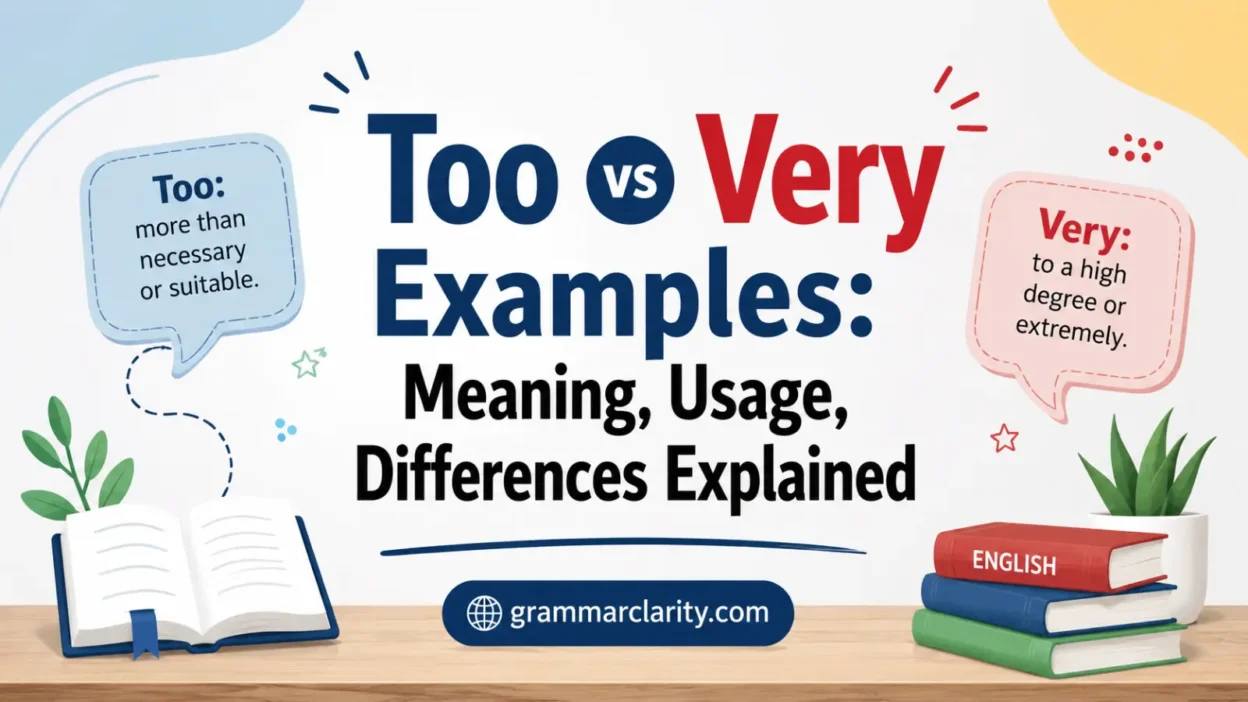
- Very means “to a high degree.”
- Too means “more than needed, more than wanted, or excessively.”
Understanding this distinction helps you communicate more clearly and avoid common mistakes.
Quick Answer
Use very when you simply want to strengthen a description.
- The movie was very interesting.
- She is very kind.
Use too when something exceeds an acceptable, desirable, or comfortable limit.
- The movie was too long.
- She is too tired to work.
A helpful shortcut is this:
Very = a lot
Too = more than enough
Why People Confuse Them
People confuse these words because both intensify meaning.
Consider these sentences:
- The coffee is very hot.
- The coffee is too hot.
Both describe strong heat.
Yet the meaning changes significantly.
The first sentence simply tells us the coffee has a high temperature.
The second sentence tells us the temperature has become a problem.
That small difference creates confusion because the words appear similar grammatically while expressing different ideas.
Another reason for confusion is that many languages use a single word where English uses two separate concepts.
As a result, learners may accidentally substitute one for the other.
Key Differences At A Glance
| Context | Best Choice | Why |
|---|---|---|
| Strong description | Very | Shows a high degree |
| Excessive amount | Too | Shows more than desired |
| Positive compliment | Very | Usually sounds natural |
| Complaint | Too | Often signals a problem |
| Neutral statement | Very | Adds emphasis only |
| Limitation or inability | Too | Often followed by consequences |
| Formal writing | Both | Depends on meaning |
| Everyday conversation | Both | Depends on context |
Quick Comparison
| Feature | Too | Very |
| Shows intensity | Yes | Yes |
| Shows excess | Yes | No |
| Usually suggests a problem | Often | Usually no |
| Can be positive | Sometimes | Frequently |
| Common before adjectives | Yes | Yes |
| Common before adverbs | Yes | Yes |
Meaning and Usage Difference
The core distinction lies in whether the intensity creates a problem.
Using Very
Very strengthens an adjective or adverb without suggesting anything negative.
Examples:
- The restaurant was very busy.
- He drove very carefully.
- The weather is very pleasant.
- The test was very easy.
In each sentence, the speaker simply emphasizes the description.
No negative consequence is implied.
Using Too
Too usually means “excessively” or “more than is desirable.”
Examples:
- The restaurant was too busy.
- He drove too slowly.
- The weather is too cold.
- The test was too difficult.
Each example suggests a problem or undesirable result.
Compare the Meanings
- The room is very warm. → Strong warmth.
- The room is too warm. → Uncomfortably warm.
- She is very confident. → Positive description.
- She is too confident. → Excessive confidence.
- The music is very loud. → Loud music.
- The music is too loud. → Unpleasantly loud.
The difference may seem small, but it changes the message completely.
Tone, Context, and Formality
Both words are standard in American English.
Neither is considered informal or incorrect.
The choice depends entirely on meaning.
Tone of Very
Very often sounds neutral, positive, or descriptive.
Examples:
- The presentation was very effective.
- He is very professional.
- The product is very reliable.
These statements focus on quality rather than problems.
Tone of Too
Too frequently introduces criticism, concern, limitation, or inconvenience.
Examples:
- The presentation was too long.
- He is too impatient.
- The product is too expensive.
The speaker signals dissatisfaction.
Positive Uses of Too
Although too often sounds negative, it can occasionally be positive.
Examples:
- The gift is too generous.
- You’re too kind.
- That’s too good to be true.
In these cases, the speaker uses exaggeration for emphasis.
Even so, the sense of excess remains.
Which One Should You Use?
Ask yourself one simple question:
Is there a problem because of the intensity?
If the answer is no, choose very.
If the answer is yes, choose too.
Examples:
- The soup is very hot. ✓
- The soup is too hot to eat. ✓
- She is very busy. ✓
- She is too busy to attend. ✓
- The building is very tall. ✓
- The building is too tall for the project requirements. ✓
This question works in most situations.
When One Choice Sounds Wrong
Sometimes replacing one word with the other changes the meaning completely.
Example 1
- The exam was very hard.
This means the exam was difficult.
- The exam was too hard.
This means the difficulty exceeded an acceptable level.
Example 2
- The child is very energetic.
This sounds positive.
- The child is too energetic.
This suggests the energy level is creating problems.
Example 3
- The jacket is very large.
Simple description.
- The jacket is too large.
It does not fit properly.
Example 4
- The movie was very long.
Neutral observation.
- The movie was too long.
Complaint.
Because of these differences, substituting one word for the other can unintentionally change your message.
Common Mistakes and Quick Fixes
Mistake 1: Using Too for Positive Emphasis
Incorrect:
- She is too beautiful.
This may imply an excessive level of beauty.
Better:
- She is very beautiful.
Mistake 2: Using Very When Excess Is Intended
Incorrect:
- The box is very heavy to carry.
Better:
- The box is too heavy to carry.
The second sentence clearly explains the problem.
Mistake 3: Ignoring Consequences
A common structure is:
too + adjective + to + verb
Examples:
- Too tired to drive.
- Too young to vote.
- Too busy to help.
- Too expensive to buy.
This structure naturally expresses limitation.
Mistake 4: Assuming Too Is Always Negative
Not always.
Examples:
- You’re too kind.
- That’s too funny.
- He’s too generous.
These are often compliments expressed with exaggeration.
Everyday Examples
Below are realistic examples from daily American English.
At Home
- The living room is very clean.
- The living room is too crowded.
- The coffee is very strong.
- The coffee is too strong for me.
At School
- The teacher was very helpful.
- The homework was too difficult.
- The lecture was very informative.
- The lecture was too long.
At Work
- The meeting was very productive.
- The meeting was too expensive to organize weekly.
- She is very experienced.
- She is too busy to take another project.
Shopping
- This phone is very useful.
- This phone is too expensive.
- The shoes are very comfortable.
- The shoes are too small.
Travel
- The hotel was very nice.
- The hotel was too far from downtown.
- The flight was very smooth.
- The layover was too long.
Dictionary-Style Word Details
Verb
Too:
Not commonly used as a verb in standard American English.
Very:
Not commonly used as a verb in standard American English.
Noun
Too:
Not commonly used as a noun in standard American English.
Very:
Not commonly used as a noun in standard American English.
Synonyms
Too
Closest plain alternatives:
- Excessively
- Overly
- Unduly
- More than enough
Possible opposites:
- Adequately
- Reasonably
- Sufficiently
Very
Closest plain alternatives:
- Extremely
- Highly
- Really
- Quite
- Particularly
Possible opposites:
- Slightly
- Somewhat
- Barely
These alternatives do not always match perfectly in every sentence, but they often express similar levels of intensity.
Example Sentences
Too
- The backpack is too heavy.
- The music is too loud.
- The road is too narrow.
- The deadline is too close.
- The house is too expensive.
Very
- The backpack is very durable.
- The music is very enjoyable.
- The road is very busy.
- The deadline is very important.
- The house is very attractive.
Word History
Too
The word has been part of English for centuries and developed meanings related to addition and excess. Modern usage commonly emphasizes an amount beyond what is desired or acceptable.
Very
The word has long been used as an intensifier in English. Over time, it became one of the most common ways to strengthen adjectives and adverbs without necessarily adding a negative meaning.
Phrases Containing
Too
- Too much
- Too many
- Too little
- Too late
- Too soon
- Too good to be true
- Too bad
Very
- Very good
- Very well
- Very often
- Very likely
- Very important
- Very much
- Very carefully
FAQs
Is it correct to say “very hot” and “too hot”?
Yes.
Very hot means hot to a high degree.
Too hot means hotter than desired or comfortable.
Can too and very be used interchangeably?
Usually not.
Replacing one with the other often changes the meaning because too suggests excess while very simply adds emphasis.
Which word is more positive?
Generally, very sounds more positive because it does not automatically imply a problem.
Why does “too tired to work” sound natural?
Because the structure too + adjective + to + verb expresses a limitation or consequence.
The person is so tired that working becomes difficult or impossible.
Is “too good” always negative?
No.
It can be positive in expressions such as:
- That’s too good to be true.
- The offer is too good to pass up.
The meaning depends on context.
Can I use very before adverbs?
Yes.
Examples:
- She speaks very clearly.
- He worked very efficiently.
- They arrived very early.
Can I use too before adverbs?
Yes.
Examples:
- She speaks too quickly.
- He worked too slowly.
- They arrived too late.
Which word appears more often in everyday conversation?
Both are extremely common, but very is generally used more frequently because people often describe things without implying excess.
Conclusion
The difference between too and very is one of the most important distinctions among English intensifiers.
Use very when you want to show a strong degree of something.
Use too when that degree becomes excessive, problematic, or beyond what is wanted.
Remember this simple rule:
- Very = a lot
- Too = more than enough
If there is no problem, choose very.
If the intensity creates a problem, choose too.
Mastering this distinction will make your English sound more natural, accurate, and confident in everyday situations.