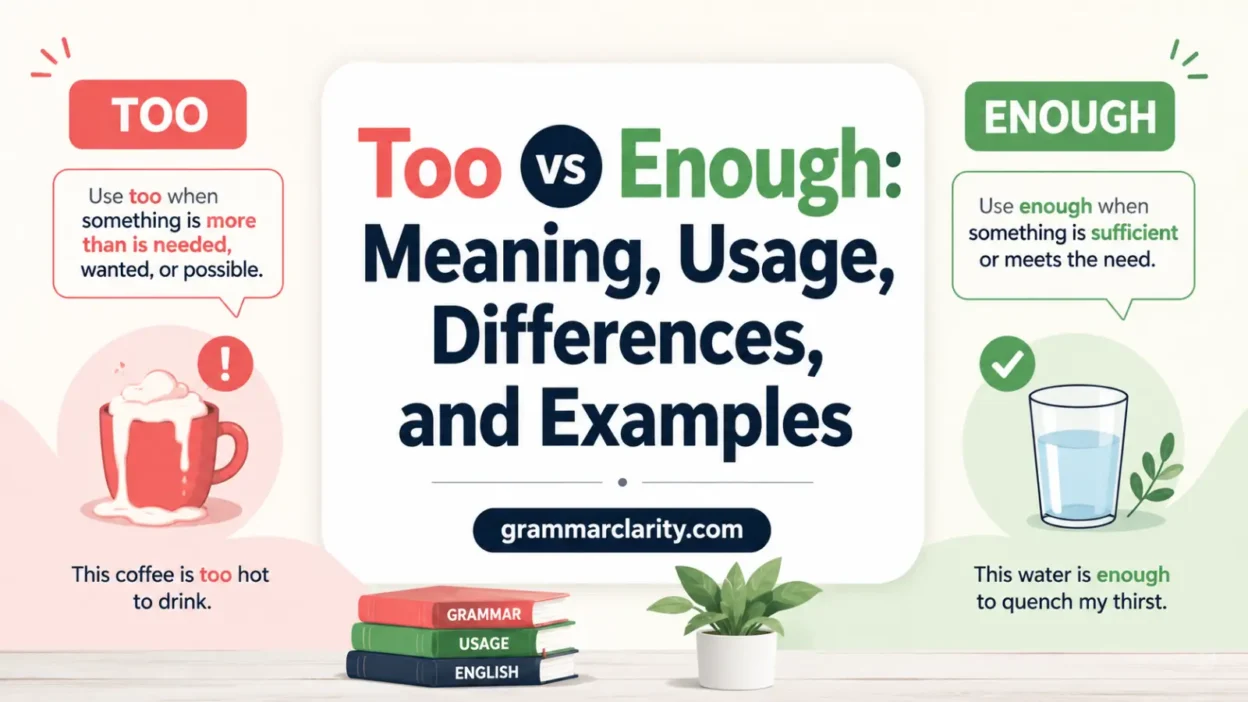
Many English learners struggle with too and enough because both words talk about quantity, degree, or adequacy. They often appear in similar situations, yet they communicate opposite ideas.
A sentence with too usually suggests that something exceeds a desired limit. A sentence with enough usually suggests that a requirement is met.
Understanding this difference helps you speak and write more naturally. Once you learn the basic patterns, choosing between too and enough becomes much easier.
Quick Answer
The main difference is simple:
- Too means more than needed, wanted, or acceptable.
- Enough means as much as needed or required.
Examples:
- The coffee is too hot to drink.
- The coffee is cool enough to drink.
In the first sentence, the temperature exceeds the acceptable limit.
In the second sentence, the temperature meets the requirement.
Whenever something goes beyond a limit, use too. Whenever something meets a limit or requirement, use enough.
Why People Confuse Them
People confuse these words because both deal with amounts, degrees, and suitability.
Consider these examples:
- The room is too small.
- The room is big enough.
Both sentences evaluate the room’s size. However, they reach different conclusions.
Another reason for confusion is sentence structure.
With too, the word usually comes before an adjective or adverb:
- too expensive
- too quickly
- too late
With enough, the position changes:
- expensive enough
- quickly enough
- late enough
Because the word order differs, learners sometimes mix the patterns.
The concepts are also closely related. When something is too much, it is not enough in the opposite direction. This relationship makes the distinction seem subtle even though the meanings are quite different.
Key Differences At A Glance
| Context | Best Choice | Why |
|---|---|---|
| Something exceeds a limit | Too | Indicates excess |
| Something meets a requirement | Enough | Indicates sufficiency |
| A shirt costs more than you can afford | Too | Cost is excessive |
| A shirt fits your budget | Enough | Requirement is met |
| A task is beyond your ability | Too | Difficulty exceeds ability |
| A task matches your ability | Enough | Ability is sufficient |
| Something prevents an action | Too | Excess creates a problem |
| Something allows an action | Enough | Requirement allows success |
Quick Comparison
| Feature | Too | Enough |
|---|---|---|
| Core Meaning | More than necessary | As much as necessary |
| General Feeling | Negative limitation | Positive sufficiency |
| Typical Position | Before adjective/adverb | After adjective/adverb |
| Indicates Excess? | Yes | No |
| Indicates Adequacy? | No | Yes |
| Often Creates Problems? | Yes | Usually No |
Meaning and Usage Difference
The clearest distinction is that too expresses excess while enough expresses sufficiency.
Using Too
Too means beyond what is desirable, acceptable, practical, or necessary.
Examples:
- The music is too loud.
- The road is too narrow.
- The package is too heavy.
- She arrived too late.
In each example, a limit has been exceeded.
The loudness is excessive.
The narrowness creates difficulty.
The weight causes a problem.
The lateness prevents success.
A common structure is:
too + adjective
Examples:
- too cold
- too expensive
- too slow
- too crowded
Another pattern is:
too + adverb
Examples:
- too quickly
- too slowly
- too carefully
- too loudly
Using Enough
Enough means sufficient for a purpose.
Examples:
- The room is large enough.
- The car is fast enough.
- We have enough food.
- She worked hard enough.
In each case, the requirement has been satisfied.
Common structures include:
adjective + enough
Examples:
- warm enough
- tall enough
- strong enough
- quiet enough
adverb + enough
Examples:
- quickly enough
- carefully enough
- slowly enough
enough + noun
Examples:
- enough money
- enough water
- enough time
- enough experience
This noun pattern is especially important because too cannot be used in the same way.
Compare:
- We have enough time.
- We do not have enough time.
But:
- We have too much time.
- We have too little time.
Too + Infinitive
A very common pattern is:
too + adjective + to + verb
Examples:
- The box is too heavy to lift.
- The soup is too hot to eat.
- The child is too young to drive.
The meaning is that the excessive quality prevents the action.
Enough + Infinitive
Another common pattern is:
adjective + enough + to + verb
Examples:
- The box is light enough to lift.
- The soup is cool enough to eat.
- The child is old enough to drive.
The meaning is that the requirement is met, making the action possible.
Notice how these structures often express opposite ideas.
- Too hot to eat.
- Cool enough to eat.
- Too young to drive.
- Old enough to drive.
- Too weak to lift.
- Strong enough to lift.
These pairs clearly show the contrast between excess and sufficiency.
Tone, Context, and Formality
Both words are common in everyday American English.
Neither word is particularly formal or informal.
You can use them in:
- conversations
- emails
- academic writing
- business writing
- news articles
The difference is not about formality. It is about meaning.
Tone of Too
Too often carries a negative tone because it highlights a problem.
Examples:
- The line is too long.
- The rent is too high.
- The movie was too boring.
- The traffic is too heavy.
These statements point to an obstacle or inconvenience.
Tone of Enough
Enough often sounds more neutral or positive.
Examples:
- We have enough supplies.
- The house is big enough.
- She is experienced enough.
- The battery is charged enough.
These examples indicate that requirements have been met.
However, enough can also appear in negative statements.
Examples:
- We do not have enough money.
- There is not enough space.
- He was not careful enough.
In these cases, the speaker is saying that a requirement has not been met.
The word itself still means sufficiency; the negative form indicates insufficient quantity or degree.
Which One Should You Use?
Ask yourself one question:
Is the amount greater than needed or sufficient for the need?
Choose too when the amount is greater than acceptable.
Examples:
- The water is too cold.
- The assignment is too difficult.
- The suitcase is too heavy.
Choose enough when the amount satisfies a need.
Examples:
- The water is warm enough.
- The assignment is easy enough.
- The suitcase is light enough.
A useful memory trick is:
- Too = excess
- Enough = adequacy
Whenever you hear a hidden idea of “more than necessary,” use too.
Whenever you hear a hidden idea of “sufficient,” use enough.
When One Choice Sounds Wrong
Sometimes only one word fits naturally.
Consider:
- The exam was too difficult.
This means the difficulty exceeded what was manageable.
Now compare:
- The exam was difficult enough.
This sentence has a different meaning. It means the exam met a required level of difficulty.
The two sentences are not interchangeable.
Another example:
- The coffee is too strong.
This means the strength is excessive.
- The coffee is strong enough.
This means the strength meets expectations.
The meaning changes completely.
Many learners incorrectly substitute one for the other because both refer to degree. In reality, they point in opposite directions.
Common Mistakes (and Quick Fixes)
Even advanced English learners sometimes misuse too and enough. Most mistakes happen because the sentence patterns look similar but follow different grammar rules.
Mistake 1: Putting Enough Before an Adjective
Incorrect:
- The test was enough difficult.
- The room is enough large.
Correct:
- The test was difficult enough.
- The room is large enough.
Remember that enough normally comes after adjectives and adverbs.
Mistake 2: Using Too When You Mean Sufficient
Incorrect:
- The room is too big for twenty people.
If your meaning is that the room can comfortably hold twenty people, use:
- The room is big enough for twenty people.
The first sentence suggests excess. The second suggests adequacy.
Mistake 3: Forgetting the Noun Pattern
Incorrect:
- We have money enough for the trip.
Although this structure exists in older styles, modern American English strongly prefers:
- We have enough money for the trip.
Mistake 4: Mixing Opposite Meanings
Incorrect:
- The coffee is too warm to drink.
If the coffee can actually be drunk comfortably, use:
- The coffee is warm enough to drink.
Too often creates a barrier. Enough usually removes the barrier.
Mistake 5: Misplacing Too
Incorrect:
- She speaks English fluent too.
Correct:
- She speaks English too fluently.
Or:
- She speaks English fluently enough.
The choice depends on the intended meaning.
Quick Fix Rule
Ask yourself:
“Is this more than necessary or sufficient?”
- More than necessary = too
- Sufficient = enough
That simple question solves most usage problems.
Everyday Examples
The easiest way to understand these words is through real-life examples.
School
- The homework was too difficult.
- The homework was easy enough.
- The classroom was too noisy.
- The classroom was quiet enough.
Work
- The deadline was too tight.
- The schedule was flexible enough.
- The project was too complicated.
- The instructions were clear enough.
Shopping
- The jacket is too expensive.
- The jacket is affordable enough.
- The shoes are too small.
- The shoes are large enough.
Travel
- The suitcase is too heavy.
- The suitcase is light enough.
- The flight arrived too late.
- The flight arrived early enough.
Technology
- My phone is too old to run that app.
- My phone is new enough to run that app.
- The internet connection is too slow.
- The internet connection is fast enough.
Health and Fitness
- The weight is too heavy.
- The weight is manageable enough.
- The workout is too intense.
- The workout is easy enough for beginners.
Family Life
- The kids are too young to stay home alone.
- The kids are old enough to stay home alone.
- The movie is too scary for children.
- The movie is gentle enough for children.
These examples show the same pattern repeatedly: too points to excess, while enough points to adequacy.
Dictionary-Style Word Details
Verb
Too:
Not commonly used as a verb in standard American English.
Enough:
Not commonly used as a verb in standard American English.
Neither word functions as a standard verb in everyday modern usage.
Noun
Too:
Not commonly used as a noun in standard American English.
Enough:
Can occasionally function as a noun meaning a sufficient amount.
Example:
- I’ve had enough.
In this sentence, enough refers to a sufficient or maximum amount.
Synonyms
Too
Closest plain alternatives:
- excessively
- overly
- unduly
- excessively much
- more than necessary
Possible opposite ideas:
- sufficiently
- adequately
- enough
Enough
Closest plain alternatives:
- sufficiently
- adequately
- satisfactorily
- as needed
- in adequate quantity
Possible opposite ideas:
- insufficiently
- inadequately
- too little
Exact synonyms do not always work in every sentence, so context remains important.
Example Sentences
Too
- The restaurant was too crowded.
- The backpack is too heavy.
- She arrived too late.
- The music is too loud.
- The road is too narrow.
Enough
- The restaurant is large enough.
- The backpack is light enough.
- She arrived early enough.
- The music is quiet enough.
- The road is wide enough.
Word History
Too
The word has been part of English for centuries and developed meanings related to addition and excess. Modern usage commonly emphasizes excess or an amount beyond what is desired.
Enough
The word has long been used in English to express sufficiency or adequacy. Its core meaning remains largely unchanged in modern American English.
Specific historical details vary among language sources, but the central meanings of both words have remained stable for a very long time.
Phrases Containing
Too
Common expressions include:
- too much
- too many
- too little
- too late
- too soon
- all too often
- none too happy
Examples:
- We spent too much money.
- There were too many people.
- It was too late to change plans.
Enough
Common expressions include:
- enough is enough
- good enough
- fair enough
- enough time
- enough space
- enough money
Examples:
- Enough is enough.
- That’s good enough for now.
- We have enough time to finish.
Frequently Asked Questions
Is too always negative?
Usually, yes. Too generally indicates that something exceeds a desirable limit and creates a problem.
Example:
- The room is too hot.
The heat is excessive.
Does enough always mean positive?
Not always.
In positive statements, enough usually means a requirement has been met.
Example:
- We have enough food.
In negative statements, it shows insufficiency.
Example:
- We do not have enough food.
Can too and enough appear in the same sentence?
Yes.
Examples:
- The box is too heavy and not strong enough.
- The room is too small and not comfortable enough.
Both words can help describe different aspects of a situation.
Which word comes before a noun?
Enough commonly comes before nouns.
Examples:
- enough money
- enough water
- enough experience
Too usually requires additional words:
- too much money
- too much water
- too little experience
Can enough come after a noun?
In modern American English, placing enough before the noun is much more common.
Preferred:
- enough time
Less common:
- time enough
What is the easiest way to remember the difference?
Think of a scale.
- Too = beyond the limit.
- Enough = reaches the limit.
That single idea explains most uses.
Is “too much” different from “enough”?
Yes.
- Too much means an excessive amount.
- Enough means a sufficient amount.
Compare:
- We have too much food.
- We have enough food.
The first suggests excess. The second suggests adequacy.
Which word is more common in daily conversation?
Both are extremely common. Native speakers use them every day when talking about quantity, degree, ability, cost, time, and suitability.
Conclusion
The difference between too and enough comes down to one core idea: excess versus sufficiency.
Use too when something goes beyond what is needed, wanted, or acceptable.
Use enough when something meets a requirement or reaches a satisfactory level.
Compare these examples:
- The soup is too hot to eat.
- The soup is cool enough to eat.
- The child is too young to drive.
- The child is old enough to drive.
- The suitcase is too heavy to carry.
- The suitcase is light enough to carry.
When you remember that too signals excess and enough signals adequacy, choosing the correct word becomes much easier. Whether you are speaking, writing, or editing, this simple distinction will help you communicate more accurately and naturally in American English.