Much vs many is a choice about quantity. Both words help you talk about “how large an amount” or “how large a number,” but they do not work with the same kinds of nouns.
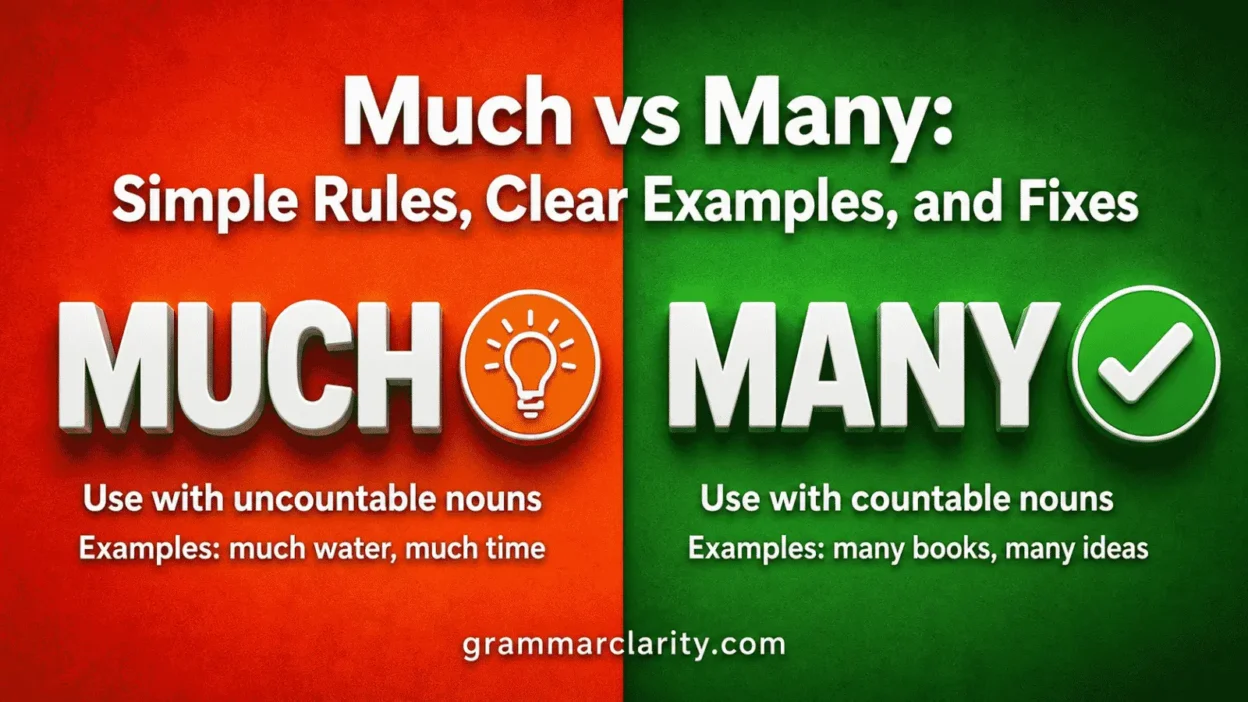
Use much with things you measure as an amount. Use many with things you can count one by one.
That is the core rule, but real sentences can still feel tricky. Words like money, time, work, advice, and information often cause mistakes because they feel countable in everyday life even when they act as noncount nouns in standard English.
Quick Answer
Use much with noncount nouns:
- much time
- much money
- much information
- much effort
- much traffic
Use many with plural count nouns:
- many days
- many dollars
- many details
- many people
- many cars
The easiest test is this: if you can naturally put a number directly before the noun, use many. If not, use much.
You can say three cars, so use many cars.
You would not normally say three traffic, so use much traffic.
Why People Confuse Them
People confuse much and many because both point to quantity. The difference is not about size alone. It is about the noun that follows.
Some nouns are easy:
- many books because books can be counted
- much water because water is treated as a substance
Other nouns are less obvious:
- much advice, not many advice
- much furniture, not many furniture
- much progress, not many progress
- many suggestions, not much suggestions
The confusion grows because some ideas can be expressed either way, depending on the noun you choose:
- much money
- many dollars
- much work
- many tasks
- much information
- many facts
The idea may be similar, but the noun changes the word choice.
Key Differences At A Glance
| Context | Best Choice | Why |
|---|---|---|
| You are talking about an amount of time | much time | Time is usually noncount. |
| You are talking about separate days | many days | Days are countable. |
| You are talking about money in general | much money | Money is treated as noncount. |
| You are talking about dollars | many dollars | Dollars are countable. |
| You are talking about traffic | much traffic | Traffic is noncount. |
| You are talking about cars | many cars | Cars are countable. |
| You are talking about advice | much advice | Advice is noncount. |
| You are talking about tips | many tips | Tips are countable. |
Compact comparison:
- Much means “a large amount.”
- Many means “a large number.”
- Much usually goes with singular noncount nouns.
- Many goes with plural count nouns.
- Much often appears in questions and negative statements.
- Many works naturally in questions, negatives, and affirmative statements.
Meaning and Usage Difference
Much is used when the noun names something viewed as a whole amount rather than separate units.
Examples:
- We do not have much time before the meeting.
- She gave the project much attention.
- There is not much space in the apartment.
- How much coffee do you want?
- I did not get much sleep last night.
Many is used when the noun names separate people, places, things, ideas, or events that can be counted.
Examples:
- We do not have many minutes before the meeting.
- She answered many questions.
- There are not many seats left.
- How many cups of coffee do you want?
- I woke up many times last night.
Notice the difference between coffee and cups of coffee. Coffee is an amount. Cups are individual units. That is why the correct choices are much coffee and many cups.
Tone, Context, and Formality
Both much and many are standard English. The difference is not that one is more correct than the other. The correct choice depends on the noun.
Still, tone matters.
In everyday affirmative sentences, Americans often use a lot of instead of much, especially in casual speech.
Natural:
- We have a lot of work to do.
- She has a lot of experience.
- There was a lot of traffic this morning.
More formal or emphatic:
- We have much work to do.
- She has much experience.
- There was much concern about the delay.
With many, affirmative sentences usually sound natural in both formal and everyday contexts:
- Many people signed up.
- Many stores close early on holidays.
- Many parents had the same question.
Which One Should You Use?
Choose much when the noun is noncount.
- much patience
- much homework
- much energy
- much research
- much news
Choose many when the noun is plural and countable.
- many students
- many assignments
- many reasons
- many updates
- many articles
A practical way to decide is to ask whether the noun can take a number directly.
Can you say five students? Yes. Use many students.
Can you say five homework? No. Use much homework.
When you need to count a noncount idea, add a countable unit:
- much water → many bottles of water
- much information → many pieces of information
- much furniture → many pieces of furniture
- much bread → many slices of bread
- much equipment → many pieces of equipment
When One Choice Sounds Wrong
One choice sounds wrong when it clashes with the noun type.
Wrong:
- many water
- many advice
- many furniture
- much books
- much people
- much dollars
Correct:
- much water
- much advice
- much furniture
- many books
- many people
- many dollars
Some nouns can be count or noncount depending on meaning. In those cases, the word choice depends on how the noun is being used.
Examples:
- How much chicken did you buy?
This means an amount of chicken as food. - How many chickens are on the farm?
This means individual animals. - How much paper do we need?
This means paper as material. - How many papers did you grade?
This means individual documents or assignments.
Common Mistakes (and Quick Fixes)
A common mistake is using many with nouns that feel countable but are grammatically noncount.
Wrong: She gave me many advice.
Correct: She gave me much advice.
More natural: She gave me a lot of advice.
Wrong: We bought many furniture for the house.
Correct: We bought much furniture for the house.
More natural: We bought a lot of furniture for the house.
Wrong: I do not have many information.
Correct: I do not have much information.
More natural: I do not have much information yet.
Another common mistake is using much with plural count nouns.
Wrong: There are much reasons to wait.
Correct: There are many reasons to wait.
Wrong: We invited much people.
Correct: We invited many people.
Wrong: She has much ideas for the campaign.
Correct: She has many ideas for the campaign.
Everyday Examples
Use much when the sentence is about an amount:
- I do not have much time this afternoon.
- How much money did the repair cost?
- There was not much traffic after lunch.
- He does not show much interest in sports.
- We made much progress during the first week.
- How much room is left in the suitcase?
- She did not get much help with the move.
- There is not much sugar in this recipe.
Use many when the sentence is about a number:
- I do not have many appointments this afternoon.
- How many dollars did the repair cost?
- There were not many cars after lunch.
- He does not follow many teams.
- We completed many steps during the first week.
- How many shirts are in the suitcase?
- She asked many friends to help with the move.
- How many teaspoons of sugar are in this recipe?
The contrast becomes clearer when the examples sit side by side:
- much time / many hours
- much money / many bills
- much traffic / many cars
- much food / many meals
- much work / many tasks
- much furniture / many chairs
Dictionary-Style Word Details
Verb
Neither much nor many is used as a verb in standard modern English. In this comparison, both words function as quantity words, not action words.
Correct:
- How much time do we have?
- How many tickets did you buy?
Not correct:
- I much the report.
- She many the files.
Noun
Much can work as a pronoun-like noun substitute when the noun is understood.
Examples:
- Much has changed since last year.
- I do not know much about that topic.
- There is not much left to say.
Many can also work as a pronoun-like noun substitute when it refers to many people or things already understood.
Examples:
- Many were surprised by the decision.
- I invited ten people, but not many came.
- Many of the emails were duplicates.
Synonyms
For much, close alternatives often include:
- a lot of
- plenty of
- a great deal of
- a large amount of
- considerable
For many, close alternatives often include:
- a lot of
- numerous
- several
- plenty of
- a large number of
Be careful with replacements. Several usually means more than two but not a huge number, so it does not always match many. Considerable sounds more formal and usually fits amounts, not everyday countable things.
Example Sentences
- We do not have much time, so let’s start now.
- I have many emails to answer before noon.
- She put much effort into the presentation.
- They visited many cities during the summer.
- There is not much milk left in the fridge.
- Not many guests stayed after dinner.
- How much experience does the applicant have?
- How many years has the applicant worked here?
Word History
Both much and many are old English words with long histories in the language. For present-day writers, the useful point is not their origin but their current grammatical role: much pairs with noncount nouns, and many pairs with plural count nouns.
That rule is the safest guide for modern American English.
Phrases Containing
Common phrases with much:
- too much
- so much
- not much
- how much
- much better
- much more
- much less
- as much as
Common phrases with many:
- too many
- so many
- not many
- how many
- many more
- many fewer
- as many as
- a good many
These phrases still follow the same basic pattern:
- too much noise
- too many distractions
- not much time
- not many minutes
- so much work
- so many tasks
Conclusion
The difference between much vs many comes down to the noun.
Use much for noncount nouns: much time, much money, much advice, much traffic.
Use many for plural count nouns: many hours, many dollars, many tips, many cars.
When you are unsure, try placing a number before the noun. If a number works naturally, choose many. If the noun is treated as one general amount, choose much.