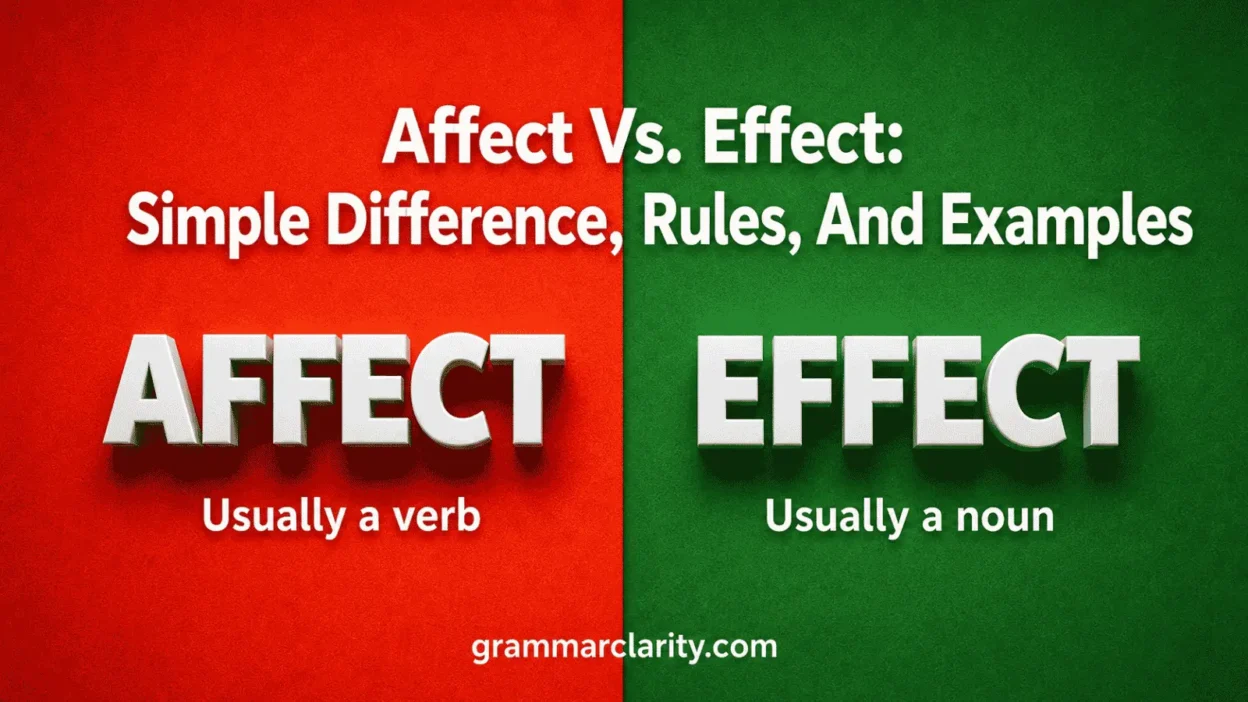
Affect vs effect is one of the most common word-choice problems in English because the words sound almost the same and often appear in similar sentences.
The quick distinction is simple: affect is usually a verb, and effect is usually a noun.
That means affect usually describes an action, while effect usually names the result of that action.
Quick Answer
Use affect when you mean to influence or change something.
Use effect when you mean a result, outcome, or consequence.
Examples:
- The weather can affect your mood.
- The weather can have an effect on your mood.
- The new policy may affect employees.
- One effect of the new policy is a shorter workweek.
A helpful shortcut is: affect = action; effect = end result.
Why People Confuse Them
People confuse affect and effect because both words deal with change.
If something affects you, it creates an effect. That close meaning makes the choice feel harder than it usually is.
The grammar is the clearest clue. In everyday writing, affect usually acts as a verb. Effect usually acts as a noun.
So instead of asking only what the sentence means, ask what job the word is doing.
Is the word showing action? Choose affect.
Is the word naming a result? Choose effect.
Key Differences At A Glance
| Context | Best Choice | Why |
|---|---|---|
| To mean influence | affect | It works as a verb: one thing changes another. |
| To mean result | effect | It works as a noun: it names the outcome. |
| After “an,” “the,” “this,” or “that” | effect | These words often come before nouns. |
| After “can,” “will,” “may,” or “could” | affect | These words often come before verbs. |
| In “have an ___ on” | effect | The phrase needs a noun. |
| In “___ the outcome” | affect | The sentence needs a verb meaning influence. |
Meaning and Usage Difference
Affect means to influence, change, or make a difference to something.
Examples:
- Stress can affect your sleep.
- The delay will affect our schedule.
- Your choice may affect the final price.
In those sentences, something is doing something. Stress influences sleep. A delay changes a schedule. A choice changes the price.
Effect means the result or outcome of a cause.
Examples:
- Stress can have a serious effect on sleep.
- The delay had no lasting effect.
- The price increase was one effect of higher demand.
In those sentences, the word names the result. It does not describe the action.
Tone, Context, and Formality
Both affect and effect are standard in casual, professional, and academic writing.
The difference is not really about tone. It is about grammar and meaning.
In workplace writing, affect often appears when discussing changes to plans, costs, deadlines, customers, or results.
Examples:
- The outage may affect customer access.
- Budget changes could affect hiring.
In formal writing, effect often appears when describing consequences, findings, results, or outcomes.
Examples:
- The study measured the effect of sleep on memory.
- The decision had a lasting effect on the company.
The words can sound polished or plain depending on the sentence. The important thing is choosing the word that fits the sentence’s structure.
Which One Should You Use?
Use affect if you can replace the word with influence, change, or impact as a verb.
- The news may affect sales.
- The news may influence sales.
Use effect if you can replace the word with result, outcome, or consequence.
- The news had a strong effect on sales.
- The news had a strong result on sales.
That second replacement sounds a little less natural, but it still points to the right category: the word is naming what happened.
A practical test:
- If the sentence needs doing, use affect.
- If the sentence needs a thing, use effect.
Compact comparison:
- Affect: usually a verb; means to influence; points to the action.
- Effect: usually a noun; means result; points to the outcome.
When One Choice Sounds Wrong
Use the surrounding words to catch mistakes.
Incorrect: The storm had a strong affect on travel.
Correct: The storm had a strong effect on travel.
Why: “Had a strong” points to a noun, so effect is correct.
Incorrect: The storm will effect travel plans.
Correct: The storm will affect travel plans.
Why: “Will” points to a verb, so affect is correct.
Incorrect: The medicine may have side affects.
Correct: The medicine may have side effects.
Why: “Side effects” is the standard phrase for results caused by medicine or treatment.
Common Mistakes (and Quick Fixes)
A common mistake is using effect as the verb in ordinary sentences.
Wrong: The change will effect everyone.
Right: The change will affect everyone.
Another common mistake is using affect after an article like the, an, or a.
Wrong: The affect was immediate.
Right: The effect was immediate.
A third mistake is treating the shortcut as an absolute rule. In most everyday writing, affect is a verb and effect is a noun. Still, there are less common uses.
For example, effect can be a verb meaning to bring something about, as in “effect change.” That use is formal and much less common.
Affect can also be a noun in psychology, where it refers to emotional expression. That use is specialized and not the one most writers need in everyday sentences.
Everyday Examples
- Loud noise can affect concentration.
- The loud noise had a bad effect on concentration.
- A positive attitude can affect team morale.
- The coach’s speech had a positive effect on the team.
- Rising rent may affect where people choose to live.
- One effect of rising rent is a longer commute for some workers.
- Screen time can affect sleep quality.
- Poor sleep is one possible effect of too much screen time.
- The new schedule will affect parents with young children.
- The biggest effect of the new schedule is an earlier pickup time.
Notice the pattern. Affect shows what something does. Effect names what happens because of it.
Dictionary-Style Word Details
Verb
Affect is most often a verb. It means to influence or change something.
Example:
- The result could affect our next decision.
Effect can be a verb, but this use is less common. It means to bring about or cause something to happen.
Example:
- The new director hopes to effect meaningful change.
In everyday writing, use effect as a verb only when you truly mean bring about, not simply influence.
Noun
Effect is most often a noun. It means a result, outcome, or consequence.
Example:
- The effect was easy to see.
Affect can be a noun in specialized contexts, especially when discussing emotional expression.
Example:
- The patient showed a flat affect.
That noun use is not common in everyday writing.
Synonyms
For affect, useful alternatives include:
- influence
- change
- shape
- alter
- impact
For effect, useful alternatives include:
- result
- outcome
- consequence
- impact
- reaction
Choose the synonym that fits the sentence. Impact can work as either a noun or a verb, so it does not always solve the same problem.
Example Sentences
- The teacher’s feedback affected how I revised the essay.
- The teacher’s feedback had a lasting effect on my writing.
- Gas prices can affect travel plans.
- Higher gas prices can have a noticeable effect on summer travel.
- The update should not affect your saved files.
- One effect of the update is faster loading.
Word History
The history of these words helps explain why they are easy to mix up, but it does not need to control everyday usage.
For most modern writing, the useful distinction is grammatical: affect usually does the action, and effect usually names the result.
That practical rule is clearer than relying on word origin.
Phrases Containing
Common phrases with affect:
- affect the outcome
- affect your decision
- affect the results
- affect performance
- affect someone’s mood
Common phrases with effect:
- have an effect on
- cause and effect
- side effect
- lasting effect
- in effect
- take effect
- ripple effect
These phrases are good clues. If you see have an, side, lasting, or take, the word is usually effect.
Conclusion
The easiest way to remember affect vs effect is to connect affect with action and effect with result.
Use affect when one thing influences another.
Use effect when you are naming the outcome.
Most sentences become clear when you ask one question: does the sentence need a verb showing change, or a noun naming the result?