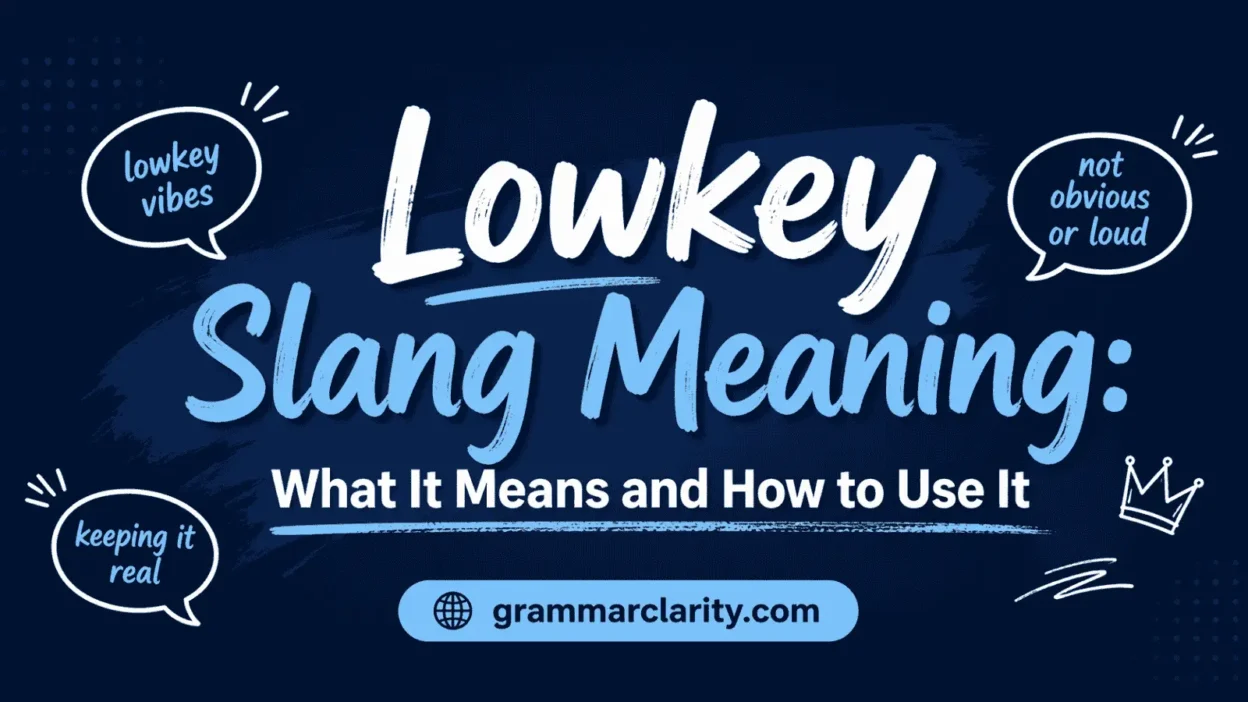
You may see lowkey in texts, TikTok comments, captions, or everyday chat. It often shows up before a feeling, opinion, or plan. People use it when they want to sound casual and not too intense.
That is why this word matters. It can change the tone of a sentence in a small but important way. It helps speakers sound softer, less dramatic, or a bit more guarded.
This guide explains what lowkey means in plain English. You will learn how Americans use it, how it is pronounced, when it fits, and when it does not. You will also see the difference between lowkey and low-key, plus real examples you can copy.
Quick Answer
Lowkey slang meaning is usually “quietly,” “a little,” or “without making a big deal about it.”
People use it to soften what they say.
It is common in casual American English, especially in texts and online posts.
TL;DR
• Lowkey is informal and common in slang.
• It often softens a feeling or opinion.
• It can mean “kind of” or “quietly.”
• It is usually not for formal writing.
• Low-key is the older standard form.
• Highkey is a common opposite in slang.
What Does “Lowkey” Mean?
In slang, lowkey usually means something like quietly, a little, or in an understated way. The speaker is saying something real, but not loudly.
For example, “I lowkey miss summer” means the person really does miss summer. They are just saying it in a softer way.
Sometimes it can feel close to secretly. Still, it often means more than that. It also adds a relaxed, careful tone.
Lowkey vs. Low-Key
This part is important. Low-key with a hyphen is the older standard spelling. It often describes something quiet, simple, or not attention-seeking.
Examples:
• “We had a low-key dinner at home.”
• “She has a low-key style.”
Lowkey without the hyphen is common in casual online writing and speech. That is the slang form people often use before opinions or feelings.
Examples:
• “I lowkey love this song.”
• “He lowkey annoyed me.”
Both forms exist, but they do not always do the same job.
Part of Speech: Is It an Adjective, Adverb, or Phrase?
In standard English, low-key is most often an adjective. It describes a noun.
Example: “It was a low-key party.”
In slang, lowkey often works like an adverb. It changes a verb, adjective, or whole idea.
Examples:
• “I lowkey agree.”
• “She is lowkey funny.”
• “We lowkey want to leave.”
Some learners call it a phrase marker too. That is because it can soften the whole sentence, not just one word.
Pronunciation
Most people say lowkey as LOH-kee.
It sounds like:
• low + key
There is not much pronunciation trouble here. The main issue is spelling, not sound.
How People Use Lowkey in Real Life
People often use lowkey in three main ways.
• To soften an opinion
Example: “I lowkey don’t like that show.”
• To admit a feeling carefully
Example: “I’m lowkey nervous about tomorrow.”
• To keep the tone casual
Example: “Let’s keep it lowkey tonight.”
In many cases, the speaker wants to sound honest without sounding too strong.
When to Use It
Use lowkey in casual settings. It fits best in:
• texts
• social media posts
• chats with friends
• relaxed spoken English
It works well when you want to sound natural and soft. It can also help when you feel shy, unsure, or playful.
When Not to Use It
Do not use lowkey in very formal writing. It can sound too casual for:
• school essays
• job applications
• formal emails
• reports
• professional presentations
A safer choice may be somewhat, slightly, quietly, or privately.
Common mistake:
“I lowkey disagree with the policy stated above.”
Better in formal writing:
“I somewhat disagree with the policy stated above.”
Examples of Lowkey in Sentences
Here are natural examples in American English:
• “I lowkey want pizza again.”
• “She lowkey carried the whole team.”
• “We kept the birthday low-key this year.”
• “He was lowkey upset, but he did not show it much.”
• “I’m lowkey excited for the weekend.”
• “They wanted a low-key wedding.”
Notice the pattern. The slang form often comes before a feeling or opinion. The standard form often describes an event, style, or mood.
Lowkey vs. Secretly vs. Highkey
These words are related, but they are not equal.
| Context | Best Choice | Why |
|---|---|---|
| You feel something, but want to sound soft | lowkey | It lowers the emotional force |
| You want to hide something from others | secretly | It stresses concealment |
| You want to say something strongly and openly | highkey | It adds clear emphasis |
Example set:
• “I lowkey like him.”
This sounds careful and understated.
• “I secretly like him.”
This focuses more on hiding the feeling.
• “I highkey like him.”
This sounds open, strong, and obvious.
Synonyms and Antonyms
There is no perfect one-word match in every case. The best choice depends on context.
Close synonyms can include:
• somewhat
• kind of
• quietly
• subtly
• understatedly
For standard low-key, close synonyms can include:
• subdued
• restrained
• simple
• understated
Useful opposites can include:
• highkey
• loudly
• openly
• boldly
• flashy
Common Mistakes
One mistake is using lowkey in formal writing. That can sound too casual.
Another mistake is treating it as exactly the same as secretly. Sometimes it does overlap, but not always.
A third mistake is mixing the forms carelessly. Use low-key for standard adjective use. Use lowkey for casual slang use.
Wrong: “It was a lowkey event” in careful formal prose.
Better: “It was a low-key event.”
Mini Quiz
1) What does “I lowkey agree” usually mean?
A. I strongly agree
B. I agree, but softly
C. I do not agree
2) Which sentence sounds more formal?
A. We kept it lowkey
B. We kept it low-key
3) Which word is closest to “highkey”?
A. openly
B. secretly
C. quietly
4) Where does “lowkey” fit best?
A. text message
B. legal contract
C. research paper
Answer Key:
- B
- B
- A
- A
FAQ
What does lowkey mean in text?
In texts, lowkey usually softens what the writer says. It can mean “kind of,” “quietly,” or “not making a big deal about it.”
Is lowkey a real word?
Yes, people use it widely in casual English. The older standard form is usually low-key, while lowkey is common in slang and online writing.
Is lowkey an adjective or an adverb?
It can work in more than one way. Low-key is commonly an adjective in standard English, while slang lowkey often works like an adverb.
How do you use lowkey in a sentence?
Put it before a feeling, opinion, or reaction. For example: “I lowkey miss that place.”
What does “I lowkey like you” mean?
It usually means “I do like you, but I’m saying it gently.” The feeling sounds real, but the tone is careful.
What is the opposite of lowkey?
In slang, the common opposite is highkey. It means openly, strongly, or with more emphasis.
Can lowkey mean secretly?
Sometimes, yes, but that is not always the best reading. Often the stronger idea is understated, not fully hidden.
Conclusion
Lowkey slang meaning is simple once you hear the tone behind it.
It usually signals a real feeling said in a softer way.
Next time you see it in a text, check whether it means “a little,” “quietly,” or “without making a big deal.”