To vs too is a word-choice problem because the two words sound the same but do different jobs.
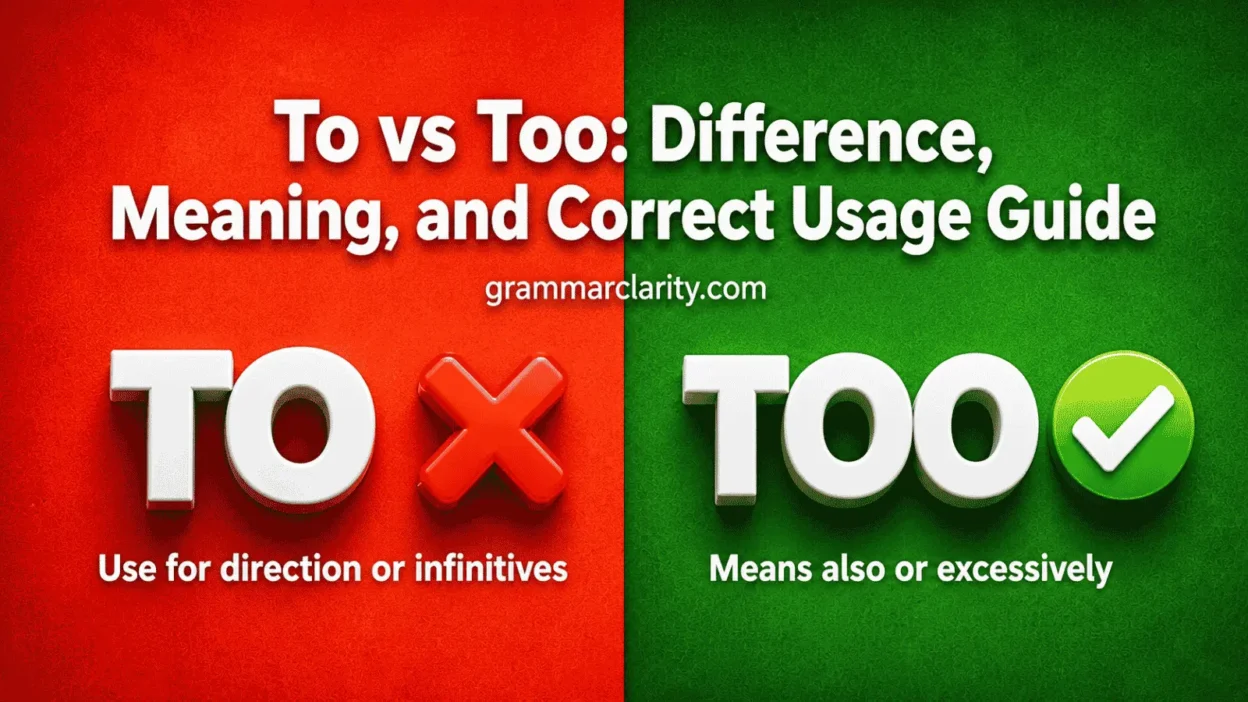
Use to for direction, destination, purpose, or an infinitive verb. Use too when you mean also, as well, or more than needed.
The easiest test is this: if you can replace the word with also or excessively, use too. In most other common uses, choose to.
Quick Answer
To usually points toward something or connects to a verb.
Examples:
I’m going to the store.
She wants to study tonight.
Send the file to Marcus.
Too means also or more than enough.
Examples:
I want coffee too.
This shirt is too small.
You replied too late.
So the difference is simple:
To = toward, for, or part of an infinitive verb.
Too = also or excessive.
Why People Confuse Them
People confuse to and too because they sound identical in speech. When you say them aloud, there is no difference in pronunciation.
The mistake usually happens in writing, especially in quick texts, emails, captions, and comments. A sentence may sound right when spoken but look wrong when written.
Another reason is that to is extremely common. Because writers use it so often, they sometimes type it automatically where too belongs.
Compare these:
Incorrect: I want to.
Correct: I want too.
Incorrect: This is to expensive.
Correct: This is too expensive.
The first sentence needs too because it means “also.” The second needs too because it means “more than it should be.”
Key Differences At A Glance
| Context | Best Choice | Why |
|---|---|---|
| Movement or direction | to | It points toward a place, person, or thing. |
| Destination | to | It shows where someone or something goes. |
| Infinitive verb | to | It comes before a base verb, as in “to leave.” |
| Recipient | to | It shows who receives something. |
| Meaning “also” | too | It adds another person, thing, or idea. |
| Meaning “excessively” | too | It shows that something is more than needed or wanted. |
Meaning and Usage Difference
To is most often used as a preposition or as part of an infinitive verb.
Use to when showing movement:
We drove to Chicago.
She walked to the front desk.
Use to when showing a recipient:
Please give this to your manager.
I sent the invite to Dana.
Use to before a base verb:
He needs to call back.
They plan to leave early.
Too is an adverb. It changes the meaning of a sentence by adding the idea of “also” or “more than enough.”
Use too to mean “also”:
I’m coming too.
She likes that restaurant too.
Use too to mean “excessively”:
The soup is too salty.
That deadline is too tight.
Tone, Context, and Formality
Both to and too are normal in casual and formal writing. The difference is not about tone. It is about meaning.
In professional writing, the wrong choice can make a sentence look careless:
Incorrect: I would like too schedule a meeting.
Correct: I would like to schedule a meeting.
Incorrect: The report is to long.
Correct: The report is too long.
In casual writing, the same rules apply:
I’m going to Target.
I’m going too.
The first sentence means the person is going somewhere. The second means the person is also going.
Which One Should You Use?
Choose to when the sentence involves direction, transfer, purpose, or an action word that follows.
Use to in sentences like these:
I need to finish this.
We’re heading to the airport.
Can you send it to me?
Choose too when the sentence means “also” or “more than enough.”
Use too in sentences like these:
I need a copy too.
It’s too cold outside.
You’re talking too fast.
A quick replacement test helps:
I want one too.
I want one also.
That works, so too is correct.
This bag is too heavy.
This bag is excessively heavy.
That also works, so too is correct.
When One Choice Sounds Wrong
To sounds wrong when the sentence clearly means “also.”
Incorrect: Can I come to?
Correct: Can I come too?
Incorrect: I miss you to.
Correct: I miss you too.
Too sounds wrong before most verbs when the sentence needs an infinitive.
Incorrect: I need too leave.
Correct: I need to leave.
Incorrect: She wants too apply.
Correct: She wants to apply.
Too also sounds wrong when the sentence is about direction.
Incorrect: We’re going too the office.
Correct: We’re going to the office.
Common Mistakes (and Quick Fixes)
One common mistake is using to when the meaning is “also.”
Incorrect: I agree to.
Correct: I agree too.
Another common mistake is using to before an adjective when the meaning is “excessively.”
Incorrect: The room is to bright.
Correct: The room is too bright.
Writers also mix up too and to before verbs.
Incorrect: I’m trying too learn Spanish.
Correct: I’m trying to learn Spanish.
A good quick fix is to ask one question:
Does the sentence mean “also” or “more than enough”?
If yes, use too.
If no, to is probably the right choice.
Everyday Examples
I’m going to the gym after work.
I’m going too if I finish early.
She wants to order lunch now.
I want lunch too.
That package was sent to the wrong address.
The shipping fee was too high.
He forgot to call his sister.
He forgot my birthday too.
We need to leave by 7.
It’s too late to start a movie.
Please talk to your teacher.
I was confused too.
Dictionary-Style Word Details
Verb
Neither to nor too is a verb.
To can appear before a verb in the infinitive form:
to run
to think
to decide
to improve
In that structure, to is not the action itself. The verb comes after it.
Too does not create an infinitive verb. It modifies meaning by adding “also” or “excessively.”
Noun
Neither to nor too is normally used as a noun in everyday English.
They are function words. Their meaning depends on how they work inside a sentence.
Synonyms
To usually does not have a simple one-word synonym because it often works grammatically rather than descriptively. Depending on context, it can suggest toward, until, for, or in order to.
Too can often be replaced by:
also
as well
excessively
overly
more than enough
Examples:
I want to go too.
I want to go as well.
The box is too heavy.
The box is excessively heavy.
Example Sentences
Use to:
I need to respond before noon.
She drove to Austin for the weekend.
Please hand the keys to your brother.
We’re trying to reduce the delay.
Use too:
I’d like a receipt too.
This coffee is too hot.
He arrived too early.
The instructions were too vague.
Word History
For modern writing, the history of these words matters less than their current use.
The important point is that to and too are separate standard words with separate jobs. They are not interchangeable spellings.
Use to for direction, connection, or infinitive verbs. Use too for “also” or “more than enough.”
Phrases Containing
Common phrases with to:
to be honest
to the point
from time to time
back to work
ready to go
close to home
Common phrases with too:
me too
you too
too much
too many
too late
too soon
too good to be true
Notice that too good to be true uses both words correctly. Too means “excessively,” and to introduces the phrase “be true.”
Conclusion
The difference between to vs too comes down to meaning.
Use to when you mean direction, destination, transfer, purpose, or an infinitive verb. Use too when you mean also or more than enough.
The fastest check is simple: if also or excessively fits, choose too. Otherwise, to is usually correct.