Then vs than is a common word-choice problem because the two words look alike, sound alike in casual speech, and differ by only one letter.
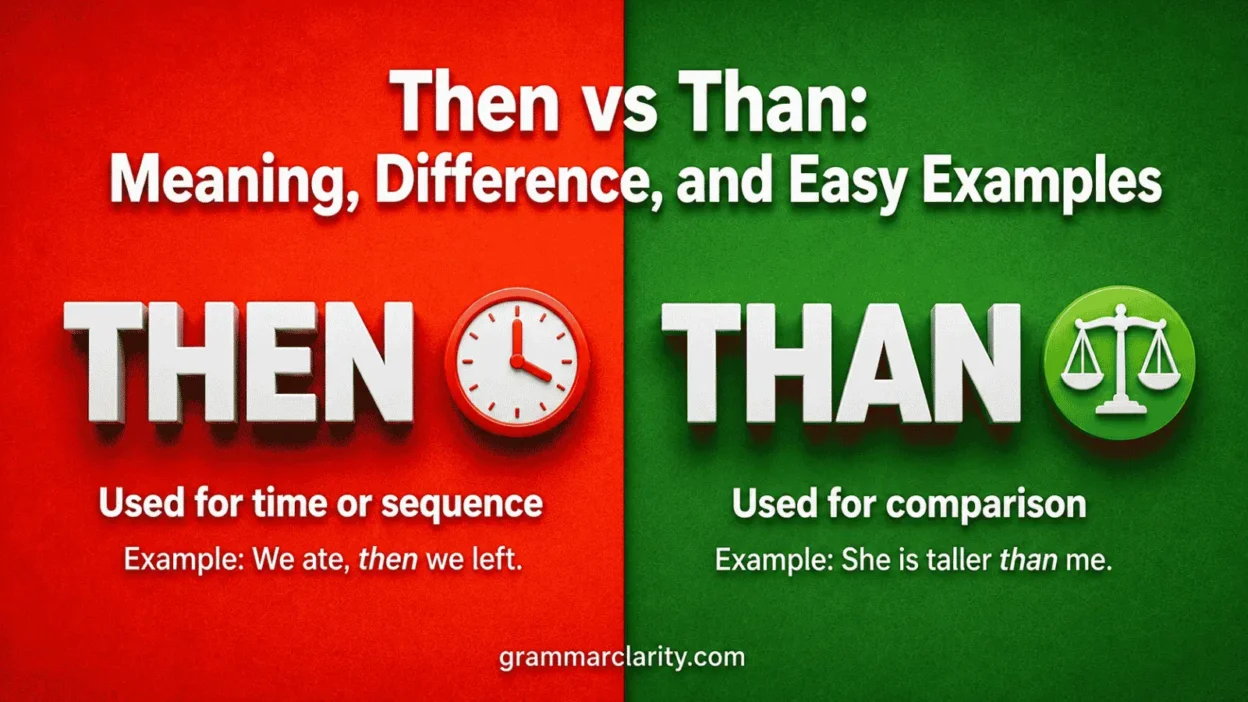
The difference is simple: then is about time, order, or result. Than is about comparison.
Use then when something happens next, happened at a certain time, or follows from a condition. Use than when you compare one thing with another.
Quick Answer
Use then for time or sequence.
Use than for comparison.
Correct:
- I finished work, then went for a run.
- This plan is cheaper than the old one.
- If the store is closed, then we’ll order online.
- She is more confident than she was last year.
A quick test works in most sentences: if you mean next or at that time, choose then. If you mean compared with, choose than.
Why People Confuse Them
People confuse then and than mostly because they are near-homophones in everyday American speech. In fast conversation, the vowel difference may be hard to hear.
They also appear in similar-looking sentence positions:
- We ate dinner, then watched a movie.
- We ate earlier than usual.
Both words can sit between sentence parts, so the spelling choice depends on meaning, not placement.
The safest question is: Am I showing time or making a comparison?
Key Differences At A Glance
| Context | Best Choice | Why |
|---|---|---|
| Showing what happened next | then | It marks sequence. |
| Referring to a past or future time | then | It means “at that time.” |
| Showing a result after “if” | then | It means “in that case.” |
| Comparing people, things, amounts, or ideas | than | It introduces the second part of a comparison. |
| Using words like better, worse, more, less, taller, earlier | than | Comparative words usually need than. |
| Saying “except for” in phrases like “other than” | than | The fixed phrase uses than. |
Compact comparison:
- Then = time, order, result.
- Than = comparison, contrast, exception in fixed phrases.
Meaning and Usage Difference
Then usually answers a time-based question: When? What happened next? What follows from that?
Examples:
- I lived in Chicago then.
- Turn left, then go two blocks.
- If the numbers are correct, then we can approve the budget.
Than introduces comparison. It often appears after comparative words such as better, worse, more, less, faster, slower, older, younger, higher, and lower.
Examples:
- This version is better than the draft.
- She arrived earlier than expected.
- The repair cost more than we planned.
The words are not interchangeable. Then does not compare. Than does not show what happens next.
Tone, Context, and Formality
Both words are normal in formal and informal English. The issue is not tone; the issue is accuracy.
In formal writing, than can raise a pronoun question:
- She is taller than I am.
- She is taller than me.
Both forms are common, but than I am sounds more formal because the comparison is written as a full clause. Than me is natural in everyday American English.
With then, formal writing often benefits from clearer punctuation:
- First, we reviewed the contract. Then we signed it.
- If the proposal is approved, then hiring can begin.
The word then does not always require a comma. Use punctuation only when it improves clarity or fits the sentence structure.
Which One Should You Use?
Choose then when the sentence deals with time, sequence, or consequence.
Use then for:
- what happened next
- what was true at a certain time
- what follows from a condition
- a step in a process
Choose than when the sentence compares.
Use than after:
- more
- less
- better
- worse
- rather
- other
- comparative adjectives and adverbs
Correct choices:
- We met in 2020; I was living in Denver then.
- The new phone is lighter than my old one.
- Submit the form, then check your email.
- I’d rather walk than wait in traffic.
When One Choice Sounds Wrong
Then sounds wrong when the sentence clearly compares two things.
Incorrect: This laptop is faster then mine.
Correct: This laptop is faster than mine.
Than sounds wrong when the sentence shows order or time.
Incorrect: We parked the car, than walked inside.
Correct: We parked the car, then walked inside.
Some sentences become especially confusing because they contain both time and comparison:
- We left earlier than usual, then stopped for coffee.
Here, than compares the leaving time with the usual time. Then shows what happened next.
Common Mistakes (and Quick Fixes)
Mistake: Using then after a comparative word.
Fix: Use than after words like better, more, less, faster, and older.
Incorrect: Your idea is better then mine.
Correct: Your idea is better than mine.
Mistake: Using than to show the next step.
Fix: Use then for sequence.
Incorrect: Save the file, than close the app.
Correct: Save the file, then close the app.
Mistake: Writing rather then.
Fix: The correct phrase is rather than.
Incorrect: I’d rather email then call.
Correct: I’d rather email than call.
Mistake: Writing other then.
Fix: The correct phrase is other than.
Incorrect: I don’t need anything other then water.
Correct: I don’t need anything other than water.
Everyday Examples
- I’ll call you then.
- Finish the report, then send it to me.
- Back then, rent was much lower.
- If that’s the final price, then we should compare options.
- My schedule is busier than yours.
- This coffee is stronger than the one I made yesterday.
- We need more time than we expected.
- I’d rather leave now than rush later.
- Other than a few typos, the draft looks good.
- She was more prepared than anyone else in the room.
A sentence can use both words naturally:
- We paid more than expected, then asked for an updated estimate.
Dictionary-Style Word Details
Verb
Neither then nor than is normally used as a verb in standard modern English.
Do not write sentences that try to make either word act like an action word.
Noun
Then can work as a noun meaning “that time.”
Example:
- We stayed in touch from then on.
Than is not normally used as a noun in standard writing.
Synonyms
For then, useful alternatives include:
- afterward
- next
- at that time
- in that case
- subsequently
For than, there is no exact one-word replacement in most comparisons. Depending on the sentence, you may be able to rephrase with:
- compared with
- compared to
- instead of
- other than
Example:
- This model is cheaper than that one.
- This model is cheaper compared with that one.
The first version is usually cleaner.
Example Sentences
- I was in college then.
- Add the eggs, then stir the mixture.
- If everyone agrees, then we can move forward.
- This route is shorter than the highway.
- Her answer was clearer than mine.
- I’d rather stay home than drive in the storm.
Word History
Then and than developed from older English forms that were closely related, which helps explain why they look and sound so similar today. In modern English, their jobs have separated clearly: then handles time and sequence, while than handles comparison.
That history may explain the confusion, but it does not make the words interchangeable now.
Phrases Containing
Common phrases with then:
- back then
- just then
- since then
- now and then
- every now and then
- then and there
Common phrases with than:
- better than
- more than
- less than
- rather than
- other than
- no sooner than
- easier said than done
Conclusion
The difference between then vs than comes down to one clear choice.
Use then for time, order, or result. Use than for comparison.
If the sentence means next, at that time, or in that case, choose then. If the sentence means compared with, choose than. Once you apply that test, most mistakes become easy to catch.