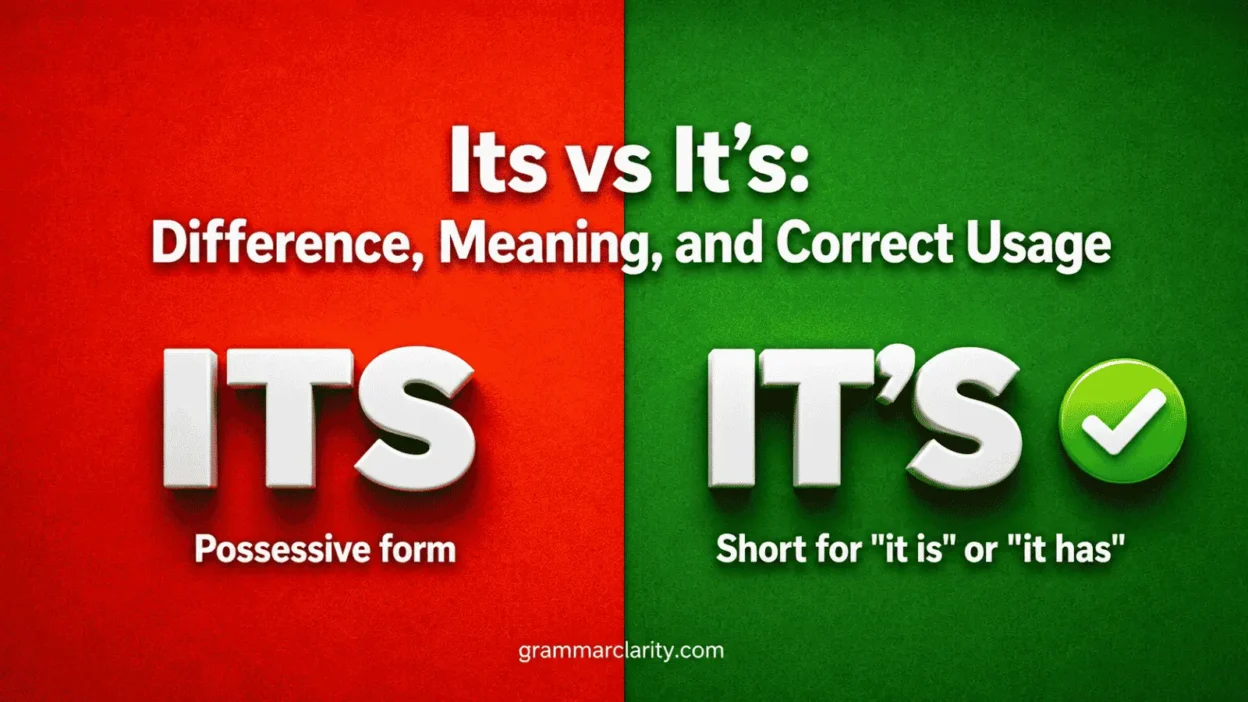
The difference between its vs it’s is simple once you know what the apostrophe does.
Its shows possession. It’s means it is or it has.
The mistake happens because English usually uses an apostrophe for possession, as in the dog’s collar or the company’s policy. But its is different. It is a possessive word like his, her, and their, so it does not need an apostrophe.
Quick Answer
Use its when you mean belonging to it.
Use it’s when you mean it is or it has.
Correct examples:
- The cat licked its paw.
- It’s raining again.
- The company changed its logo.
- It’s been a long week.
The easiest test is this: replace the word with it is or it has. If the sentence still makes sense, use it’s. If it does not, use its.
Why People Confuse Them
People confuse its and it’s because apostrophes often show possession with nouns.
For example:
- the teacher’s book
- the car’s engine
- the restaurant’s menu
That pattern makes it’s color look as if it should mean “the color belonging to it.” But it does not. It’s is only a contraction.
So this sentence is wrong:
- The dog chased it’s tail.
The correct version is:
- The dog chased its tail.
The tail belongs to the dog, so the possessive form is its.
Key Differences At A Glance
| Context | Best Choice | Why |
|---|---|---|
| Shows ownership or association | its | Means “belonging to it” |
| Means “it is” | it’s | The apostrophe replaces a missing letter |
| Means “it has” | it’s | The apostrophe marks the shortened form |
| Describes a feature of something | its | The feature belongs to or relates to the thing |
| Starts a statement like “it is clear” | it’s | Can be expanded to “it is” |
Compact comparison:
- Its = possessive form.
- It’s = contraction of it is or it has.
- Its’ = not the standard form.
- The apostrophe in it’s does not show possession.
Meaning and Usage Difference
Its is used when something belongs to, is part of, or is connected with a thing, animal, place, organization, idea, or situation.
Examples:
- The phone lost its signal.
- The school updated its policy.
- The bird spread its wings.
- The storm reached its peak overnight.
In each sentence, its points to something connected with the subject.
It’s is a shortened form of it is or it has.
Examples:
- It’s cold outside.
- It’s almost noon.
- It’s been a difficult month.
- It’s taken longer than expected.
If you can say it is or it has, the apostrophe belongs there.
Tone, Context, and Formality
Both its and it’s are normal in American English, but they work differently in formal writing.
Its is common in all types of writing, including business, academic, technical, and legal contexts.
Examples:
- The report explains its main findings.
- The device stores its settings automatically.
- The city revised its budget.
It’s is also correct, but contractions can sound more conversational. In formal writing, some writers prefer it is or it has instead of it’s.
Conversational:
- It’s important to reply by Friday.
More formal:
- It is important to reply by Friday.
That does not make it’s wrong. It just means the full form may sound more polished in serious or formal contexts.
Which One Should You Use?
Choose its when the word answers a question like “whose?” or “belonging to what?”
- The laptop needs its charger.
- The team reached its goal.
- The book has its own style.
Choose it’s when the sentence needs it is or it has.
- It’s a good idea.
- It’s not ready yet.
- It’s been approved.
A quick way to check your sentence is to read it out loud with it is or it has.
If “The team reached it is goal” sounds wrong, then it’s is wrong there. The correct sentence is:
- The team reached its goal.
When One Choice Sounds Wrong
It’s sounds wrong when the sentence is about ownership.
Wrong:
- The company improved it’s website.
- The bird built it’s nest.
- The app changed it’s design.
Correct:
- The company improved its website.
- The bird built its nest.
- The app changed its design.
Its sounds wrong when the sentence needs it is or it has.
Wrong:
- Its getting late.
- Its been a while.
- Its not your fault.
Correct:
- It’s getting late.
- It’s been a while.
- It’s not your fault.
Common Mistakes (and Quick Fixes)
The most common mistake is using it’s for possession because the apostrophe looks possessive.
Wrong:
- The store changed it’s hours.
Correct:
- The store changed its hours.
Another common mistake is leaving out the apostrophe in a contraction.
Wrong:
- Its been a great year.
Correct:
- It’s been a great year.
A third mistake is writing its’. Avoid this form in standard English.
Wrong:
- The machine reached its’ limit.
Correct:
- The machine reached its limit.
Quick fix: before using it’s, ask whether you can replace it with it is or it has. If not, use its.
Everyday Examples
- The dog carried its toy into the kitchen.
- It’s too early to call.
- The restaurant updated its menu.
- It’s been a busy morning.
- The phone is in its case.
- It’s not as expensive as I expected.
- The city opened its new library branch.
- It’s clear that we need more time.
- The movie has its funny moments.
- It’s already on your calendar.
These examples show the main pattern: its connects something to a noun, while it’s introduces a shortened statement.
Dictionary-Style Word Details
Verb
Its is not a verb.
It’s is not a single verb by itself, but it contains a verb because it shortens it is or it has.
Examples:
- It’s ready. = It is ready.
- It’s changed. = It has changed.
Noun
Its is not a noun.
It’s is not a noun. It is a contraction.
Synonyms
There are no exact one-word synonyms for its or it’s because they serve grammar functions.
Useful replacements:
- its → belonging to it
- it’s → it is
- it’s → it has
Examples:
- The bird cleaned its feathers.
- The feathers belonging to the bird were clean.
- It’s raining.
- It is raining.
Example Sentences
- The museum restored its oldest painting.
- It’s hard to believe the year is almost over.
- The puppy found its blanket.
- It’s been three days since the update.
- The office changed its closing time.
- It’s safe to park here after 6 p.m.
Word History
The modern difference is tied to two separate jobs.
It’s uses an apostrophe because it is a shortened form. The apostrophe shows that letters have been left out.
Its follows the pattern of possessive words like his, hers, ours, and theirs, which do not use apostrophes.
That is why its may look unusual at first, but it fits the broader pattern of possessive pronouns.
Phrases Containing
Common phrases with its:
- on its own
- in its place
- at its best
- at its worst
- in its early stages
- its own way
- its full potential
Common phrases with it’s:
- it’s okay
- it’s fine
- it’s been a while
- it’s up to you
- it’s worth it
- it’s not over
- it’s about time
Conclusion
The difference between its vs it’s comes down to one clear rule.
Use its for possession:
- The dog wagged its tail.
Use it’s for it is or it has:
- It’s a nice day.
- It’s been fun.
When you are unsure, expand the word. If it is or it has fits, write it’s. If it does not fit, write its.