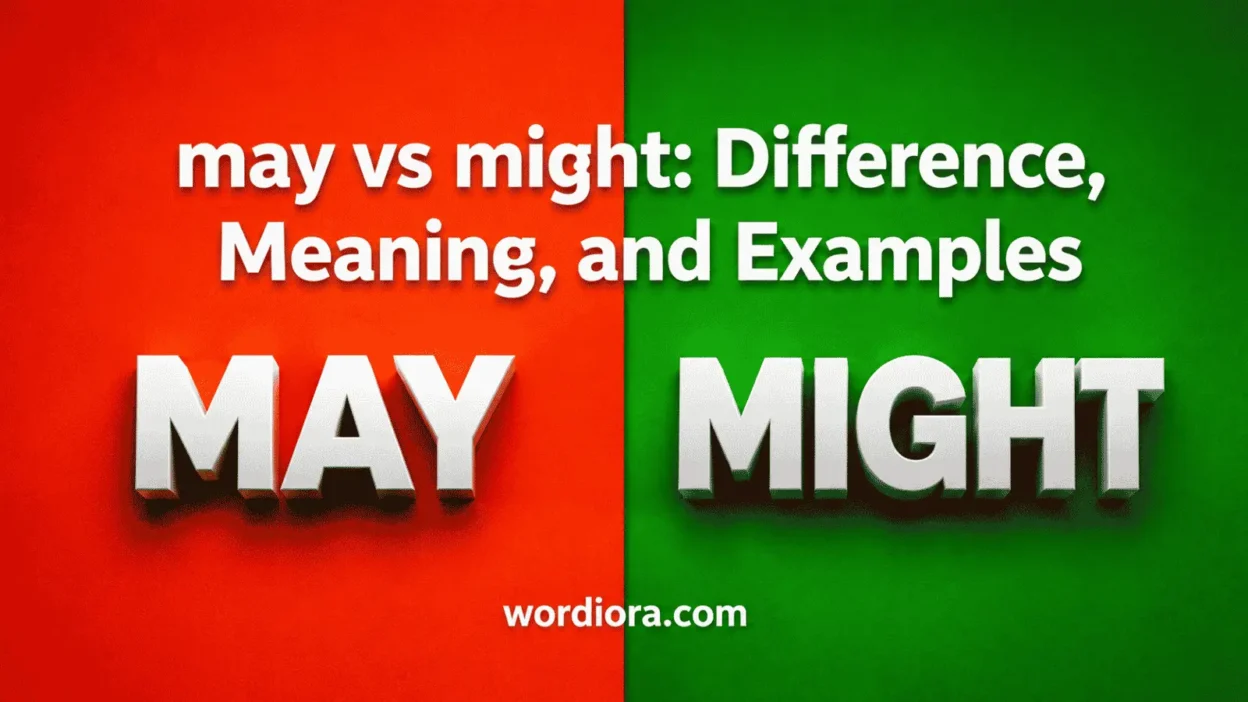
May and might are both correct words, but they do not always feel the same.
Use may when something is possible, somewhat likely, formally allowed, or politely permitted. Use might when something is possible but less certain, more cautious, more remote, or imagined.
The cleanest answer is this: may often sounds a little more direct or formal. Might often sounds a little more uncertain or tentative.
Quick Answer
For everyday US English, may and might can both talk about possibility.
Correct:
I may stop by after work.
I might stop by after work.
Both mean the visit is possible. The difference is tone. May sounds a bit more open or likely. Might sounds less sure.
For permission, may is usually the better choice.
Correct:
You may leave early today.
Awkward in standard US English:
You might leave early today.
That second sentence does not clearly grant permission. It sounds like a guess about what the person could do.
Why People Confuse Them
People confuse may and might because both are modal verbs. They help another verb show possibility, permission, or uncertainty.
They also appear in the same sentence pattern:
may + base verb
She may call tonight.
might + base verb
She might call tonight.
Because both sentences are grammatical, the real choice often depends on meaning and tone, not basic correctness.
Key Differences At A Glance
| Context | Best Choice | Why |
|---|---|---|
| A real possibility | may or might | Both can mean something is possible. |
| A slightly stronger possibility | may | It often sounds a bit more likely or direct. |
| A weaker or more cautious possibility | might | It often sounds less certain. |
| Formal permission | may | It clearly gives or asks permission. |
| Past imagined result | might have | It often describes something that was possible but did not happen. |
| Polite suggestion | might | It can sound softer and less direct. |
Meaning and Usage Difference
May means something is possible or allowed.
Examples:
The package may arrive today.
You may use the conference room at 3.
Might means something is possible, but the speaker often sounds less sure.
Examples:
The package might arrive today.
I might use the conference room later.
The difference is not a hard math rule. In many real sentences, may and might overlap. Still, readers often hear may as a little more confident and might as a little more cautious.
One important pattern is might have.
Might have often points to a past possibility or an imagined result.
Example:
We might have won if we had started earlier.
That means winning was possible, but it did not happen.
Tone, Context, and Formality
May sounds more formal in permission sentences.
Example:
Employees may park in Lot B.
That sentence sounds like a rule or policy.
Might sounds softer when making a suggestion.
Example:
You might want to check the deadline again.
That sounds less bossy than “Check the deadline again.”
For possibility, both words work in normal conversation. Still, may can sound cleaner in formal writing, while might can sound more natural when you are unsure.
Compact comparison:
• may: possible, permitted, somewhat formal, often more direct
• might: possible, uncertain, tentative, often softer
• may have: possible past event, depending on context
• might have: possible past event, often unreal or less certain
Which One Should You Use?
Choose may when you mean “is allowed to.”
Example:
Students may submit the form online.
Choose may when you want a clear, formal statement of possibility.
Example:
The office may close early on Friday.
Choose might when you want to sound less certain.
Example:
The office might close early on Friday.
Choose might for polite, low-pressure suggestions.
Example:
You might try restarting the app.
Choose might have for a past possibility, especially one that did not happen or cannot be confirmed.
Example:
She might have missed the email.
When One Choice Sounds Wrong
May sounds wrong when the sentence needs a clearly unreal past result.
Awkward:
We may have won if we had practiced more.
Better:
We might have won if we had practiced more.
The better sentence means the win did not happen, but it was possible.
Might sounds wrong when you are granting permission in clear US English.
Awkward:
You might take your break now.
Better:
You may take your break now.
The better sentence clearly says the person is allowed to take a break.
Common Mistakes (and Quick Fixes)
Mistake 1: Using might to give permission.
Weak:
You might enter the building after 8 a.m.
Better:
You may enter the building after 8 a.m.
Mistake 2: Treating may as always more likely.
Too rigid:
Use may only when something is likely.
Better:
Use may when something is possible and you want a slightly more direct or formal tone.
Mistake 3: Using may have for an unreal past result.
Weak:
I may have gone if you had invited me.
Better:
I might have gone if you had invited me.
Mistake 4: Adding “to” after either word.
Wrong:
She may to call later.
He might to join us.
Correct:
She may call later.
He might join us.
Everyday Examples
I may work from home tomorrow.
I might work from home tomorrow.
You may pay by card at the front desk.
You might want to pay before the line gets long.
The meeting may run late.
The meeting might run late.
She may know the answer.
She might know the answer.
We might have missed the exit.
They may have already sent the receipt.
In these examples, may often feels a little more direct. Might often feels more cautious.
Dictionary-Style Word Details
Verb
may: A modal verb used with a base verb. It can show possibility, permission, or a wish. It does not take -s in the third person.
Example:
She may join us.
might: A modal verb used with a base verb. It can show possibility, a more tentative idea, a polite suggestion, or a past/hypothetical possibility. It does not take -s in the third person.
Example:
She might join us.
Noun
may: Not commonly used as a regular noun in this word-choice sense. May is also the name of a month, but that is a separate use.
Example:
May is usually busy for graduations.
might: A noun meaning strength, power, or force. This use is separate from the modal verb.
Example:
He pushed the door with all his might.
Synonyms
may: Closest plain alternatives include could, is allowed to, is permitted to, and is possible that. These are not always exact replacements.
might: Closest plain alternatives include could, may possibly, is possible that, and could perhaps. These are not exact in every sentence.
Clear antonyms do not fit well for the modal meanings because may and might express possibility, not a simple opposite idea. For permission uses of may, a clear opposite can be may not or is not allowed to.
Example Sentences
may:
You may start the test now.
The storm may delay our flight.
This update may fix the issue.
might:
I might stop for coffee on the way.
That answer might be right.
We might have chosen a different route.
Word History
may: The word has long been used in English as a modal verb connected with ability, possibility, and permission. Its older history is complex, so the safest modern point is its current role: it helps another verb express possibility or permission.
might: The modal verb might developed as a past form connected to may, but modern English also uses it for present and future possibilities. As a noun, might has a separate meaning: strength or power.
Phrases Containing
may:
may be
may have
may as well
may or may not
if I may
might:
might be
might have
might as well
might or might not
with all one’s might
Conclusion
May and might are both correct for possibility, but they carry different shades of meaning.
Use may for possibility when you want a clearer or slightly more formal tone. Use may for permission.
Use might when the idea is less certain, softer, more cautious, or hypothetical. Use might have for many past possibilities, especially when the thing did not happen or is only being guessed.
The safest rule is simple: may is more direct; might is more tentative.