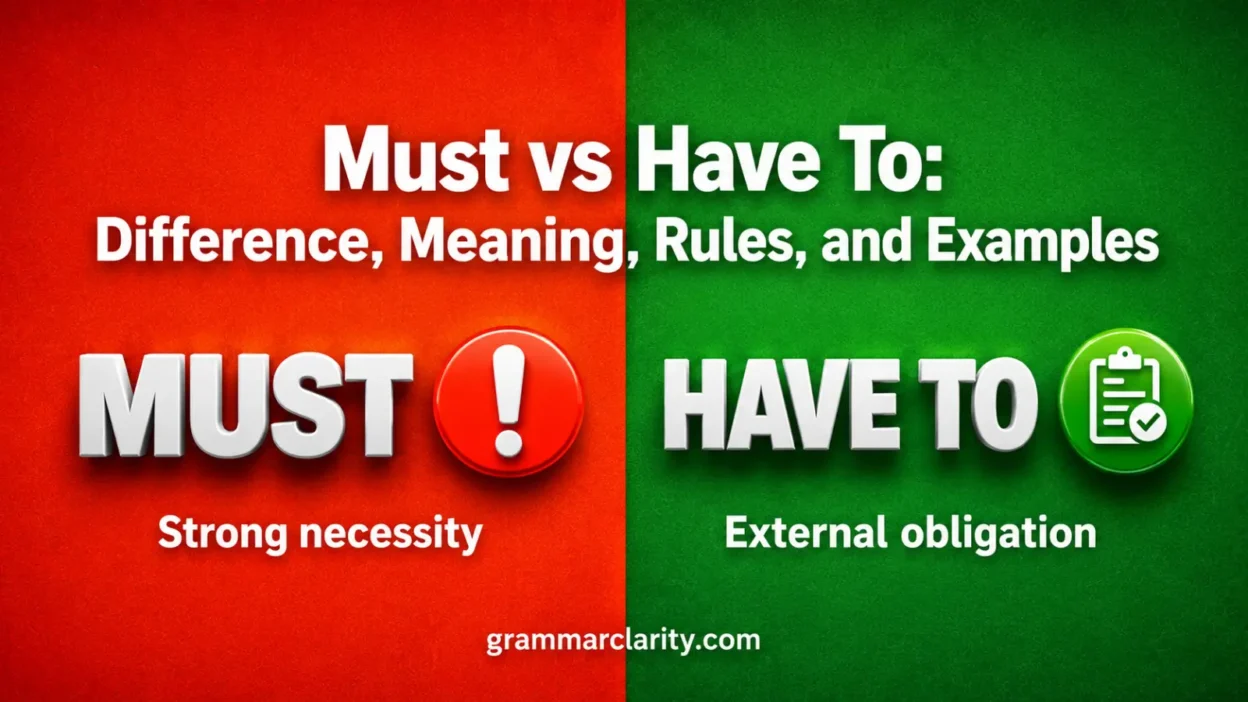
The difference between must vs have to is small but important. Both phrases show obligation, necessity, or requirement, but they do not always feel the same.
Use must when the obligation feels strong, personal, formal, or speaker-driven. Use have to when the obligation comes from a rule, schedule, law, situation, or outside requirement.
In everyday American English, have to is often more natural in conversation. Must sounds stronger and more formal, though it is still useful in rules, warnings, instructions, and serious advice.
Quick Answer
Must means something is necessary, required, or strongly expected.
Example:
I must finish this report today.
Have to also means something is necessary or required, but it often points to an outside reason.
Example:
I have to finish this report today because my manager needs it by 5 p.m.
The easiest rule is this:
Use must for strong personal necessity or formal rules.
Use have to for everyday obligations, outside requirements, and normal conversation.
Why People Confuse Them
People confuse must and have to because both can mean “it is necessary.” In many sentences, they are close enough that the meaning stays almost the same.
For example:
I must leave now.
I have to leave now.
Both sentences mean the speaker needs to leave. The difference is tone. Must sounds more direct, serious, or personal. Have to sounds more common and natural in everyday speech.
The confusion becomes bigger in negative forms. Must not and do not have to do not mean the same thing.
You must not enter.
This means entering is not allowed.
You do not have to enter.
This means entering is optional.
Key Differences At A Glance
| Context | Best Choice | Why |
|---|---|---|
| Personal decision | must | The need comes from the speaker’s own judgment |
| Outside rule | have to | The need comes from a rule, law, schedule, or authority |
| Everyday speech | have to | It sounds more natural in casual American English |
| Formal warning | must | It sounds stronger and more serious |
| Past obligation | had to | Must does not normally form a past-tense obligation |
| Future obligation | will have to | Have to works naturally with future time |
| Prohibition | must not | It means something is not allowed |
| No obligation | do not have to | It means something is not necessary |
Meaning and Usage Difference
Must is used when something is necessary, required, or strongly recommended. It often carries a feeling of urgency, authority, or personal conviction.
Examples:
You must wear a seat belt.
We must protect customer information.
I must call my doctor today.
Have to is used when a person is required to do something because of rules, facts, duties, or circumstances.
Examples:
I have to be at work by 8 a.m.
Students have to submit the form online.
She has to renew her license this month.
Compact comparison:
- Must: stronger, more formal, often personal or rule-based.
- Have to: more conversational, often based on outside facts.
- Must not: not allowed.
- Do not have to: not required.
- Had to: past obligation.
- Will have to: future obligation.
Tone, Context, and Formality
Must can sound firm, official, or urgent. It is common in signs, policies, safety instructions, formal writing, and strong advice.
Examples:
Visitors must check in at the front desk.
Employees must follow safety procedures.
You must see a doctor if the pain gets worse.
In conversation, must can sometimes sound too serious unless the situation truly calls for it.
Example:
I must buy milk after work.
This sentence is correct, but it may sound a little formal or dramatic in casual speech. Most Americans would say:
I have to buy milk after work.
Have to is more common in everyday conversation because it sounds plain and natural.
Examples:
I have to pick up the kids.
We have to leave soon.
He has to work late tonight.
Which One Should You Use?
Use have to when you want a natural everyday sentence.
Examples:
I have to pay rent tomorrow.
She has to take the exam again.
We have to get gas before the trip.
Use must when you want the sentence to sound stronger, more formal, or more urgent.
Examples:
You must stop at a red light.
All guests must show identification.
I must admit, that was a great idea.
Common FAQ-style answers:
Is must stronger than have to?
Yes. Must usually sounds stronger, more direct, and more formal than have to.
Is have to more common in American English?
Yes. In everyday speech, Americans often use have to for normal obligations.
Can I use must and have to in the same sentence?
You usually do not need both for the same obligation. Say I must go or I have to go, not I must have to go.
Which one should I use in formal rules?
Use must when writing firm rules, official instructions, or safety requirements.
When One Choice Sounds Wrong
Sometimes must sounds too formal for a casual situation.
Too stiff:
I must clean my room before dinner.
More natural:
I have to clean my room before dinner.
Sometimes have to sounds weaker than needed in official instructions.
Less firm:
Employees have to wash their hands before returning to work.
Stronger:
Employees must wash their hands before returning to work.
The biggest mistake is using must not when you mean “not necessary.”
Wrong:
You must not come to the meeting if you are busy.
This sounds like you are not allowed to come.
Better:
You do not have to come to the meeting if you are busy.
Common Mistakes (and Quick Fixes)
One common mistake is using must for past obligation.
Wrong:
I must work late yesterday.
Correct:
I had to work late yesterday.
Another mistake is using must after another helping verb.
Wrong:
She will must retake the test.
Correct:
She will have to retake the test.
A third mistake is confusing must not with do not have to.
Wrong:
You must not bring a laptop.
If laptops are optional, say:
You do not have to bring a laptop.
If laptops are banned, say:
You must not bring a laptop.
Everyday Examples
I have to stop by the grocery store after work.
You must keep this door closed during the exam.
We have to reschedule the appointment.
Drivers must carry proof of insurance.
She has to finish her training before Friday.
I must say, your presentation was excellent.
You do not have to answer every question.
You must not park in front of the fire hydrant.
They had to cancel the flight because of bad weather.
We will have to make a decision soon.
Dictionary-Style Word Details
Verb
Must works as a helping verb. It is followed by the base form of another verb.
Examples:
You must leave now.
We must finish this today.
Have to works with the verb have plus to and the base form of another verb.
Examples:
You have to leave now.
She has to finish this today.
Noun
Must can also be used as a noun meaning something required or highly recommended.
Example:
Comfortable shoes are a must for a long walking tour.
Have to is not normally used as a noun in standard everyday writing.
Synonyms
Synonyms for must include:
need to
be required to
be obligated to
be expected to
Synonyms for have to include:
need to
be supposed to
be required to
be forced to
be necessary to
These are not always exact replacements. The best choice depends on tone and context.
Example Sentences
You must follow the instructions carefully.
I have to renew my passport this year.
Students must remain quiet during the test.
We have to leave by noon to avoid traffic.
You must not share your password.
You do not have to print the form.
Word History
Must has long been used in English to show necessity, command, strong expectation, or certainty.
Have to developed from the ordinary verb have, which can show possession, duty, or necessity. In modern English, have to is widely used for obligations in everyday speech and writing.
The important point for current usage is simple: must often sounds stronger or more formal, while have to often sounds more natural and conversational.
Phrases Containing
Common phrases with must:
must-see
must-have
must-read
must not
must be
must admit
must remember
Common phrases with have to:
have to go
have to do
have to be
have to say
have to work
have to wait
have to choose
Examples:
That movie is a must-see.
I have to say, this turned out better than expected.
You must remember to sign the form.
We have to wait until the office opens.
FAQs
Is “must” stronger than “have to”?
Yes. Must usually sounds stronger, more direct, and more formal than have to. Use it when the obligation feels serious, official, or urgent.
Is “have to” more common in American English?
Yes. In everyday American English, have to is usually more natural for regular duties and obligations.
Can I use “must” and “have to” in the same sentence?
Usually, no. Do not say I must have to go. Say I must go or I have to go.
What is the difference between “must not” and “do not have to”?
Must not means something is not allowed. Do not have to means something is optional or not required.
Example:
You must not park here.
You do not have to attend the meeting.
Which is better for rules: “must” or “have to”?
Must is better for formal rules, warnings, policies, and instructions.
Example:
All visitors must check in at the front desk.
Which is better for everyday speech?
Have to usually sounds better in casual conversation.
Example:
I have to leave early today.
Can “must” be used in the past tense?
Not usually for past obligations. Use had to instead.
Wrong:
I must work late yesterday.
Correct:
I had to work late yesterday.
Can “must” be used for future obligations?
It can, but will have to often sounds more natural when clearly talking about the future.
Example:
We will have to decide by Friday.
Conclusion
Must and have to both express necessity, but they differ in tone and context. Use must when the obligation feels strong, formal, personal, or official. Use have to when the obligation comes from rules, schedules, circumstances, or everyday responsibilities.
For most casual American English sentences, have to will sound more natural. For warnings, rules, serious advice, and formal instructions, must is often the better choice.
The most important rule is this: must not means “not allowed,” while do not have to means “not necessary.”