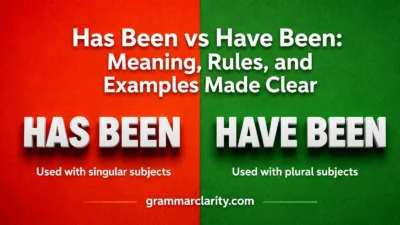

The difference between is vs are comes down to the subject of the sentence.
Use is with a singular subject. Use are with a plural subject or with you.
That sounds simple, but many sentences hide the real subject behind extra words. That is where mistakes happen.
Quick Answer
Use is when the subject is one person, place, thing, or idea.
- The door is open.
- My sister is here.
- This answer is correct.
Use are when the subject is plural or when the subject is you.
- The doors are open.
- My sisters are here.
- You are correct.
The main rule is this: the verb must agree with the real subject, not with a nearby word.
Why People Confuse Them
People often confuse is and are because the subject is not always right next to the verb.
Look at this sentence:
- The keys to the car are on the table.
The word car is singular, but it is not the subject. The subject is keys, which is plural. That is why are is correct.
The same thing happens with phrases such as one of, a group of, there is, and there are. A nearby noun can distract the writer from the real subject.
Key Differences At A Glance
| Context | Best Choice | Why |
|---|---|---|
| One person or thing | is | The subject is singular. |
| More than one person or thing | are | The subject is plural. |
| The subject is you | are | You takes are in the present tense. |
| The sentence begins with there and one thing follows | is | The noun after the verb is singular. |
| The sentence begins with there and multiple things follow | are | The noun after the verb is plural. |
| A singular subject has an extra phrase after it | is | The added phrase does not change the subject. |
| A plural subject has an extra phrase after it | are | The plural subject still controls the verb. |
Meaning and Usage Difference
Is and are are both present-tense forms of the verb be.
Use is with:
- he
- she
- it
- this
- that
- one person
- one place
- one thing
- one idea
Examples:
- She is ready.
- It is raining.
- The meeting is at noon.
- This plan is better.
Use are with:
- you
- we
- they
- these
- those
- plural nouns
Examples:
- You are invited.
- We are almost done.
- They are outside.
- These cookies are fresh.
Here is the key point: is does not mean “formal,” and are does not mean “informal.” The choice depends on grammar, not tone.
Tone, Context, and Formality
Both is and are are neutral. You can use either one in casual writing, business writing, school assignments, emails, and professional documents.
The difference is not style. It is agreement.
Casual:
- My phone is dead.
- My headphones are missing.
Professional:
- The report is attached.
- The files are attached.
Academic:
- The evidence is limited.
- The results are significant.
In every case, the subject decides the verb.
Which One Should You Use?
Ask one question: What is the subject?
If the subject names one thing, use is.
- The package is on the porch.
- Her answer is clear.
- The problem is serious.
If the subject names more than one thing, use are.
- The packages are on the porch.
- Her answers are clear.
- The problems are serious.
Be careful with phrases that come between the subject and the verb.
- The box of markers is on the shelf.
- The boxes of markers are on the shelf.
In the first sentence, box is the subject. In the second sentence, boxes is the subject.
When One Choice Sounds Wrong
Use is with a plural subject and the sentence sounds incorrect.
Wrong:
- The books is on the desk.
Correct:
- The books are on the desk.
Use are with a singular subject and the sentence also sounds wrong.
Wrong:
- The book are on the desk.
Correct:
- The book is on the desk.
The tricky part is that some incorrect sentences may sound natural in fast conversation, especially with there’s.
Casual speech often uses:
- There’s three people waiting.
In careful writing, use:
- There are three people waiting.
Common Mistakes (and Quick Fixes)
One common mistake is matching the verb to the closest noun instead of the subject.
Wrong:
- The list of names are on my desk.
Correct:
- The list of names is on my desk.
The subject is list, not names.
Another common mistake happens with there is and there are.
Wrong:
- There is several reasons to wait.
Correct:
- There are several reasons to wait.
The noun reasons is plural, so are is correct.
A third mistake appears with compound subjects.
Wrong:
- My brother and sister is coming.
Correct:
- My brother and sister are coming.
Two subjects joined by and usually take are.
Everyday Examples
Use is when talking about one thing:
- The coffee is hot.
- My laptop is charging.
- The store is closed.
- Her idea is interesting.
- This seat is taken.
Use are when talking about more than one thing:
- The drinks are cold.
- My devices are charging.
- The stores are closed.
- Her ideas are interesting.
- These seats are taken.
Use are with you, even when speaking to one person:
- You are early.
- You are the first person here.
- You are doing the right thing.
Use is or are after there based on the noun that follows:
- There is a message for you.
- There are two messages for you.
- There is one problem left.
- There are several problems left.
Dictionary-Style Word Details
Verb
Is is a present-tense form of be used with third-person singular subjects.
Examples:
- He is tired.
- She is a nurse.
- It is late.
Are is a present-tense form of be used with plural subjects and with you.
Examples:
- They are ready.
- We are here.
- You are right.
Noun
In ordinary grammar use, is is treated as a verb, not a noun.
Are can also be a noun in a separate technical sense: an are is a metric unit of area equal to 100 square meters. That noun meaning is rare in everyday US writing and is not the meaning involved in is vs are.
Synonyms
Because is and are are forms of be, they do not have simple one-word replacements that work in every sentence.
Depending on the sentence, they may express:
- exists
- remains
- seems
- equals
- belongs
- happens
Examples:
- The answer is correct.
Similar idea: The answer seems correct. - The guests are outside.
Similar idea: The guests remain outside.
These are not exact swaps. They only show the kind of meaning be can carry.
Example Sentences
- The dog is sleeping.
- The dogs are sleeping.
- My schedule is full.
- My appointments are confirmed.
- The answer is simple.
- The details are important.
- There is a chair in the hallway.
- There are chairs in the hallway.
- You are welcome to join us.
- This email is ready to send.
Word History
Is and are are old forms of the English verb be. Modern English keeps several forms of this verb, including am, is, are, was, were, be, being, and been.
That is why be feels less regular than many other English verbs. Instead of one simple pattern, it changes form based on the subject and tense.
Phrases Containing
Common phrases with is include:
- there is
- it is
- what is
- that is
- as is
- the point is
- the truth is
Common phrases with are include:
- there are
- you are
- we are
- they are
- chances are
- odds are
- all eyes are on
Compact comparison:
- is: one person, one thing, one idea, he, she, it, this, that
- are: plural subjects, you, we, they, these, those
FAQS
Is it “there is” or “there are”?
Use there is before a singular noun and there are before a plural noun.
- There is a problem.
- There are several problems.
Is “you is” ever correct?
No in standard English. Use you are, whether you are speaking to one person or more than one person.
- You are right.
- You are both invited.
Do I use is or are after a list?
Use are when two or more subjects are joined by and.
- Coffee and tea are available.
- My brother and sister are coming.
Is “there’s” okay with plural nouns?
In casual speech, people often say there’s before plural nouns, but in careful writing, use there are.
- Casual: There’s two seats left.
- Better in writing: There are two seats left.
Which is correct: “one of the reasons is” or “one of the reasons are”?
Use is when the subject is one.
- One of the reasons is cost.
The plural word reasons is part of the phrase, but the main subject is one.
Which is correct: “a number of people is” or “a number of people are”?
Use are with a number of people because it means “several people.”
- A number of people are waiting.
But use is with the number of because it refers to one total amount.
- The number of people is increasing.
Conclusion
The difference between is vs are is mostly about number.
Use is for a singular subject.
Use are for a plural subject or for you.
When a sentence feels confusing, do not choose based on the closest noun. Find the real subject first. Once you know whether the subject is singular or plural, the choice becomes much easier.