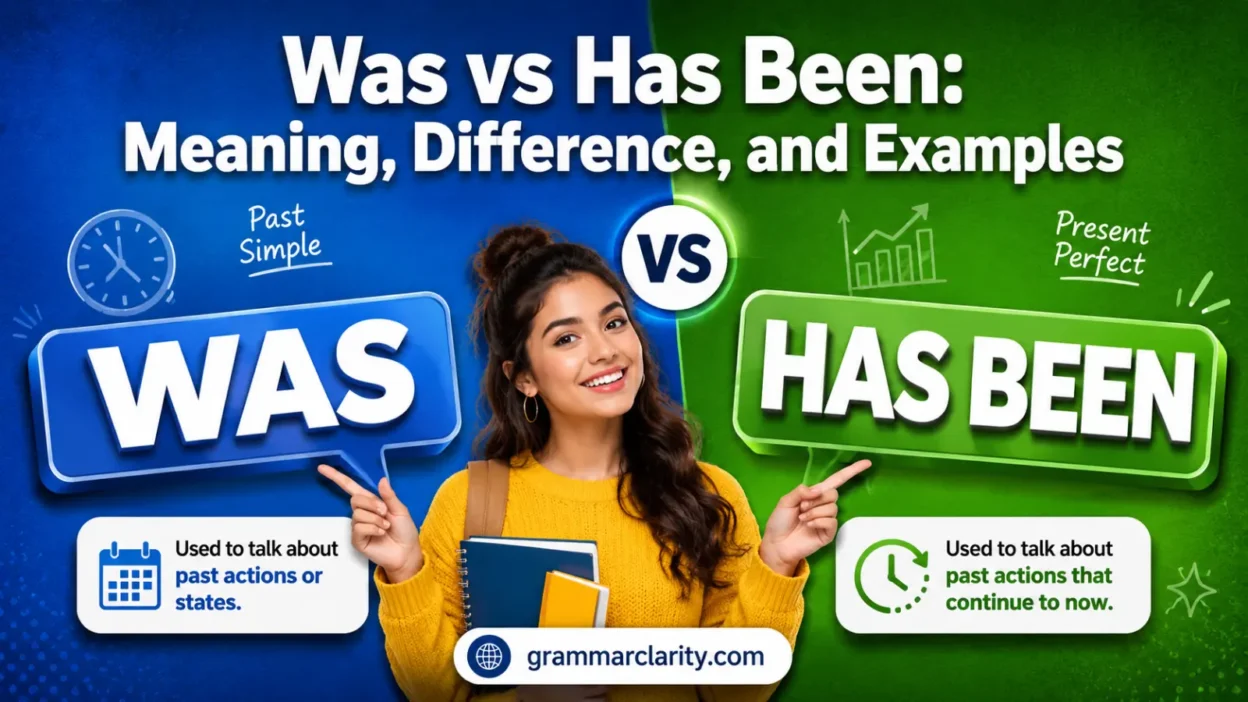
The difference between was vs has been is mainly about time.
Use was for something that happened or existed in the past and is finished. Use has been for something that started in the past and still connects to the present, or for a recent result that matters now.
Both forms come from the verb be, but they do not point to time in the same way.
Quick Answer
Was is the simple past form of be for I, he, she, and it.
Has been is the present perfect form of be for he, she, and it.
Use was when the time is finished:
- She was sick yesterday.
- The office was closed last Friday.
- He was the manager in 2020.
Use has been when the situation reaches into the present or has present importance:
- She has been sick all week.
- The office has been closed since Monday.
- He has been the manager for three years.
The easiest rule is this: was points back to a finished past time. Has been connects the past to now.
Why People Confuse Them
People confuse was and has been because both can describe something that began before now.
For example:
- The road was closed.
- The road has been closed.
Both sentences are grammatical, but they do not say exactly the same thing.
The road was closed sounds like a past condition. Maybe it is open now, or maybe the speaker is simply talking about a past time.
The road has been closed suggests the closure still matters now. It may still be closed, or the result may still affect the current situation.
The confusion usually comes from one question: Is the speaker talking only about the past, or about the past with a present connection?
Key Differences At A Glance
| Context | Best Choice | Why |
|---|---|---|
| A finished time is named | was | Finished time usually takes simple past |
| The situation continues now | has been | Present perfect connects past to present |
| A past role is no longer true | was | The role ended |
| A role continues today | has been | The role started earlier and still applies |
| The sentence uses yesterday, last week, or in 2020 | was | These point to completed past time |
| The sentence uses since, for, lately, or all week | has been | These often show time continuing up to now |
| A current result matters | has been | The past action affects the present |
| A story is told in past time | was | Narratives usually use simple past |
Meaning and Usage Difference
Was places a state, condition, identity, or location in the past.
Examples:
- I was tired after work.
- She was at the airport.
- The meeting was short.
- It was a difficult year.
In these sentences, the speaker looks back at a completed time.
Has been describes a state or condition that began before now and has a link to the present.
Examples:
- She has been busy all morning.
- The system has been slow today.
- He has been quiet since lunch.
- It has been a difficult year.
In these sentences, the speaker is not only looking back. The speaker is connecting the past situation to now.
A useful test is to ask: Could I add “until now,” “so far,” or “since then”?
If yes, has been may be the better choice.
- She has been helpful so far.
- The weather has been strange this week.
- The house has been empty since March.
If the sentence clearly names a finished time, was is usually better.
- She was helpful yesterday.
- The weather was strange last week.
- The house was empty in March.
Tone, Context, and Formality
Both was and has been are common in formal and informal English. The difference is not about politeness. It is about time and meaning.
Was often sounds direct and definite because it treats the situation as finished.
- The request was approved.
- The room was clean when I arrived.
- The answer was correct.
Has been often sounds more connected to the current moment.
- The request has been approved.
- The room has been clean since morning.
- The answer has been correct in every version.
In emails, reports, and everyday updates, has been is useful when the reader needs to know the present status.
- Your application has been received.
- The issue has been fixed.
- The schedule has been updated.
In stories, memories, and finished reports, was is usually more natural.
- The application was received on Tuesday.
- The issue was fixed last night.
- The schedule was updated before the meeting.
Which One Should You Use?
Use was when the sentence answers when did it happen?
- The store was closed on Sunday.
- My phone was dead this morning.
- She was nervous before the interview.
Use has been when the sentence answers how long has this been true? or what is the current result?
- The store has been closed since Sunday.
- My phone has been dead all morning.
- She has been nervous about the interview.
Here is a compact comparison:
- was = past fact, finished time, completed situation
- has been = past-to-present connection, continuing state, current result
In many sentences, both can be grammatically possible, but the meaning changes.
- The package was delivered.
- The package has been delivered.
The first sentence reports a past event. The second sentence emphasizes the current result: the package is now delivered.
When One Choice Sounds Wrong
Has been sounds wrong with a clearly finished time word.
Incorrect: She has been sick yesterday.
Correct: She was sick yesterday.
Incorrect: The office has been closed last Friday.
Correct: The office was closed last Friday.
Incorrect: He has been late in 2022.
Correct: He was late in 2022.
Words like yesterday, last night, last year, in 2020, and two days ago usually call for was.
Was can sound wrong when the sentence needs a continuing time period.
Incorrect: She was sick since Monday.
Correct: She has been sick since Monday.
Incorrect: The office was closed for three days and is still closed.
Correct: The office has been closed for three days.
Incorrect: He was quiet all morning, and he still is.
Better: He has been quiet all morning.
Common Mistakes (and Quick Fixes)
One common mistake is using has been with a finished date.
- Wrong: The file has been updated yesterday.
- Right: The file was updated yesterday.
Another mistake is using was with since when the situation continues.
- Wrong: She was here since 9 a.m.
- Right: She has been here since 9 a.m.
Writers also mix up current roles and past roles.
- Past role: He was our coach in college.
- Current role: He has been our coach for two seasons.
A quick fix is to check the time marker.
Use was with finished-time markers:
- yesterday
- last week
- in 2019
- two hours ago
- before lunch
Use has been with present-connected markers:
- since Monday
- for years
- lately
- recently
- all day
- so far
Everyday Examples
- I was tired after the flight.
- I has been tired since the flight.
Correct: I have been tired since the flight.
That second example also shows an important subject rule. Use has been with he, she, and it. Use have been with I, you, we, and they.
More natural examples:
- She was upset last night.
- She has been upset all morning.
- The dog was outside earlier.
- The dog has been outside since breakfast.
- It was cold yesterday.
- It has been cold all week.
- He was a teacher before he became a lawyer.
- He has been a teacher for ten years.
- The website was down at noon.
- The website has been down since noon.
Notice how was works best when the sentence looks back at a completed time. Has been works best when the past condition still touches the present.
Dictionary-Style Word Details
Verb
Was is a past-tense form of be. It is used with I, he, she, and it.
- I was ready.
- She was late.
- It was easy.
Has been is a verb phrase. It combines has with been, the past participle of be.
- She has been ready for an hour.
- He has been late twice this week.
- It has been easy so far.
Noun
Was is not normally used as a noun in standard everyday grammar.
Has been is also not a noun when written as two words in this comparison. The hyphenated word has-been is a separate noun meaning someone who was once successful or admired but is no longer. That noun is different from the verb phrase has been.
Synonyms
Because was and has been are forms of be, they do not have exact one-word replacements in every sentence. Depending on context, nearby meanings may include:
For was:
- existed
- occurred
- seemed
- became
- remained
For has been:
- has existed
- has remained
- has continued
- has become
- has stayed
Choose replacements carefully, because changing was or has been can also change the tense.
Example Sentences
- The answer was correct.
- The answer has been correct in every draft.
- She was calm during the call.
- She has been calm since the call.
- The room was empty when I arrived.
- The room has been empty all afternoon.
Word History
Was and been both come from the irregular English verb be. The verb be has several forms, including am, is, are, was, were, being, and been. Because these forms are irregular, English learners often have to learn them by use rather than by a simple spelling pattern.
For this comparison, the important point is practical: was is simple past, while has been is present perfect.
Phrases Containing
Common phrases with was include:
- I was wondering
- it was supposed to
- there was
- that was close
- as it was
Common phrases with has been include:
- has been done
- has been said
- has been shown
- has been used
- has been waiting
These phrases still follow the same time rule. Was usually points to a past situation. Has been usually connects that situation to the present.
FAQs
Is “has been” past tense?
Has been is not simple past. It is present perfect. It describes something that started in the past and still connects to the present.
When should I use “was”?
Use was when you are talking about a finished past time.
Example:
She was tired yesterday.
When should I use “has been”?
Use has been when the situation began in the past and is still true now, or when the result matters now.
Example:
She has been tired all day.
Can I say “has been yesterday”?
No. Do not use has been with a finished time like yesterday, last week, or in 2020.
Correct:
She was sick yesterday.
Incorrect:
She has been sick yesterday.
What is the difference between “was sick” and “has been sick”?
Was sick means the sickness happened in the past. It may be over now.
Has been sick means the sickness started earlier and likely continues now, or still matters now.
Which is correct: “He was working” or “He has been working”?
Both can be correct.
Use he was working for a past moment:
He was working when I called.
Use he has been working for an action continuing up to now:
He has been working all morning.
Can “was” and “has been” ever mean almost the same thing?
Sometimes they can describe a similar event, but the focus changes.
The package was delivered reports a past event.
The package has been delivered emphasizes the current result.
Conclusion
The choice between was vs has been depends on whether the past is finished or still connected to now.
Use was for a completed past time:
- She was sick yesterday.
- The office was closed last week.
Use has been for a condition, result, or situation that reaches the present:
- She has been sick since yesterday.
- The office has been closed all week.
When in doubt, look for the time clue. Finished time usually needs was. Time continuing up to now usually needs has been.