Your vs you’re is a common word-choice problem because the two forms sound exactly alike. In writing, though, they do very different jobs.
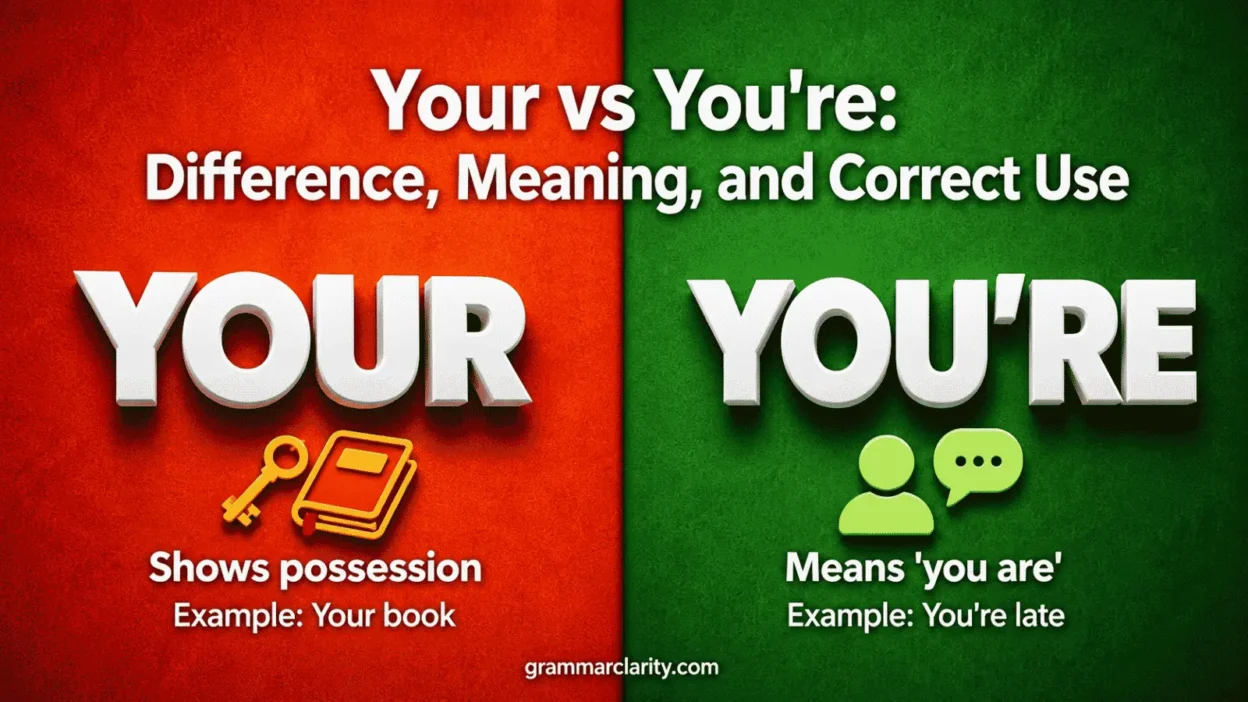
Use your when you mean something belongs to or relates to the person you are addressing. Use you’re when you mean you are.
The easiest test is simple: replace the word with you are. If the sentence still makes sense, use you’re. If it does not, use your.
Quick Answer
Your is possessive.
Example: Your phone is on the table.
You’re is a contraction of you are.
Example: You’re going to need your phone.
Here is the simplest rule:
Use your before a noun or noun phrase that belongs to “you.” Use you’re when the sentence means “you are.”
Why People Confuse Them
People confuse your and you’re because they are pronounced the same way in everyday speech. When spoken aloud, there is no sound that clearly separates them.
The difference appears only in writing.
Another reason is that apostrophes often show possession, as in Sarah’s book. But in you’re, the apostrophe does not show ownership. It marks missing letters from you are.
That makes you’re a contraction, not a possessive form.
Key Differences At A Glance
| Context | Best Choice | Why |
|---|---|---|
| Showing ownership | your | It tells what belongs to or relates to the person being addressed. |
| Meaning “you are” | you’re | It is the shortened form of “you are.” |
| Before a noun | your | It commonly comes before a noun, such as “your car.” |
| Before an adjective or verb phrase | you’re | It often begins a statement such as “you’re ready” or “you’re leaving.” |
| In “welcome” after thanks | you’re | The phrase means “you are welcome.” |
Compact comparison:
- your = belonging to you
- you’re = you are
- your idea = the idea belongs to you
- you’re right = you are right
Meaning and Usage Difference
Your points to possession, association, or connection.
Examples:
- Is this your jacket?
- I like your idea.
- Please check your email.
- Your meeting starts at 3 p.m.
In each sentence, your connects something to the person being addressed: jacket, idea, email, meeting.
You’re means you are.
Examples:
- You’re early.
- You’re doing great.
- I think you’re ready.
- You’re going to love this place.
In each sentence, you’re can be expanded to you are without changing the meaning.
Tone, Context, and Formality
Both your and you’re are normal in everyday writing. The choice is not really about formal or informal tone. It is about grammar and meaning.
Your appears in all kinds of writing, including emails, instructions, essays, forms, and casual messages.
Example: Please bring your ID to the appointment.
You’re is also widely used, especially in natural-sounding communication.
Example: You’re invited to join us Friday.
In very formal writing, some writers avoid contractions, so they may write you are instead of you’re. That does not make you’re wrong. It just makes you are slightly more formal.
Which One Should You Use?
Choose your when the next idea is something the person has, owns, uses, feels, says, or is connected to.
Examples:
- your name
- your address
- your opinion
- your schedule
- your car
Choose you’re when the sentence is saying what the person is, feels, does, or is about to do.
Examples:
- you’re kind
- you’re late
- you’re leaving
- you’re invited
- you’re not alone
A quick check:
- Your late is wrong because “late” is not something someone owns.
- You’re late is correct because it means “you are late.”
When One Choice Sounds Wrong
The wrong choice often becomes obvious when you expand you’re to you are.
Wrong: I found you’re keys.
Test: I found you are keys.
Correct: I found your keys.
Wrong: Your going to miss the bus.
Test: You are going to miss the bus.
Correct: You’re going to miss the bus.
Wrong: Thanks for you’re help.
Test: Thanks for you are help.
Correct: Thanks for your help.
Wrong: Your the best.
Test: You are the best.
Correct: You’re the best.
Common Mistakes (and Quick Fixes)
One common mistake is writing your welcome after someone says thank you.
Correct: You’re welcome.
Why? The full phrase is you are welcome.
Another common mistake is using you’re before a noun.
Wrong: You’re password needs to be reset.
Correct: Your password needs to be reset.
Use your because the password belongs to or relates to the person being addressed.
A third mistake is using your before an action phrase.
Wrong: Your going to be fine.
Correct: You’re going to be fine.
Use you’re because the sentence means you are going to be fine.
Everyday Examples
Here are natural examples that show the difference clearly:
- Your coffee is getting cold.
- You’re going to need a jacket.
- I appreciate your patience.
- You’re welcome to stay.
- Did you bring your laptop?
- You’re not required to attend.
- I like your new apartment.
- You’re making this harder than it needs to be.
- What is your plan for tonight?
- You’re probably right.
In many sentences, both words can appear together:
- You’re responsible for your own ticket.
- You’re doing well on your first week.
- You’re free to change your answer.
- You’re almost done with your application.
Dictionary-Style Word Details
Verb
Your is not a verb.
You’re contains the verb are because it is a contraction of you are.
Example: You’re ready means you are ready.
Noun
Your is not a noun.
You’re is not a noun either. It is a contraction used as a subject and verb together.
Synonyms
Your does not have a true one-word synonym in ordinary use. It functions as a possessive word connected to you.
You’re can be replaced by you are.
Examples:
- You’re correct.
- You are correct.
Example Sentences
- Please send me your address.
- You’re on the list.
- I saw your message this morning.
- You’re not the only one who noticed.
- Is your dog friendly?
- You’re going to enjoy the concert.
Word History
You’re is formed by combining you and are. The apostrophe marks the missing letter from the shortened form.
Your is the possessive form used with you. Its job is to show that something belongs to, relates to, or is associated with the person being addressed.
Phrases Containing
Common phrases with your:
- your choice
- your call
- your turn
- your problem
- your best
Common phrases with you’re:
- you’re welcome
- you’re right
- you’re invited
- you’re late
- you’re kidding
Conclusion
The difference between your and you’re is simple once you test the meaning.
Use your for possession or connection: your book, your idea, your appointment.
Use you’re when you mean you are: you’re ready, you’re right, you’re welcome.