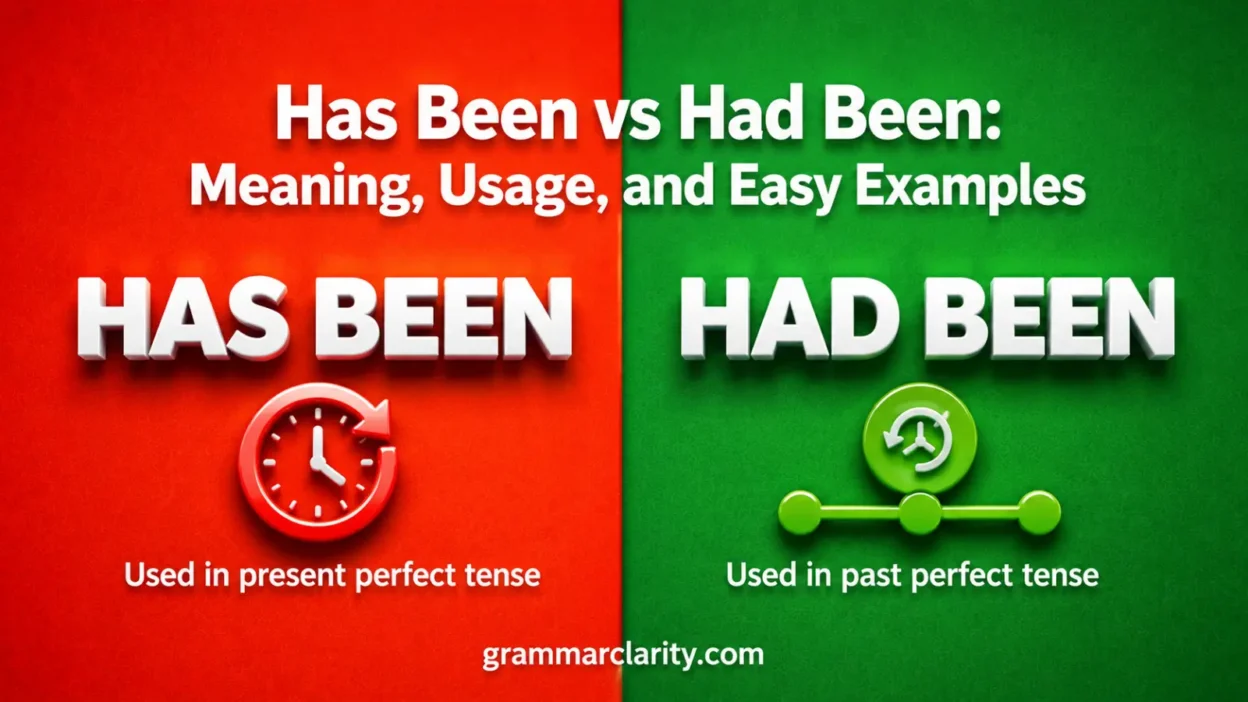
Has been vs had been is a tense choice. Use has been when something connects to the present. Use had been when something happened before another point in the past.
The difference is not about which phrase sounds more formal. It is about time.
She has been sick all week means her sickness is still connected to now.
She had been sick before the trip means her sickness happened before another past event.
Once you look for the time reference, the choice becomes much easier.
Quick Answer
Use has been for the present perfect or present perfect continuous with he, she, it, or a singular noun.
Use had been for the past perfect or past perfect continuous with any subject.
Examples:
- He has been working late this week.
- He had been working late before he took Friday off.
- The project has been approved.
- The project had been approved before the meeting began.
The quick test is simple: if the sentence connects the past to now, choose has been. If the sentence places one past action before another past action, choose had been.
Why People Confuse Them
People confuse has been and had been because both phrases talk about something that started before another time.
The difference is the reference point.
With has been, the reference point is usually now.
- The store has been closed since Monday.
This suggests the store is still closed now, or the closing still matters now.
With had been, the reference point is another time in the past.
- The store had been closed for two days when we arrived.
This places the closing before another past event: we arrived.
Another reason they are confusing is that both can appear before an -ing verb or a past participle.
- has been waiting
- had been waiting
- has been repaired
- had been repaired
The words after the phrase do not decide the answer by themselves. The timeline does.
Key Differences At A Glance
| Context | Best Choice | Why |
|---|---|---|
| Something started in the past and is still true now | has been | It connects past action or state to the present |
| Something happened before another past event | had been | It shows an earlier past |
| A current result matters | has been | The sentence focuses on present relevance |
| A past result mattered before a later past event | had been | The sentence focuses on past sequence |
| A singular subject such as he, she, it, or the company | has been | “Has” agrees with a singular subject |
| Any subject in the past perfect | had been | “Had” does not change by subject |
Meaning and Usage Difference
Has been is formed with has + been. It is used with singular subjects.
- She has been busy all morning.
- The office has been quiet today.
- My phone has been acting strange lately.
These sentences connect past time to the present. The situation may still be happening, or the result still matters.
Had been is formed with had + been. It can be used with singular or plural subjects.
- She had been busy before the guests arrived.
- The office had been quiet until the announcement.
- My phone had been acting strange before it shut down.
These sentences look back from a past moment. The phrase had been tells readers that something was already true before another past event happened.
| Feature | has been | had been |
|---|---|---|
| Main time focus | Past to present | Earlier past to later past |
| Common tense use | Present perfect or present perfect continuous | Past perfect or past perfect continuous |
| Subject agreement | Used with singular subjects | Used with any subject |
| Example signal words | since, lately, today, this week | before, until, by the time, when |
Tone, Context, and Formality
Both has been and had been work in casual, professional, and academic writing. Neither one is automatically more formal.
The difference is context.
In everyday speech, has been often describes current experience, recent activity, or an ongoing condition.
- She has been really helpful lately.
- It has been raining all afternoon.
In storytelling, reports, and explanations of past events, had been helps arrange the order of events.
- The team had been preparing for months before the launch.
- He had been living in Denver when he got the offer.
In business writing, both are common.
- The invoice has been paid.
- The invoice had been paid before the reminder was sent.
The second sentence avoids confusion because it makes the order of past events clear.
Which One Should You Use?
Choose has been when the sentence is about now, this period, a current result, or a condition that still matters.
Use has been with:
- he
- she
- it
- one person
- one company
- one object
- one situation
Examples:
- The manager has been reviewing the file.
- The building has been empty since June.
- It has been a difficult week.
Choose had been when the sentence already lives in the past and you need to show what happened earlier.
Examples:
- The manager had been reviewing the file before the call started.
- The building had been empty for years before the city bought it.
- It had been a difficult week before things finally improved.
A useful shortcut:
Has been = up to now.
Had been = before then.
When One Choice Sounds Wrong
Has been sounds wrong when the sentence clearly points to a finished past time.
Incorrect: She has been nervous before the interview started.
Correct: She had been nervous before the interview started.
The interview started in the past, so the nervousness came before another past event.
Had been sounds wrong when the sentence is about the present.
Incorrect: She had been nervous all morning, and she still is.
Correct: She has been nervous all morning, and she still is.
The phrase still is connects the sentence to now.
Also watch for finished time words.
Incorrect: He has been absent yesterday.
Better: He was absent yesterday.
If the sentence names a finished past time such as yesterday, last year, or in 2020, the simple past is often better unless the sentence needs a different structure.
Common Mistakes (and Quick Fixes)
One common mistake is using has been with a plural subject.
Incorrect: The employees has been waiting.
Correct: The employees have been waiting.
That mistake is related, but it is not the same as has been vs had been. For this comparison, remember that has been works with singular subjects only.
Another mistake is using had been without a past reference point.
Weak: She had been tired lately.
Better: She has been tired lately.
The word lately usually points to a time that reaches the present.
A third mistake is using has been when the sentence needs past sequence.
Incorrect: The food has been cold before the server brought it back.
Correct: The food had been cold before the server brought it back.
The food was cold first. The server brought it back later. Both events are in the past, so had been is the better choice.
Everyday Examples
- My laptop has been slow all week.
- My laptop had been slow before I installed the update.
- She has been studying for her nursing exam.
- She had been studying for months before she passed.
- The restaurant has been packed every Friday.
- The restaurant had been packed before the storm started.
- He has been careful with his spending lately.
- He had been careful with his spending before the emergency expense.
- The package has been delivered.
- The package had been delivered before I got home.
Notice how has been keeps the sentence connected to the present, while had been pushes the action further back in a past timeline.
Dictionary-Style Word Details
Verb
Has been and had been are verb phrases built with a form of have plus been, the past participle of be.
Has been is used with singular subjects in present perfect forms.
- The car has been repaired.
- She has been waiting outside.
Had been is used in past perfect forms.
- The car had been repaired before the inspection.
- She had been waiting outside when we arrived.
Noun
As written, has been and had been are not nouns.
The hyphenated word has-been is a separate noun. It means someone who was once successful, respected, or popular but is no longer seen that way.
Example:
- The article unfairly described the former star as a has-been.
Do not confuse the noun has-been with the verb phrase has been.
Synonyms
These phrases do not have exact one-word synonyms because they carry tense.
For has been, possible rewordings may include:
- is still
- has remained
- has continued to be
- has already been
For had been, possible rewordings may include:
- was already
- had remained
- had continued to be
- had already been
The best replacement depends on the sentence.
Example Sentences
- The report has been updated.
- The report had been updated before the client asked for changes.
- She has been confident since the training.
- She had been confident until the final interview.
- It has been quiet in the office today.
- It had been quiet before the phones started ringing.
Word History
Both phrases come from the perfect tense structure in English: a form of have plus a past participle. In these phrases, been is the past participle of be.
The difference comes from the auxiliary verb:
- has points to a present connection with a singular subject.
- had points to an earlier past.
That is why the phrases feel similar but place events in different time relationships.
Phrases Containing
Common phrases with has been:
- has been working
- has been waiting
- has been approved
- has been completed
- has been difficult
- has been delayed
Common phrases with had been:
- had been working
- had been waiting
- had been approved
- had been completed
- had been difficult
- had been delayed
The same following word can appear after both phrases. The correct choice depends on whether the sentence points to now or to an earlier past.
Conclusion
The difference between has been vs had been comes down to timeline.
Use has been when something started in the past and connects to the present.
Use had been when something happened before another past event.
If the sentence means up to now, choose has been. If it means before then, choose had been.