On vs at can be confusing because both words often talk about time and place. The correct choice depends on what kind of time or place you mean.
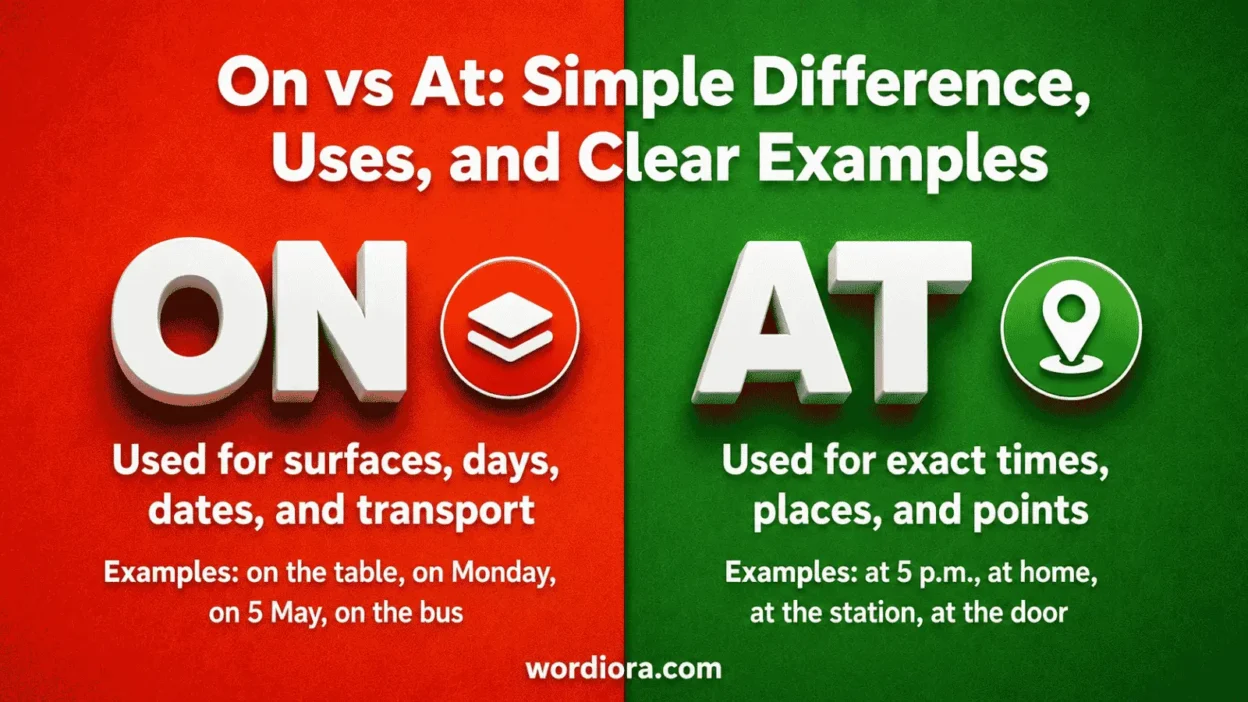
Use on when you mean a surface, a day, a date, a street, a device, or a platform. Use at when you mean a specific point, exact time, event, business, school, office, or address.
The main idea is simple: on often points to a surface, line, day, or platform. At often points to a specific spot, time, or activity.
Quick Answer
Use on for:
- days: on Monday
- dates: on July 4
- surfaces: on the table
- streets: on Oak Street
- devices or platforms: on my phone, on the website
Use at for:
- exact times: at 8:30
- exact places: at the front desk
- events: at the concert
- businesses or institutions: at Target, at school
- full addresses: at 415 Oak Street
So, on Monday is correct, but at Monday is not. At 8 p.m. is correct, but on 8 p.m. is not.
Why People Confuse Them
People confuse on and at because both can answer “where?” or “when?”
For example:
- She is on the bus.
- She is at the bus stop.
Both sentences talk about location, but they do not mean the same thing. On the bus means she is riding or inside the bus as a passenger. At the bus stop means she is standing in that specific place.
The words are also small and common, so English speakers learn many fixed patterns one by one. That is why rules help, but examples matter too.
Key Differences At A Glance
| Context | Best Choice | Why |
|---|---|---|
| A day | on | Use on with days: on Friday. |
| A date | on | Use on with calendar dates: on May 6. |
| An exact clock time | at | Use at with exact times: at noon. |
| A surface | on | Something rests or appears on a surface. |
| A specific point or spot | at | At points to a location. |
| A full street address | at | A full address is treated as a specific point. |
| A street name only | on | A street is treated like a line or area. |
| A website or app | on | Content appears on a site or platform. |
| An event | at | You attend or meet someone at an event. |
Meaning and Usage Difference
On shows contact, support, placement, or connection with a surface, line, day, date, device, or platform.
Examples:
- The keys are on the counter.
- I live on Pine Street.
- The sale starts on Friday.
- She posted the update on Instagram.
- I read it on the company website.
At points to a specific place, exact time, event, or activity.
Examples:
- Meet me at the entrance.
- The meeting starts at 9 a.m.
- We saw him at the game.
- She works at a hospital.
- The package arrived at 221 Maple Avenue.
A helpful test: if you mean “located at this exact point,” at often works. If you mean “attached to, placed on, scheduled for a day/date, or part of a platform,” on often works.
Tone, Context, and Formality
Both on and at are standard in casual, school, business, and formal writing. The difference is not about formality. It is about meaning and sentence pattern.
In US English, these patterns are natural:
- on the weekend
- on Saturday
- at 7 p.m.
- at work
- on my laptop
- at the office
Some phrases are fixed. For example, people say at work, not on work, when they mean someone is working or physically present at their workplace.
Which One Should You Use?
Choose on when the noun acts like a surface, line, date, day, device, or platform.
Use on in sentences like these:
- The coffee is on the desk.
- We moved on Tuesday.
- The restaurant is on 5th Avenue.
- I saw your message on Slack.
- The movie is on TV tonight.
Choose at when the noun names a point, exact time, event, institution, or full location.
Use at in sentences like these:
- I’ll call you at 6.
- We met at the airport.
- She is at college.
- The party is at my cousin’s house.
- Send it to me at 1200 Lake Drive.
Here is the core comparison:
| Feature | on | at |
|---|---|---|
| Main idea | Surface, line, day, date, device, platform | Specific point, exact time, event, institution |
| Time use | on Monday, on April 10 | at 5 p.m., at noon |
| Place use | on the table, on Main Street | at the door, at 10 Main Street |
| Common mistake | on 7 p.m. | at Monday |
When One Choice Sounds Wrong
Some mistakes sound wrong because the noun needs a different kind of preposition.
Say:
- on Monday, not at Monday
- at 3 p.m., not on 3 p.m.
- on the table, not at the table, if you mean something is resting on the surface
- at the table, not on the table, if you mean someone is sitting there
- on the website, not usually at the website
- at the office, not on the office
A few pairs can both be correct, but the meaning changes:
- She is on the school roof.
She is physically on top of the roof. - She is at school.
She is attending school or is present there. - The note is on the door.
The note is attached to the door. - He is at the door.
He is standing near the door.
Common Mistakes (and Quick Fixes)
Mistake: The meeting is on 9 a.m.
Fix: The meeting is at 9 a.m.
Mistake: I’ll see you at Friday.
Fix: I’ll see you on Friday.
Mistake: The file is at my laptop.
Fix: The file is on my laptop.
Mistake: She lives at Pine Street.
Fix: She lives on Pine Street.
Mistake: She lives on 44 Pine Street.
Fix: She lives at 44 Pine Street.
Mistake: The article is at the website.
Fix: The article is on the website.
Mistake: I’m on work right now.
Fix: I’m at work right now.
Everyday Examples
I’ll be at the coffee shop by 8.
The receipt is on the kitchen counter.
We’re meeting on Thursday.
The webinar starts at noon.
She lives on Elm Street.
The office is at 200 Elm Street.
I found your comment on the post.
They were at the Lakers game last night.
My name is on the list.
He’s at the front desk.
The app is on my phone.
Dinner is at my parents’ house.
Dictionary-Style Word Details
Verb
- on: Not commonly used as a verb in standard US English. It is mainly a preposition, adverb, or adjective.
- at: Not commonly used as a verb in standard US English. It is mainly a preposition.
Noun
- on: Not commonly used as a regular noun in everyday standard English. It can appear in special labels or technical contexts, but that does not help the usual on vs at choice.
- at: Can be a noun in limited contexts, such as the “at sign” in an email address. That noun use is separate from the preposition in sentences like at work or at 5 p.m.
Synonyms
- on: Exact synonyms usually do not fit because on is a grammar word. Closest plain alternatives depend on context: upon, attached to, supported by, using, or scheduled for.
- at: Exact synonyms usually do not fit because at is also a grammar word. Closest plain alternatives depend on context: near, by, present at, located at, or during.
Clear antonyms do not work well for either word because the opposite depends on the sentence. For example, the opposite of on the table could be under the table, but that does not make under a general antonym of on in every use.
Example Sentences
- on: The report is on my desk.
- on: We’re launching the campaign on June 1.
- on: I saw the update on the website.
- on: The apartment is on Madison Avenue.
- at: The interview starts at 10:15.
- at: I’ll meet you at the gate.
- at: She works at a law firm.
- at: The party is at 88 River Road.
Word History
- on: The word is old and has long been used in English for ideas such as position, contact, continuation, and relation. For this guide, the important point is its modern use with surfaces, days, dates, devices, and platforms.
- at: The word is also old and has long been used in English to point to place, time, or direction. For this guide, the useful modern pattern is at for exact times, specific places, events, and institutions.
Phrases Containing
- on: on time, on Monday, on the table, on the phone, on the website, on Main Street, on TV, on the list
- at: at work, at school, at home, at noon, at the door, at the airport, at a concert, at 10 Main Street
Conclusion
Use on when you mean a surface, day, date, street, device, or platform. Use at when you mean an exact time, specific place, event, institution, or full address.
The fastest check is this: on often answers “what surface, day, date, street, or platform?” At often answers “what exact point, time, place, or event?”
That is why we say on Friday, on the website, and on the table, but at 5 p.m., at the office, and at the concert.