Many English learners and even native speakers sometimes hesitate when choosing between either and too. Both words can show agreement with a previous negative or positive statement, but they are not used in the same situations.
Understanding the difference is important because using the wrong word can make a sentence sound unnatural or grammatically incorrect.
The good news is that the distinction is straightforward once you see how each word works in real sentences.
Quick Answer
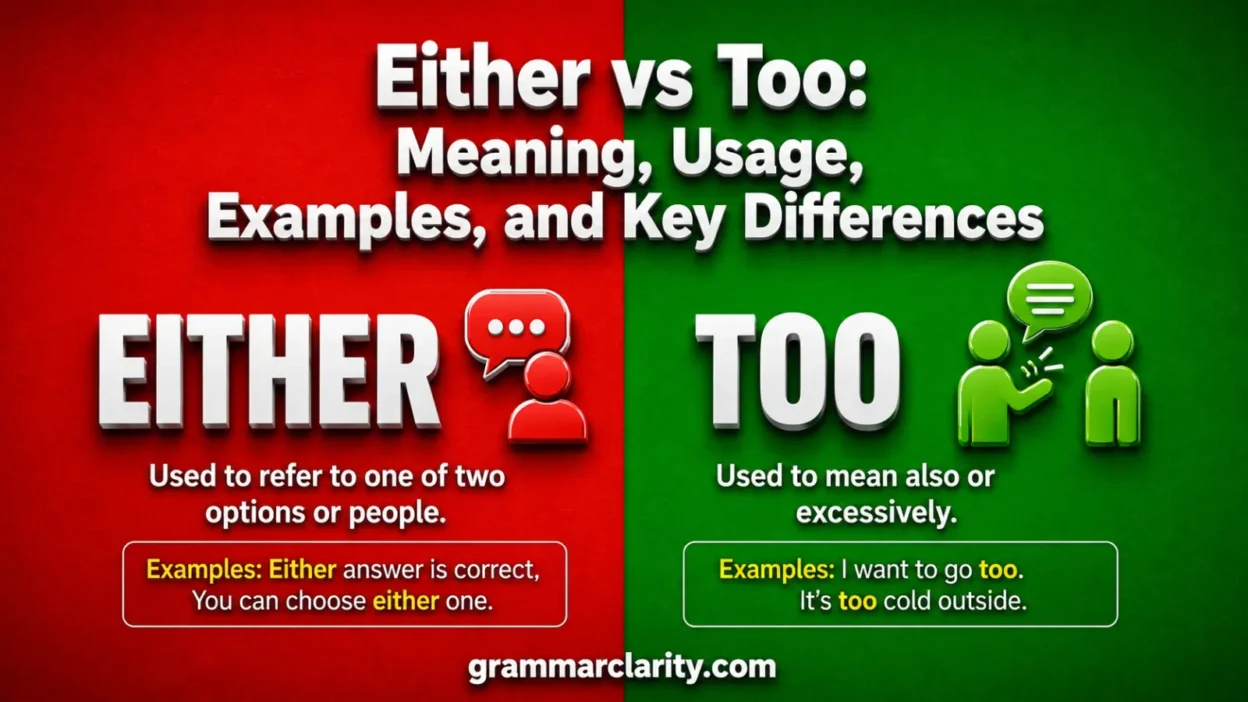
Use too when agreeing with a positive statement.
- I like coffee.
- I like coffee, too.
Use either when agreeing with a negative statement.
- I don’t like coffee.
- I don’t like coffee either.
In most everyday situations:
- Positive statement → too
- Negative statement → either
Why People Confuse Them
People confuse these words because both can mean something similar to “also” or “as well.”
Consider these examples:
- She wants to go too.
- She doesn’t want to go either.
Both sentences express agreement or addition, but one follows a positive statement while the other follows a negative statement.
Because the overall meaning feels similar, many learners accidentally swap the words.
Common incorrect examples include:
- I don’t like it too.
- I like it either.
These sound unnatural in standard American English.
Key Differences At A Glance
| Context | Best Choice | Why |
|---|---|---|
| Positive agreement | Too | Adds information to a positive statement |
| Negative agreement | Either | Adds information to a negative statement |
| Meaning “also” | Too | Common in affirmative sentences |
| Meaning “also not” | Either | Common in negative sentences |
| Informal conversation | Too | Very common after positive statements |
| Negative response | Either | Natural way to show agreement with a negative statement |
Quick Comparison
| Feature | Either | Too |
| Typical sentence type | Negative | Positive |
| Meaning | Also not | Also |
| Position | Often at end | Often at end |
| Shows agreement | Negative agreement | Positive agreement |
| Common in conversation | Yes | Yes |
Meaning and Usage Difference
The primary difference involves whether the sentence is positive or negative.
Either
When used as an adverb in this comparison, either means:
- also not
- neither
Examples:
- I don’t watch that show either.
- He isn’t coming either.
- We can’t attend either.
Each sentence contains a negative idea.
Too
Too means:
- also
- as well
Examples:
- I watch that show too.
- He is coming too.
- We can attend too.
Each sentence contains a positive idea.
Sentence Structure
In many cases, both words appear near the end of a sentence.
Positive:
- Sarah enjoyed the movie.
- I enjoyed the movie too.
Negative:
- Sarah didn’t enjoy the movie.
- I didn’t enjoy the movie either.
This pattern appears frequently in spoken and written American English.
Tone, Context, and Formality
Neither word is particularly formal or informal.
Both are widely accepted in:
- casual conversation
- emails
- business communication
- academic writing
- professional settings
However, the tone changes depending on the sentence.
Too
Usually sounds friendly and conversational.
Examples:
- I’d love to join too.
- I agree too.
- I was surprised too.
Either
Often appears when discussing limitations, disagreements, or negative situations.
Examples:
- I don’t understand it either.
- We couldn’t find it either.
- She wasn’t available either.
Both words are natural and common across American English.
Which One Should You Use?
Ask yourself one question:
Is the sentence positive or negative?
If positive, choose too.
Examples:
- I want pizza too.
- They enjoyed the concert too.
- We agree too.
If negative, choose either.
Examples:
- I don’t want pizza either.
- They didn’t enjoy the concert either.
- We don’t agree either.
This simple rule solves most usage questions.
When One Choice Sounds Wrong
Some sentences become incorrect when the wrong word is used.
Incorrect
- I don’t like broccoli too.
Correct
- I don’t like broccoli either.
Incorrect
- She likes ice cream either.
Correct
- She likes ice cream too.
Incorrect
- We aren’t going too.
Correct
- We aren’t going either.
Incorrect
- We are going either.
Correct
- We are going too.
Matching the word to the sentence type creates natural English.
Common Mistakes (and Quick Fixes)
Mistake 1: Using Too After a Negative Statement
Incorrect:
- I don’t understand too.
Correct:
- I don’t understand either.
Quick Fix
Use either after negative statements.
Mistake 2: Using Either After a Positive Statement
Incorrect:
- I understand either.
Correct:
- I understand too.
Quick Fix
Use too after positive statements.
Mistake 3: Forgetting the Negative
Incorrect:
- I like spinach either.
Correct:
- I don’t like spinach either.
Quick Fix
Either usually needs a negative idea before it.
Mistake 4: Translating Directly From Another Language
Many languages use one word for both meanings.
English separates them:
- Positive → too
- Negative → either
Remembering this distinction improves accuracy immediately.
Everyday Examples
Below are realistic examples from daily American English.
Family Conversations
- I’m tired too.
- I’m not sleeping well either.
- Dad is coming too.
- Mom isn’t coming either.
School
- I finished the assignment too.
- I didn’t understand the last question either.
- We studied chapter five too.
- We didn’t review chapter six either.
Work
- I attended the meeting too.
- I couldn’t join the earlier call either.
- My manager agreed too.
- My coworkers didn’t object either.
Travel
- We visited Chicago too.
- We didn’t visit Detroit either.
- She booked her ticket too.
- He couldn’t travel either.
Shopping
- I bought one too.
- I didn’t find my size either.
- They wanted that model too.
- They couldn’t afford it either.
These examples reflect natural American usage.
Dictionary-Style Word Details
Verb
Either:
Not commonly used as a verb in standard American English.
Too:
Not commonly used as a verb in standard American English.
Noun
Either:
Can function as a pronoun or determiner in some contexts, but it is not commonly used as a noun in standard American English.
Examples:
- Either option works.
- You may choose either.
Too:
Not used as a noun in standard American English.
Synonyms
Either (meaning also not):
Closest plain alternatives:
- neither
- likewise not
- not … either
There are few exact single-word replacements because the meaning depends on sentence structure.
Too (meaning also):
Closest plain alternatives:
- also
- as well
- likewise
Possible antonym concepts:
- neither
- not either
These are not perfect opposites in every context but can express contrasting ideas.
Example Sentences
Either
- I don’t know the answer either.
- They aren’t available either.
- She didn’t receive the message either.
- We couldn’t hear the announcement either.
- My brother doesn’t play golf either.
Too
- I know the answer too.
- They are available too.
- She received the message too.
- We heard the announcement too.
- My brother plays golf too.
Word History
Either
The word has existed in English for centuries and developed from older forms related to choosing between two possibilities. Its modern use in negative statements is well established in standard English.
Too
The word has a long history in English and has been used for centuries to mean “also,” “in addition,” or “more than enough,” depending on context.
Neither word has a recent origin, and both are deeply established parts of modern English.
Phrases Containing
Either
Common expressions:
- either way
- either one
- either side
- either of them
- not … either
Examples:
- Either way is fine.
- Either one will work.
- I don’t want that one either.
Too
Common expressions:
- too bad
- too much
- too many
- too little
- me too
Examples:
- That’s too bad.
- We spent too much money.
- Me too.
FAQs
Is it “me too” or “me either”?
Both are correct, but they apply to different situations.
- Positive statement: “Me too.”
- Negative statement: “Me either” or “I don’t either.”
Example:
- “I love tacos.” → “Me too.”
- “I don’t like tacos.” → “Me either.”
Can either mean also?
Yes, but usually only in negative sentences.
Example:
- I don’t like horror movies either.
Here, either means “also not.”
Can too be used in negative sentences?
Generally, standard American English prefers either in negative agreement.
Natural:
- I don’t like it either.
Less natural:
- I don’t like it too.
Which word is more common in conversation?
Both are extremely common. Too appears frequently in positive agreement, while either appears frequently in negative agreement.
Can either and too appear at the end of a sentence?
Yes. This is one of the most common positions for both words.
Examples:
- I was invited too.
- I wasn’t invited either.
Is “I don’t know either” correct?
Yes.
Example:
- “Do you know the answer?”
- “No, I don’t know either.”
The sentence expresses negative agreement.
Is “I know either” correct?
Usually no.
In positive agreement, use:
- I know too.
Or more naturally:
- I know as well.
What is the easiest rule to remember?
Use too after positive statements and either after negative statements.
Examples:
- I agree too.
- I don’t agree either.
That simple guideline will help you avoid most mistakes.
Conclusion
The difference between either and too comes down to whether the statement is negative or positive.
Use too with positive statements:
- I enjoyed the game too.
- She wants to come too.
Use either with negative statements:
- I didn’t enjoy the game either.
- She doesn’t want to come either.
When you remember that simple distinction, choosing the correct word becomes much easier. In everyday American English, this rule works in the vast majority of situations and helps your writing and speaking sound natural and accurate.